 Semiahmoo
 Birch Bay's Exterior Climate — What Homes Are Up Against
Birch Bay sits right on the water in Whatcom County, and that location shapes everything about how a home's exterior ages. Salt-laden air moves in off the bay and settles on siding, trim, fascia, and metal fasteners day after day. Add Whatcom County's long, wet fall-through-spring stretch — driving rain that comes in sideways off the water more often than it falls straight down — and you've got an exterior that's under near-constant moisture pressure for most of the year.
Then there's moss. The combination of shade from mature trees, persistent damp, and mild winter temperatures gives moss and algae a long growing season on roofs, in siding seams, and along anything that stays shaded and damp. It's not just cosmetic — moss holds moisture against a surface, and prolonged moisture contact is where most exterior failures start, whether that's a roof, a wall, or a deck.
None of this means a Birch Bay home is doomed to constant repair. It means the materials and installation details matter more here than they would somewhere dry and inland. We've built our business around exteriors that are engineered for exactly this kind of climate, not general-purpose products that happen to work most places.
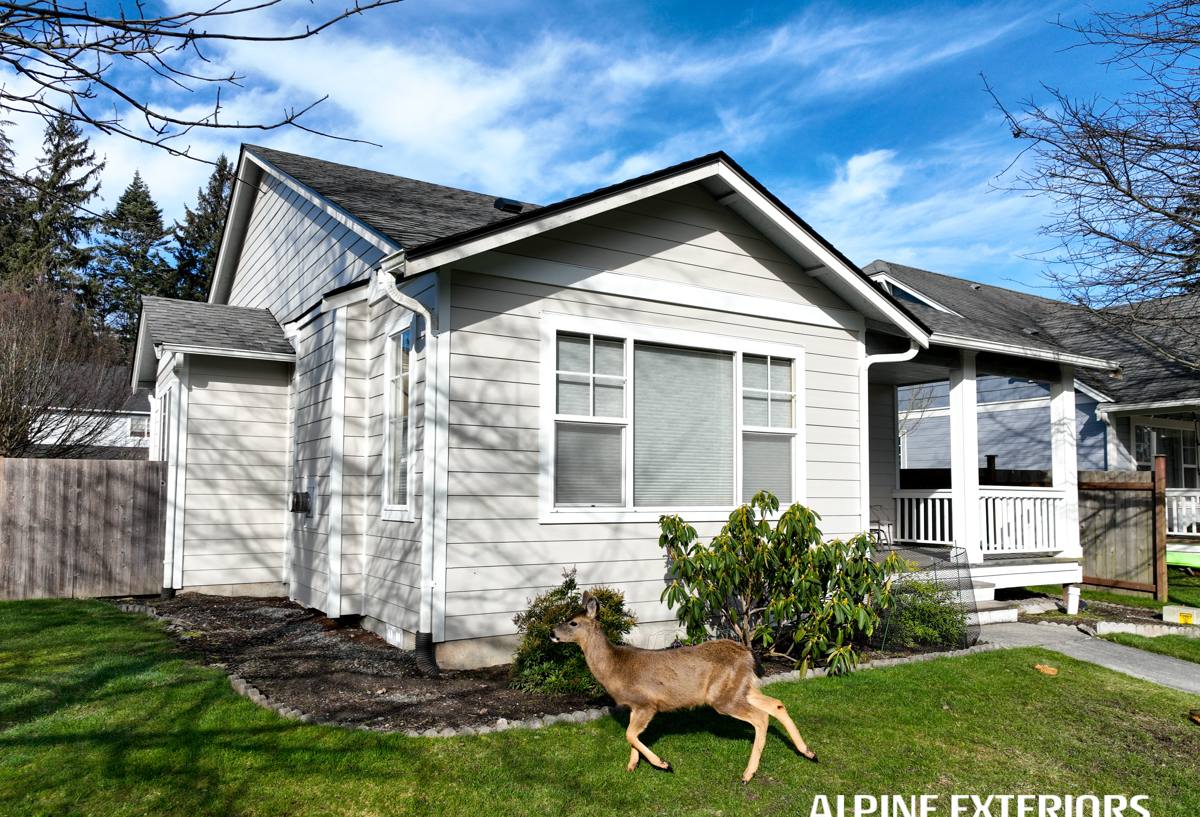
Why We Only Install James Hardie Fiber Cement Siding
We install James Hardie fiber cement siding exclusively. We don't offer vinyl, LP SmartSide, Cemplank, Allura, primed spruce, or cedar as alternatives — and we think homeowners deserve an honest explanation of why, not just a sales pitch for what we do carry.
Vinyl is inexpensive and low-maintenance in the sense that it doesn't need painting, but it's a petroleum-based product that expands and contracts with temperature swings, can crack in impact or extreme cold, and simply isn't built to the same standard as fiber cement when it comes to holding a tight seal against wind-driven rain over decades. LP SmartSide and other engineered wood products use a wood-strand core — well-engineered, but wood-based products remain more sensitive to sustained moisture exposure than fiber cement, and a marine environment like Birch Bay is a demanding test of that sensitivity. Primed spruce and cedar are natural wood siding — beautiful, but they require an ongoing maintenance commitment (painting, caulking, moisture monitoring) that most homeowners underestimate until they're several years in.
James Hardie fiber cement is cement, sand, and cellulose fiber — non-combustible, dimensionally stable, and manufactured with regional climate in mind. Hardie's HZ5 product line, in particular, is engineered for wetter, harsher climates, which is exactly the profile of a coastal Whatcom County property. It won't rot, it resists moisture-driven warping, and it holds its factory-applied ColorPlus finish far longer than field-painted materials — which matters in an area where recoating a house every few years isn't anyone's idea of a good time.
What ColorPlus Finish Means for a Salt-Air Environment
ColorPlus is a baked-on, factory-applied finish, not a job-site paint job. That distinction matters more near the water than almost anywhere else, because factory finishes are cured under controlled conditions and bond to the substrate more consistently than paint applied on-site in variable weather. In an area where salt air accelerates the breakdown of lesser coatings, starting with a finish that's already built to hold up outdoors is a real advantage, not a marketing detail.
Siding Services for Birch Bay Homes
Most of the siding work we do in this area falls into a few categories:
- Full siding replacement — removing failing or outdated siding down to the sheathing, correcting any moisture damage found underneath, and installing a complete Hardie system.
- Partial replacement and repair — matching existing Hardie siding after storm damage, impact damage, or isolated failure, without re-siding the whole home.
- New construction and additions — siding new builds or additions to match or complement the rest of a Birch Bay property from the start.
- Re-siding over problem substrates — replacing older wood, vinyl, or engineered wood siding that's showing the kind of wear common in this climate: cupping, swelling at seams, or finish breakdown.
Every job starts with an honest look at what's actually going on behind the existing siding. In a marine climate, it's not unusual to find moisture intrusion, deteriorated sheathing, or house wrap that's failed at seams — problems that need to be fixed before new siding goes up, not covered over.
Roofing, Windows, and Decks — The Rest of the Envelope
Siding is only one piece of a home's defense against Birch Bay weather. We also handle roofing, window replacement, and deck construction, because a home's exterior only performs as well as its weakest component.
Roofing
Roofs in this area carry the heaviest moss and moisture burden of any exterior surface — they're horizontal, shaded in places, and take the brunt of driving rain. Roof condition also directly affects siding performance: a roof that's shedding water improperly can send excess moisture down onto walls and trim, undermining even well-installed siding.
Windows
Window flashing and seal integrity matter enormously in a wind-driven-rain environment. Poorly flashed windows are one of the most common sources of hidden water intrusion we find when we open up walls during a siding project — the siding gets blamed, but the window was the real entry point.
Decks
Decks near the water face their own combination of salt exposure, standing moisture, and shade-driven moss growth. Material choice, proper drainage, and ventilation underneath the deck surface all matter more here than in a drier inland setting.
Handling siding, roofing, windows, and decks under one crew means these systems get evaluated together, not as isolated projects that happen to touch the same house.
What Correct Installation Looks Like Here
James Hardie siding performs the way it's designed to only when it's installed to spec — and in a climate like Birch Bay's, installation shortcuts show up faster than they would somewhere drier. Correct installation includes proper clearance from grade and roof lines, correctly lapped and sealed house wrap or weather-resistive barrier, proper fastening patterns, and factory-specified caulking at joints and penetrations. Manufacturer specifications exist because they've been tested against exactly the conditions a coastal Pacific Northwest home faces.
This is also where Hardie's warranty structure matters. Hardie's product warranty is tied to installation that meets their published requirements — which is one more reason we don't cut corners on install details, and one more reason homeowners should ask any contractor exactly how they handle flashing, fastening, and clearances before signing a contract.
Cost Factors for a Birch Bay Siding Project
Every home is different, but the factors that move a quote up or down are consistent. We provide detailed, written estimates after walking the property — the table below is meant to help you understand what drives the number, not to substitute for that estimate.
| Factor | Why It Matters | What to Expect |
|---|---|---|
| Extent of substrate repair | Moisture-related sheathing or framing damage found during tear-off adds material and labor | Varies widely; disclosed once old siding is off |
| Home size and complexity | More corners, gables, and trim details mean more cutting, fitting, and flashing work | Higher labor time on complex rooflines |
| Hardie product line chosen | HZ5 and specialty profiles (shingle-style, board-and-batten) cost more than basic lap siding | Reflected in material pricing per square |
| Access and site conditions | Waterfront lots, steep grades, or limited access affect scaffolding and staging | Can add setup time and equipment cost |
| Existing siding removal | Some materials (like old wood siding with lead paint) require extra handling | Assessed during the initial walk-through |
Choosing a Contractor for Coastal Whatcom County Work
Not every contractor who installs siding is set up to do it well in a marine climate. Before hiring anyone for siding, roofing, window, or deck work near Birch Bay, it's worth asking a few direct questions.
- Are you a certified or factory-trained James Hardie installer, and can you explain your fastening and flashing details?
- Do you carry current liability insurance and workers' compensation coverage, and can you provide proof?
- Will the estimate be in writing, with materials, scope, and timeline spelled out?
- How do you handle moisture or substrate damage discovered mid-project?
- Do you pull the required local permits, or expect the homeowner to?
- Can you speak specifically to how this climate — salt air, moss, driving rain — affects your approach?
A contractor who's done real work in this specific area should be able to answer that last question without hesitating. General experience with siding elsewhere doesn't automatically translate to a shoreline microclimate.
Maintenance in a Marine Climate
Even a well-installed Hardie exterior benefits from basic upkeep in a place like Birch Bay. Rinsing accumulated salt residue off siding periodically, keeping gutters clear so water doesn't overflow onto walls, trimming back vegetation that keeps siding shaded and damp, and addressing moss on roofs and decks before it spreads all extend the life of an exterior system. None of this is heavy maintenance — it's a fraction of what wood siding demands — but it's worth doing consistently rather than reactively.
If you're weighing whether to repair a failing section of siding or move toward full replacement, or if you're just not sure what condition your current exterior is really in, an on-site look tells you more than guessing from the driveway. We're happy to walk a Birch Bay property, point out what we see — good or bad — and put together a straightforward, no-pressure estimate for siding, roofing, windows, or deck work. There's no obligation attached to asking.