 Semiahmoo
 Two Different Materials, One Decision You'll Live With for Decades
If you're re-siding a home in Semiahmoo or anywhere along the Whatcom County shoreline, you've probably run into both names: James Hardie fiber cement and LP SmartSide engineered wood. Both are marketed as upgrades over vinyl. Both claim to handle the Pacific Northwest's wet, salt-laden weather. But they are built from fundamentally different materials, and that difference matters more here than in most parts of the country.
This page lays out how the two products actually compare — composition, moisture performance, fire resistance, finish systems, and long-term cost — so you can make an informed call. We'll also explain why our crews install James Hardie exclusively and don't offer LP SmartSide as an option, even though it's a legitimate product with real fans.
What Each Product Is Made Of
James Hardie Fiber Cement
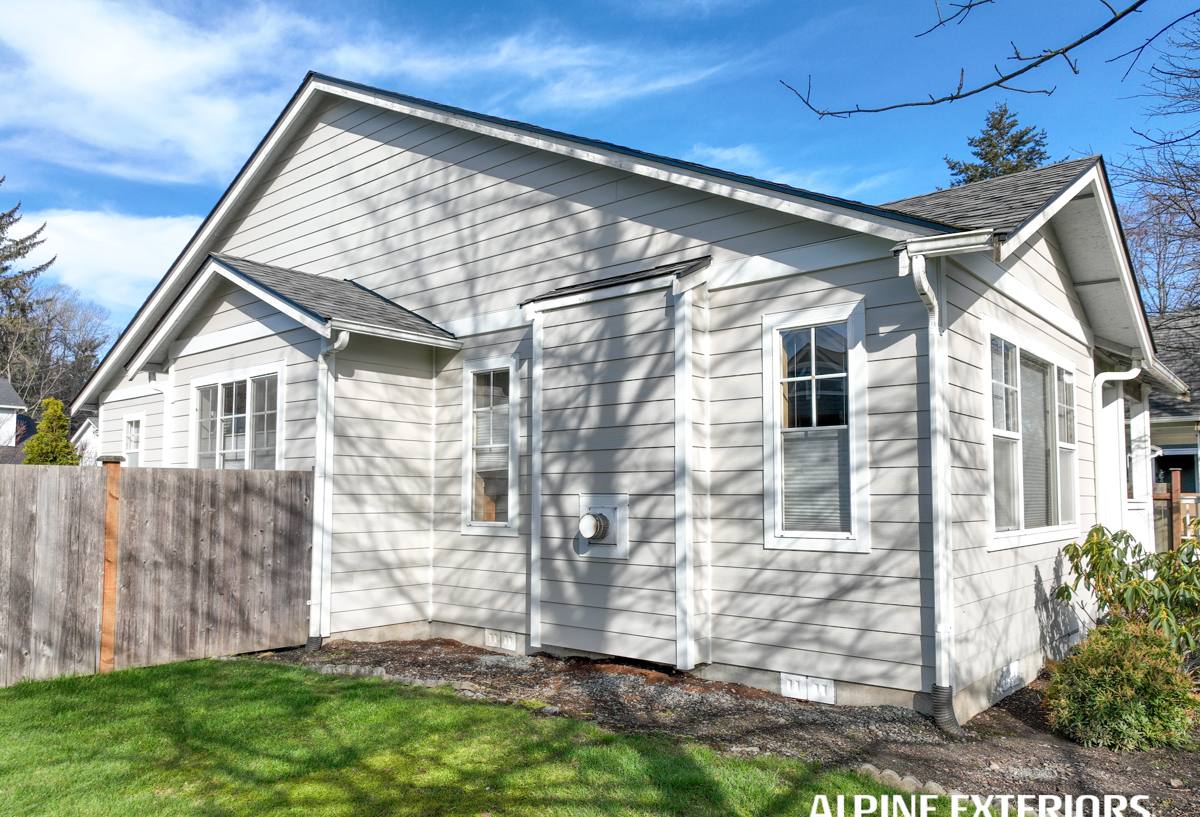
James Hardie siding is made from cement, sand, and cellulose fiber, cured into rigid boards and panels. It contains no wood pulp that can rot and no organic material for mold or insects to feed on. The raw material is essentially engineered rock. That's the core reason it holds up in wet climates: there's nothing in it for moisture to break down chemically.
LP SmartSide
LP SmartSide is an engineered wood product — strand board made from wood fiber, resin, wax, and a zinc-borate treatment for insect and fungal resistance, finished with a proprietary overlay called SmartGuard. It's a real improvement over old-school hardboard siding from the 1980s and 90s, and LP has done meaningful engineering to seal the edges and treat the wood. But at its core, it is still a wood-based product, and wood-based products behave differently than cement once water finds a way in.
Why Moisture Behavior Is the Real Story on This Coast
Semiahmoo sits right on Semiahmoo Bay, which means salt spray, near-constant humidity, and a moss season that can run from October through May in a typical Whatcom County year. Siding here doesn't just get rained on — it stays damp for days at a time, and it takes a steady coating of airborne salt that other regions never see.
Fiber cement doesn't absorb water into its structure the way wood-based products can. It can get wet on the surface and dry out without swelling, delaminating, or losing structural integrity. LP SmartSide is engineered to resist moisture intrusion at the face and edges, and when it's installed correctly — proper flashing, sealed cuts, correct clearance from grade and hardscaping — it performs reasonably well. The catch is that "installed correctly" is doing a lot of work in that sentence. Any breach in the factory seal — a missed caulk joint, a fastener that splits the strand board, a cut edge left untreated at a window return — gives moisture a path into the wood fiber core. Once that happens, the failure mode is swelling and softening, and it usually isn't visible from the ground until it's advanced.
Fiber cement has a wider margin for the small installation imperfections that happen on every real job, even with a careful crew. That margin matters more here than it would in a dry climate, because Semiahmoo homes get far more cumulative wet-days per year to expose any weak point.
Fire Resistance
This isn't the primary reason homeowners choose between these two products on the water, but it's worth stating plainly: James Hardie fiber cement is non-combustible. LP SmartSide, as an engineered wood product, is combustible, even with its treatments. If wildfire smoke and regional fire risk factor into your insurance conversations or your own priorities, that's a structural difference between the two materials, not a marketing point.
Side-by-Side Comparison
| Factor | James Hardie Fiber Cement | LP SmartSide |
|---|---|---|
| Core material | Cement, sand, cellulose fiber | Engineered wood strand, resin |
| Moisture tolerance | Does not absorb/swell; dries without damage | Resistant when intact; vulnerable if the seal is breached |
| Combustibility | Non-combustible | Combustible (treated) |
| Factory finish | ColorPlus baked-on finish, 15-year finish warranty | Primed or factory-finished options vary by line |
| Insect/rot resistance | Naturally immune (no organic food source) | Treated with zinc borate to resist, not immune |
| Typical lifespan when installed to spec | 30-50+ years | 20-30 years, installation-dependent |
| Salt air performance | Strong — cement is inert to salt exposure | Adequate with intact finish; edges are the weak point |
| Installation sensitivity | Moderate — requires correct fastening and clearances | High — cut edges, fastener placement, and caulking must be precise |
Warranty: Read the Fine Print, Not Just the Headline Number
Both manufacturers offer warranties that sound reassuring in a sales conversation. The details matter more than the years-on-paper number.
- James Hardie backs its fiber cement products with a non-prorated limited warranty (typically 30 years on siding, 15 years on the ColorPlus factory finish) that is transferable to a subsequent homeowner, which matters for resale.
- LP SmartSide warranties are generally solid on the substrate but often carry more exclusions and proration schedules tied to moisture-related failure — which is exactly the failure mode wood-based products are most exposed to in a marine climate.
- Warranty claims on any siding product typically require proof of correct installation per the manufacturer's specification. This is true for both products, but the consequences of a missed detail are more forgiving on fiber cement.
Appearance and Finish Options
Both products do a good job mimicking traditional wood lap siding, board-and-batten, and shingle profiles. James Hardie's ColorPlus finish is baked on at the factory in multiple coats and color-matched across trim, giving a more uniform, long-lasting look that resists fading better than field-applied paint. LP SmartSide is available primed for field paint or in some pre-finished options depending on the product line and market. If you want factory-baked color consistency with a long finish warranty attached, that's a Hardie strength specifically.
Cost Considerations
LP SmartSide is generally the less expensive material up front, and that's a real, valid reason some homeowners choose it — we're not going to pretend otherwise. James Hardie fiber cement typically costs more per square foot for material and is heavier, which affects labor. The honest way to think about the gap is in terms of cost per year of service life and the value of a transferable, non-prorated warranty if you sell the home. In a climate like Semiahmoo's, where moisture exposure is relentless and moss growth on the north- and west-facing walls is a near-annual maintenance item regardless of siding choice, we've seen the underlying material make a bigger difference over 15-20 years than the initial invoice does.
What Drives Cost on Either Product
| Cost Factor | Impact |
|---|---|
| Home size and wall complexity | More corners, gables, and trim details increase labor on either material |
| Tear-off vs. re-side | Removing old siding down to sheathing adds cost but allows moisture barrier inspection |
| Trim and finish package | Factory-finished trim (Hardie) vs. field-painted trim shifts cost between material and labor |
| Access and site conditions | Waterfront lots with limited staging area can add labor time |
Why Our Crews Install Only James Hardie
We're not going to tell you LP SmartSide is a bad product — plenty of homes wear it well when it's installed by a crew that respects every detail in the manufacturer's spec sheet. Our decision to install James Hardie exclusively comes down to what we can stand behind after the truck leaves. Fiber cement gives us a material that doesn't depend on a perfect seal at every cut and fastener to hold up against driving rain, salt spray, and a moss season that keeps north walls damp for months. It's non-combustible, it holds a factory finish longer, and the warranty structure is more straightforward for a homeowner who might sell the house in ten or fifteen years. That's the standard we've chosen to build our business on, and it's why we don't offer LP SmartSide as an alternative bid.
Questions to Ask Before You Choose
- What does the manufacturer's warranty actually exclude, and is it transferable if you sell?
- How is the product rated for your specific wall orientation — north- and west-facing walls near the water take the most moisture and moss exposure?
- Who is responsible for maintaining caulked joints and cut edges over the life of the siding, and what happens if that maintenance lapses?
- Does the installing contractor carry manufacturer certification for the product, and will that affect your warranty coverage?
- What is the real difference in installed cost once trim, finish, and labor are included — not just the per-square-foot material price?
If you're weighing siding options for a home in Semiahmoo or anywhere else in Whatcom County, we're happy to walk your property, point out what your specific exposure looks like, and give you a straight, no-pressure estimate for a James Hardie installation done to spec.