 Semiahmoo
 Exterior Work in a Unique Corner of Whatcom County
Point Roberts sits in a spot unlike almost anywhere else in Washington State. It's physically cut off from the rest of the U.S. mainland, connected by land only through Canada, and surrounded on three sides by saltwater. That geography shapes everything about how homes there age — and it shapes how exterior work needs to be planned and scheduled. If you own a home in Point Roberts, you already know your siding, roof, windows, and deck are dealing with conditions that inland Whatcom County homes simply don't face to the same degree.
Semiahmoo Siding works throughout the Semiahmoo and greater Whatcom County area, and Point Roberts is part of that service footprint. We install siding, roofing, windows, and decks, and on every one of those categories, the same regional reality applies: constant salt-laden air, driving rain off the water, and long stretches of damp, low-light weather that favor moss and algae growth. Building for that environment takes different judgment than building for a dry inland lot, and it's worth understanding before you plan a project.
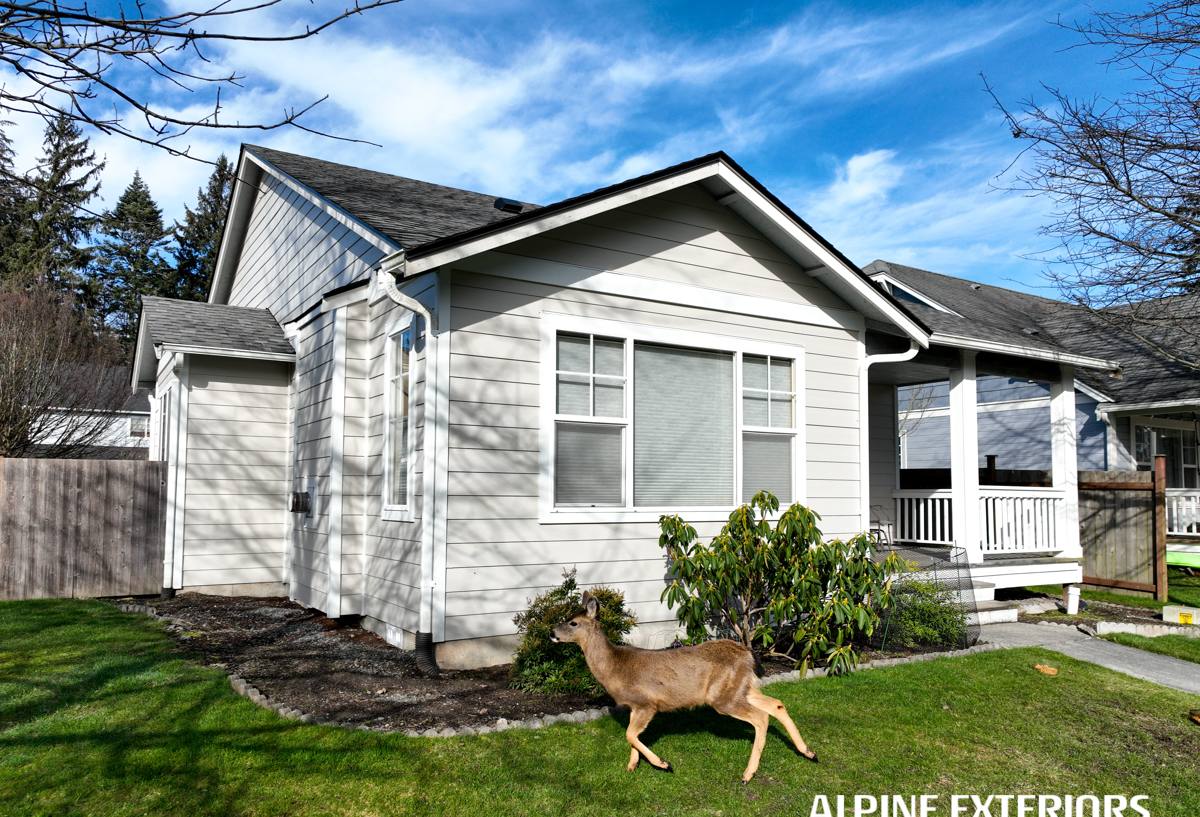
What Salt Air and Driving Rain Actually Do to a House
Salt Air
Homes close to saltwater are exposed to airborne salt that settles on every exterior surface — siding, trim, flashing, fasteners, and roofing hardware. Over years, that salt accelerates corrosion in unprotected metal, degrades certain paint and coating systems faster than manufacturers' inland warranties assume, and can leave a chalky residue that traps moisture against a wall surface. Materials and fastener systems that aren't rated for coastal exposure tend to show their weaknesses here first — rust streaks at nail heads, pitting on hardware, and premature fading or chalking on painted surfaces.
Driving Rain
Point Roberts gets weather moving straight off open water, and wind-driven rain behaves differently than a gentle vertical rainfall. It gets pushed sideways into laps, seams, and trim joints that would stay dry in a more sheltered location. Any weak point in a home's water-management details — a poorly flashed window, a gap at a butt joint, an under-caulked penetration — becomes a real liability. This is why installation detail work (flashing, house wrap integration, proper overlaps) matters as much as the siding material itself.
Moss and Prolonged Dampness
The Pacific Northwest's long wet season means north-facing walls, shaded roof slopes, and low-airflow areas stay damp for extended stretches. That's exactly the environment moss and algae need to establish. On roofing, moss holds moisture against shingles and can lift edges over time. On siding, persistent damp organic growth can stain a finish and, on porous materials, contribute to slow deterioration if it's never addressed.
Why We Install Only James Hardie Fiber Cement Siding
Semiahmoo Siding made a decision to install James Hardie fiber cement siding exclusively — not vinyl, not LP SmartSide, not Cemplank, Allura, primed spruce, or cedar. That's not a marketing position; it's a standard we hold because of what we've seen play out on homes in exactly this kind of coastal, wet climate.
Fiber cement is non-combustible and dimensionally stable, meaning it doesn't expand and contract with moisture and temperature swings the way wood-based products do. James Hardie's ColorPlus factory-applied finish is baked on under controlled conditions, which gives it more consistent, longer-lasting protection against sun and salt exposure than field-applied paint typically achieves. Hardie also engineers regional product lines (HardieZone HZ5 and HZ10) specifically for climate exposure, which matters directly in a place where wind, rain, and salt air are a daily fact rather than an occasional event.
We're not going to tell you other siding products are junk — they're not, and each has situations where it's a reasonable choice. Vinyl is inexpensive and low-maintenance in mild climates but can become brittle and distort with the wide swings some coastal storm events bring, and it's not a good match for a house style calling for a painted, dimensional wood look. Engineered wood products like LP SmartSide use resin-treated strand technology that resists moisture better than raw wood, but they're still wood-based at the core, and any breach in the factory coating opens the door to moisture absorption and swelling — a bigger risk on a home taking on-and-off salt spray and driving rain year after year. Cedar and primed spruce are beautiful materials, but they demand a maintenance commitment (recoating, caulking, moisture monitoring) that most homeowners underestimate, especially on a home that isn't lived in full-time, which is common in Point Roberts.
| Factor | Vinyl | LP SmartSide | Cedar / Primed Spruce | James Hardie Fiber Cement |
|---|---|---|---|---|
| Salt air resistance | Fair — can chalk/fade | Fair — relies on intact coating | Poor without regular upkeep | Strong, factory ColorPlus finish |
| Moisture/rot risk | Low (not wood-based) | Moderate if coating fails | High without maintenance | Low — cement-based, won't rot |
| Fire rating | Combustible | Combustible | Combustible | Non-combustible |
| Maintenance cycle | Low, but limited repair options | Recoat/inspect coating regularly | Frequent recoating/caulking | Repaint cycle measured in years, not seasons |
| Best fit | Budget-driven, mild exposure | Inland, sheltered exposure | Owners committed to upkeep | Coastal/marine exposure, low-maintenance goals |
Roofing for an Exposed, Wet Environment
Roofing in Point Roberts has to account for both wind exposure and moisture retention. Proper attic and roof ventilation matters more here than in drier parts of the state, because trapped moisture under a roof deck accelerates deterioration from the inside out. Flashing details around chimneys, vents, and valleys need to be done right the first time, since driving rain will find any shortcut. Where moss is already established, we look at whether it's a maintenance issue (cleaning, gutter and downspout function, tree cover trimming) or a sign of an underlying ventilation or underlayment problem that needs to be corrected as part of the work.
Windows That Hold Up to Wind-Driven Rain
Window failures near saltwater are rarely about the glass — they're almost always about the seal and the flashing integration with the wall assembly. Wind-driven rain will exploit a poorly sealed window frame far faster than it will in a sheltered inland location. When we replace windows, we treat the flashing and integration with the siding system as equally important to the window unit itself, because a good window installed with a weak seal will leak regardless of the product's rating.
Decks in a Marine Climate
Decks in Point Roberts take a beating from the same combination of salt exposure, standing moisture, and UV. Fastener corrosion is a common failure point on older decks near the water — hardware that isn't rated for coastal exposure will show rust and weakening well before the structural lumber does. Proper drainage under and around a deck, and materials or coatings chosen with salt exposure in mind, extend the life of the structure significantly compared to a standard inland build.
Why a Local Crew Matters Here Specifically
Point Roberts isn't a typical service call. Because it's separated from the rest of Whatcom County by Canadian territory, getting a crew, equipment, and materials on-site involves a border crossing and realistic scheduling — this isn't a place where a contractor from across the state can casually show up for a same-day fix. A crew that knows the area understands the logistics of getting materials in efficiently, plans around that reality instead of getting surprised by it, and is familiar with how the local climate actually behaves on real homes, not just in general Pacific Northwest terms. Working within Whatcom County also means understanding local permitting expectations and building department requirements that apply to exterior work in the community.
Local experience also means we've seen how different materials and details actually perform after a few years of exposure in this specific setting, not just how they're rated on paper. That's the kind of judgment that shows up in fastener selection, flashing details, and material choice — decisions that matter more here than almost anywhere else in the county.
Signs Your Point Roberts Home May Need Exterior Attention
- Chalky white residue or streaking on siding, especially on walls facing open water
- Rust staining at nail heads, hinges, or deck hardware
- Moss or algae buildup on north-facing siding or shaded roof sections
- Soft spots, bubbling paint, or visible swelling at siding seams and butt joints
- Water stains on interior ceilings or walls near window and door openings
- Gutters or downspouts that overflow or hold standing water during storms
- Visible gaps in caulking or flashing around windows, doors, or roof penetrations
Planning a Project: What to Expect
Because access requires coordinating around the border crossing, we recommend reaching out with some lead time rather than expecting a rushed turnaround, especially for larger siding or roofing projects. We'll walk the exterior, identify the specific exposure conditions on your lot (waterfront-facing walls typically need more attention than sheltered sides), and put together a plan that accounts for both the material choice and the installation detailing that actually matters in this climate.
If you're weighing a siding, roofing, window, or deck project for a home in Point Roberts, we're happy to take a look and talk through what we'd actually recommend for your specific exposure — no pressure, no upsell. Reach out for a free estimate using the form below.