 Semiahmoo
 Siding in Lynden: A Different Set of Conditions Than You'd Guess
Lynden sits inland from the water compared to our coastal Whatcom County service area, and that matters for how a homeowner should think about siding here. The salt-laden air that batters homes right on the water is less of a factor once you're up in Lynden's farmland and river-valley setting. What doesn't let up, though, is the moisture. Whatcom County as a whole sees a long wet season, heavy dew off the Nooksack River valley, and a fall-through-spring stretch where siding rarely gets a full day to dry out between rain events. That combination of humidity, shade from mature trees on older lots, and a climate that stays cool and damp for months is exactly the recipe that grows moss, mildew, and algae on exterior surfaces.
We've worked on enough homes across this county to know that "coastal siding problems" and "inland siding problems" aren't the same list, even though they're only twenty-some miles apart. Lynden homes deal less with driving salt spray and more with prolonged dampness, freeze-thaw cycling in the colder snaps, and UV exposure on south- and west-facing walls once the clouds finally break in summer. A siding material that's engineered for one set of stresses without accounting for the other tends to show its weak points here — usually within the first five to ten years.
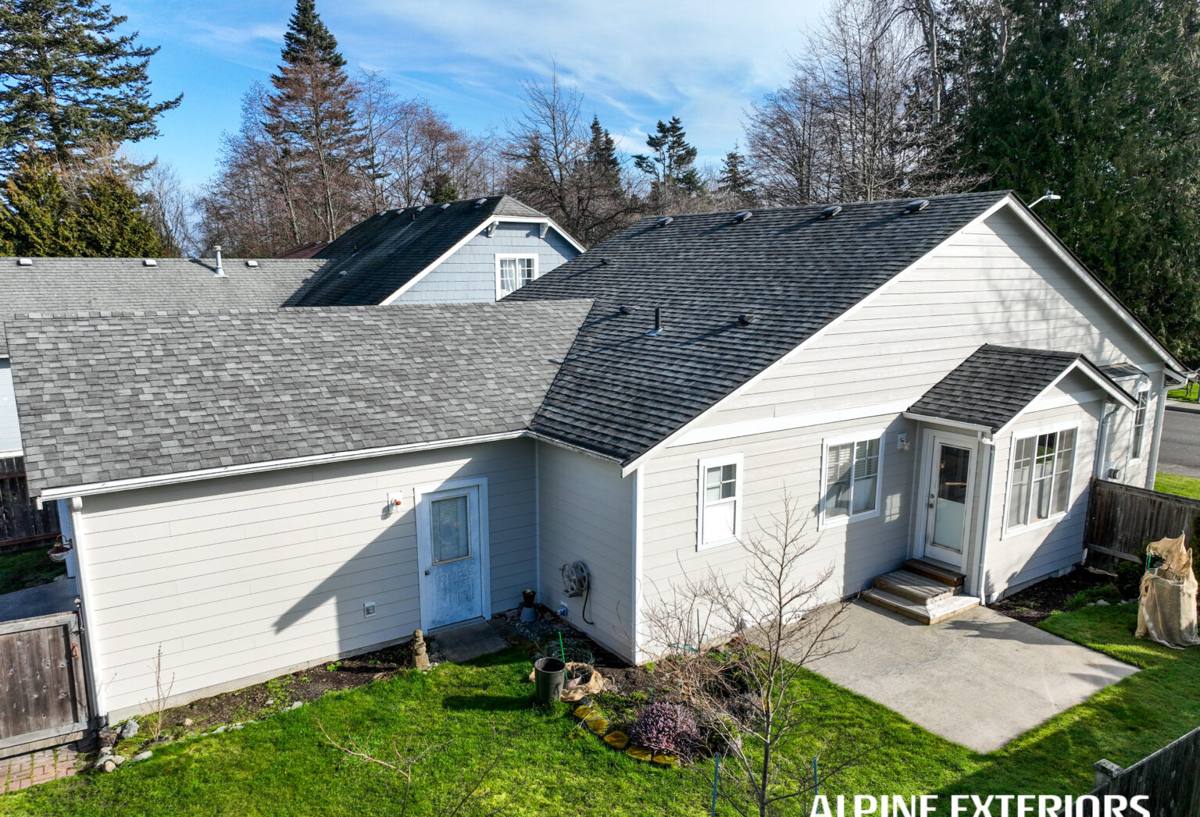
What Whatcom County's Climate Actually Does to Siding
The Long Wet Season
Most of the region gets the bulk of its precipitation between October and April, but it's not the total rainfall that causes problems — it's the duration. Siding here can stay damp for days at a stretch, especially on north-facing walls or sections shaded by trees, fences, or neighboring structures. Materials that absorb water, or that trap moisture behind them due to poor installation, don't get the drying window they'd get in a drier climate.
Moss and Organic Growth
Moss doesn't need standing water to take hold — it just needs consistent dampness and a surface it can grip. Wood-based and wood-adjacent siding products give moss and mildew something to root into over time, especially in seams, laps, and end joints. Once organic growth establishes itself, it holds moisture against the substrate, which accelerates whatever underlying decay process is already at work.
Temperature Swings and UV
Whatcom County winters bring occasional hard frosts and the county gets a real amount of summer sun despite its reputation. Siding that swells with moisture in winter and then dries and contracts in summer is under constant mechanical stress. Add UV exposure on sun-facing walls and you get fading, chalking, and eventually cracking on products that aren't factory-finished to handle it.
Why We Only Install James Hardie Fiber Cement
We get asked fairly often why we don't offer vinyl, LP SmartSide, primed wood, or the other fiber cement brands on the market. The honest answer is that we made a standard for ourselves based on what holds up in this climate with the least amount of homeowner maintenance, and James Hardie is what we landed on.
What We Don't Install, and Why
- Vinyl siding — it's inexpensive and easy to install, but it's a petroleum-based product that expands and contracts significantly with temperature, can warp or crack in impact, and typically fades over time with no way to repaint it back to a factory-quality finish.
- LP SmartSide — an engineered wood product that performs reasonably well when installation and caulking are perfect and stay perfect, but wood-based siding is inherently more vulnerable to moisture intrusion at cut edges and seams than fiber cement, and Whatcom County's wet season doesn't forgive installation shortcuts.
- Cedar and primed spruce — beautiful materials with real upkeep demands: regular refinishing, vigilance against moisture and insects, and a shorter practical lifespan in a climate this damp unless a homeowner is committed to ongoing maintenance.
- Cemplank and Allura — both are legitimate fiber cement competitors to Hardie, and we don't say otherwise. We simply standardized on one manufacturer so our crews install one system to one spec, every time, and we chose the one with the factory finish and warranty structure we trust most.
What James Hardie Gets Right for This Climate
Fiber cement is non-combustible and dimensionally stable — it doesn't swell and shrink with moisture the way wood-based products do, which matters enormously in a climate where siding stays damp for extended stretches. Hardie's ColorPlus factory finish is baked on under controlled conditions, which gives it more consistent coverage and better fade resistance than field-applied paint, and it holds up to the region's UV exposure without chalking prematurely. Hardie also builds region-specific product lines (HZ5 for our climate zone) engineered around moisture and freeze-thaw performance rather than a one-size-fits-all formulation.
How Correct Installation Protects a Lynden Home
Fiber cement siding is only as good as the installation behind it. Most of the failures we see on any brand of siding trace back to installation mistakes, not the material itself. In a climate like ours, a few details matter more than they would somewhere drier:
- Proper rain-screen or drainage-plane detailing so any moisture that gets behind the siding has somewhere to go instead of sitting against the wall sheathing.
- Correct fastener placement and nailing pattern — Hardie is specific about this, and it's one of the most commonly skipped details on rushed jobs.
- Properly caulked and flashed joints, seams, and penetrations (windows, doors, hose bibs, vents) since these are the entry points where water actually gets in.
- Adequate clearance at the bottom edge — siding installed too close to grade, a deck, or a roofline stays wet longer and is more prone to moisture wicking.
- Correct panel and trim gapping to allow for expansion without cracking the caulk joints over time.
Siding, Roofing, Windows, and Decks: Why the Whole Exterior Matters
Siding doesn't fail in isolation. A roof that's shedding water improperly, gutters that overflow onto a wall, windows with failed flashing, or a deck ledger board that's trapping moisture against the house can all undermine even a well-installed siding job. We handle siding, roofing, windows, and decks specifically because these systems interact, and a homeowner is better served by a crew that looks at the whole exterior envelope rather than one that only sees the piece it was hired to touch.
For example, we'll flag it if a roofline is dumping water directly onto a siding run below, or if an aging window is likely to be the real source of a moisture stain that looks like a siding problem. That's a more useful conversation than quoting a siding replacement that won't actually solve the underlying issue.
Comparing Common Siding Options for This Climate
| Material | Moisture Performance Here | Maintenance Burden | Typical Lifespan |
|---|---|---|---|
| James Hardie Fiber Cement | Dimensionally stable, resists warping and rot | Low — occasional wash, no refinishing needed | 30+ years with proper install |
| Vinyl | Won't rot, but can warp/crack with temperature swings | Low, but fading is permanent | 20-30 years, appearance degrades sooner |
| LP SmartSide | Vulnerable at cut edges/seams if caulking fails | Moderate — caulk and paint upkeep | 20-30 years with diligent maintenance |
| Cedar / Primed Wood | Absorbs moisture, most susceptible to rot here | High — regular refinishing required | 15-25 years depending on upkeep |
These are general performance patterns, not guarantees for any individual product or installation — actual results depend heavily on installation quality, maintenance, and site-specific exposure.
What Local Homeowners Should Look For Before Hiring
Because Whatcom County's climate is unforgiving of shortcuts, the contractor matters as much as the material. A few things worth checking before you hire anyone for a siding, roofing, window, or deck project:
- Manufacturer certification or documented training specific to the product being installed, not just general contracting experience.
- A written scope that spells out flashing, drainage plane, and fastening details rather than a vague "siding replacement" line item.
- Proper Washington state contractor licensing and insurance, verifiable independently.
- Familiarity with local permitting and inspection requirements for exterior work in your jurisdiction.
- A willingness to walk the property and explain what they're seeing, rather than jumping straight to a quote.
What a Lynden Siding Estimate Typically Covers
When we walk a property in Lynden, we're looking at more than square footage. We check the condition of the existing wall assembly, look for signs of past moisture intrusion (especially around windows, deck ledgers, and roof-to-wall transitions), assess sun and shade exposure on each elevation, and note anything upstream — gutters, downspouts, grading — that could undermine new siding if left unaddressed. That full picture is what a fair, accurate estimate is built on, rather than a flat per-square-foot number applied without context.
Ready When You Are
If you're weighing your options for siding, roofing, windows, or decks on a Lynden home, we're happy to come take a look, answer questions honestly, and put together a no-pressure estimate. There's no obligation — just a straightforward assessment from a local crew that works in this climate every day. Use the form below to get started.