 Semiahmoo
 Living Between the Harbor and the Weather
Drayton Harbor sits right where the marine layer, tidal air, and near-constant Pacific moisture collide with everyday home life. If you've owned a house here for more than a season or two, you already know the drill: the north and west-facing walls stay damp longer than the rest of the house, moss shows up in places you didn't expect, and anything metal that isn't stainless starts showing rust freckles within a couple of years. That's not bad luck. That's Whatcom County's marine climate doing exactly what it does along the water.
Homes close to the harbor take a different kind of weathering than homes even a few miles inland. Salt-laden air rides in on the wind, driving rain comes in sideways more often than straight down, and the growing season for moss and algae runs nearly year-round instead of just a few wet months. Exterior materials that hold up fine in a drier part of the state can start failing here in ways that surprise homeowners who moved from elsewhere.
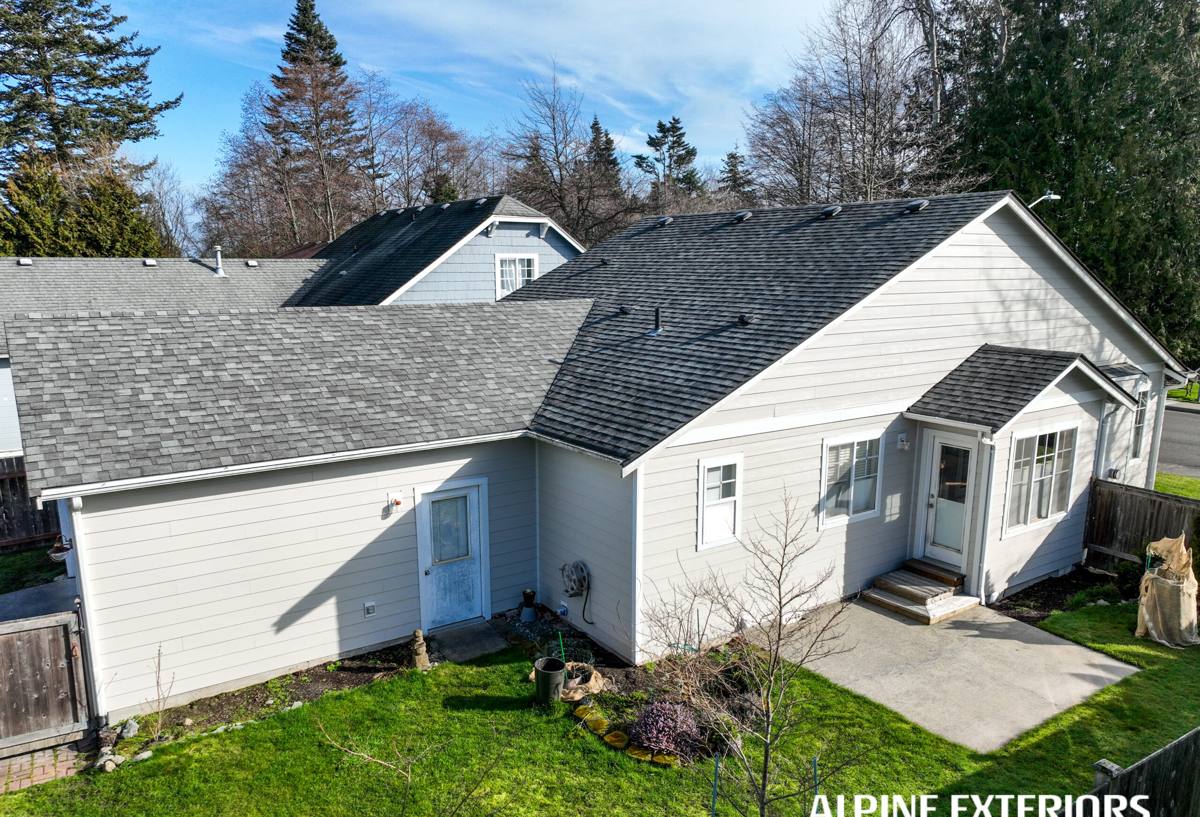
What Salt Air and Driving Rain Actually Do to a House
Salt Air
Salt is hygroscopic — it pulls moisture out of the air and holds it against whatever surface it lands on. On siding, that means a slow, steady exposure to dampness even on days that aren't technically rainy. Paint films break down faster, caulk joints dry out and crack sooner, and any exposed fasteners or trim metal are at higher risk of corrosion. It's a cumulative effect, which is why houses a block or two from the water often show wear patterns that houses further inland simply don't.
Driving Rain
Wind off the harbor doesn't just bring rain — it pushes it. Sideways, wind-driven rain finds every lap, seam, and butt joint in a siding system and tests it far harder than a calm vertical rainfall would. Siding that depends on paint film alone for water resistance, or that swells and distorts when saturated, is working overtime in this kind of exposure. The parts of a house most exposed to prevailing wind — usually the west and south walls here — tend to fail first, and it's often visible as staining, bubbling paint, or soft spots long before anyone realizes water is getting behind the cladding.
The Long Moss Season
Because Drayton Harbor rarely gets a long, hard dry stretch, moss and algae have almost year-round conditions to establish themselves on north-facing walls, under eaves, and anywhere shade keeps a surface from drying out. Moss isn't just cosmetic — it holds moisture against the substrate underneath it, which accelerates rot in wood-based products and speeds up coating failure on painted surfaces. A siding material's ability to shed water and resist organic growth matters more here than in most parts of the state.
Why This Changes What Siding Makes Sense
We install exclusively James Hardie fiber cement siding, and it's not a brand preference — it's a decision built around exactly the conditions described above. Fiber cement is dimensionally stable and non-combustible, meaning it doesn't absorb moisture and swell or shrink the way wood-based siding can, and it doesn't rely on an intact paint film to keep water out the way vinyl or wood does. James Hardie's HZ5 product line in particular is engineered for cold, wet, coastal climates like ours, and its ColorPlus factory finish is baked on under controlled conditions rather than field-applied, which matters a great deal when you're fighting salt air and near-constant humidity.
We don't install LP SmartSide, vinyl, Cemplank, Allura, primed spruce, or cedar. Each of those products has legitimate uses somewhere, but none of them hold up as consistently against this specific combination of salt exposure, driving rain, and year-round dampness as correctly installed Hardie board does. That's a professional judgment call we've made after seeing what actually happens to different materials on harbor-adjacent homes over time — not a knock on any manufacturer.
Material Comparison for Harbor-Adjacent Homes
| Factor | James Hardie Fiber Cement | Vinyl | Wood / Primed Spruce |
|---|---|---|---|
| Moisture response | Dimensionally stable, won't swell or rot | Won't rot, but can warp and gap in temperature swings | Absorbs moisture; prone to rot and swelling |
| Finish durability in salt air | Factory-baked ColorPlus finish, long fade/chip resistance | Color is through-body but can chalk and fade | Field-applied paint fails faster in salt/damp exposure |
| Moss and algae resistance | Dense, low-absorption surface resists organic growth | Resists rot but surface can stay damp longer | Higher risk — moisture retention feeds growth |
| Fire rating | Non-combustible | Combustible, can melt or deform near heat | Combustible |
| Typical lifespan (installed to spec) | Decades, with strong transferable warranty | Varies; seams and fasteners are common failure points | Shorter without diligent, ongoing maintenance |
Roofing, Windows, and Decks Face the Same Exposure
Siding isn't the only part of a Drayton Harbor home dealing with this climate. Roofing takes the brunt of the driving rain and the moss growth directly, especially on shaded north slopes and valleys where debris collects and water sits longer than it should. Windows near the harbor deal with condensation and seal failure sooner if they're older units or were installed without proper flashing detail. Decks, especially anything low to grade or shaded by trees, are prime real estate for the same moss and moisture issues that show up on siding — just at ground level, where rot is easier to miss until it's structural.
We handle all four — siding, roofing, windows, and decks — because on a lot of these homes, the problems show up together. A roof that's shedding water improperly onto a wall, or a deck ledger that's trapping moisture against the house, can undo even the best siding installation if it's not looked at as part of the whole exterior system. A local crew that's used to seeing these interactions catches things a siding-only or roofing-only outfit might miss.
Why a Local Crew Matters Here
Semiahmoo and the harbor area aren't like the rest of Whatcom County, and they're definitely not like the drier side of the state. Flashing details, ventilation gaps, and fastener choices that work fine 20 miles inland can be marginal right on the water. A crew that works this area regularly knows which walls take the worst of the wind-driven rain, where moss tends to establish first, and how much clearance and drainage detail actually matters this close to salt water — not from a manual, but from having done the work on homes just like yours.
That local knowledge also shows up in smaller ways: knowing which products genuinely hold up here versus which ones look fine in a showroom but struggle after a few harbor winters, and being straightforward about that difference instead of selling whatever's cheapest to install.
What Correct Installation Looks Like
James Hardie siding performs the way it's rated to only when it's installed to the manufacturer's specifications — and in a climate like this, the installation details matter as much as the product itself. Key points we hold to on every job:
- Proper clearance between siding and grade, decks, roof lines, and other horizontal surfaces to prevent standing water and wicking
- Correct fastener type, spacing, and penetration depth — under- or over-driven fasteners are a common failure point
- Weather-resistant barrier and flashing integration at every window, door, and penetration, not just at the field of the wall
- Proper joint and butt seam treatment to keep wind-driven rain from working its way behind the cladding
- Ventilation behind the siding where the assembly calls for it, so moisture that does get in has a way to dry out
- Factory-finished ColorPlus panels handled and cut in ways that preserve the factory seal, rather than field-painted cut edges left exposed
Skipping any of these doesn't usually cause an immediate, visible problem — it shows up two, five, or ten years down the road as staining, soft spots, or premature coating failure, which is exactly the kind of slow damage that's hardest to catch early in a wet climate like ours.
Maintenance Realities for Harbor-Adjacent Siding
No siding material is maintenance-free in this environment, but the maintenance burden is very different depending on what's on the wall. Correctly installed Hardie siding generally needs periodic washing to keep salt residue and organic growth from building up, and repainting on a much longer cycle than field-painted wood since the ColorPlus finish is factory-applied and warrantied. Wood-based products typically need more frequent recoating and closer inspection for soft spots, especially on shaded or north-facing walls where moss takes hold fastest. Vinyl needs less scrubbing but can't be repainted if it fades or chalks, and any warping or gapping from temperature swings is generally a full-panel replacement rather than a spot repair.
Simple Signs Your Siding Is Struggling With the Climate
- Persistent moss or algae staining on north or shaded walls that comes back quickly after cleaning
- Soft spots, bubbling, or peeling paint, particularly on west-facing walls that catch prevailing wind and rain
- Visible gaps, warping, or panel movement after temperature swings
- Rust streaking near fasteners, trim, or flashing
- Musty smell or discoloration on interior walls that back up to exterior siding — a sign moisture is already getting through
Planning a Siding Project Near the Harbor
If you're weighing a full replacement versus repairs, the honest starting point is an inspection of what's actually happening behind the siding, not just what's visible on the surface. On older homes, especially those with wood or early-generation composite siding, damage is often more extensive than what shows from the ground. On newer homes, sometimes it really is a matter of a few problem areas rather than a full tear-off. Either way, a straight answer up front saves money compared to patching a system that's already compromised.
If you're in Drayton Harbor or anywhere else around Semiahmoo and want an honest look at what your siding is dealing with — and what it would take to get it standing up to salt air, driving rain, and moss season without a repeat conversation in five years — we're happy to come take a look. Reach out for a free, no-pressure estimate using the form below.