 Semiahmoo
 Why Bellingham Decks Wear Out Faster Than the Manual Says
Every deck board, joist, and fastener sold in the Pacific Northwest comes with a warranty written for average conditions. Bellingham doesn't have average conditions. Sitting close to Whatcom County's saltwater shoreline, homes here deal with a steady drift of salt-laden air that settles on exposed wood and metal every day, not just during storms. Add a rainy season that stretches across most of the year and a shade-heavy tree canopy on a lot of properties, and you get the two things that age a deck faster than anything else: moisture that never fully dries out, and moss and algae that hold that moisture against the wood.
None of that means a deck is doomed. It means the repair has to account for how the structure actually fails here, not how it fails in a dry inland climate. A contractor who mostly works drier parts of the state will often patch the visible damage and miss the compounding cause underneath it. We work Bellingham and the surrounding Whatcom County coastline regularly, so we see the same failure patterns often enough to know where to look first.
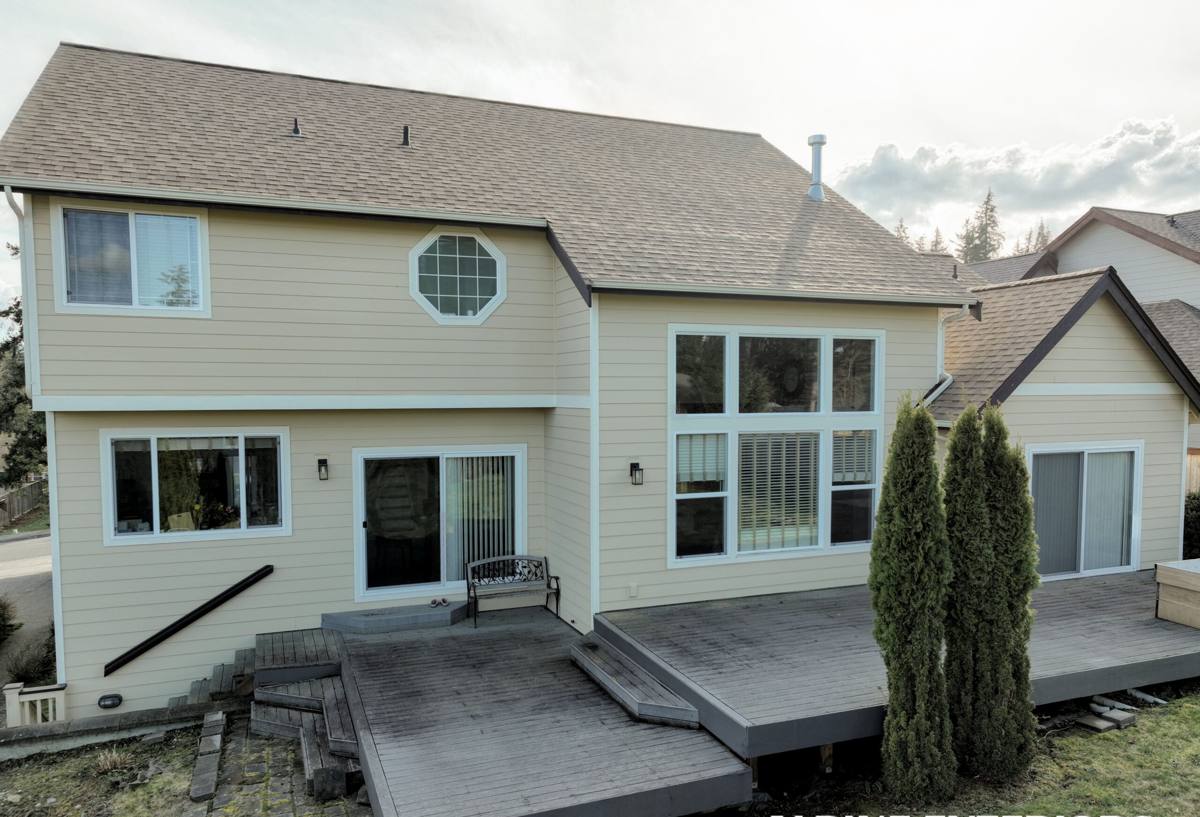
How Salt Air, Rain, and Moss Actually Damage a Deck
Salt Air
Airborne salt doesn't just sit on the surface — it's hygroscopic, meaning it pulls moisture out of the air and holds it against whatever it lands on. On a deck, that means fasteners, brackets, and any exposed metal hardware corrode faster than the wood around them would suggest. A board can look fine while the nail or screw holding it down is quietly rusting from the inside of the joint.
Driving Rain
Rain that comes in at an angle, which is common with the wind patterns off the water, gets pushed under railings, into end-grain cuts, and behind ledger boards where it wouldn't reach in a straight-down rain. End grain — the cut ends of boards — soaks up water many times faster than the flat face of the same board. Decks with a lot of exposed end-grain cuts (stair stringers, board ends at the rim joist, notched posts) tend to show rot there first.
Moss Season
Whatcom County's long wet season, combined with shaded yards, gives moss and algae months to establish themselves on deck surfaces. Once moss takes hold, it acts like a sponge sitting directly on the wood — it holds water against the boards long after the rain has stopped and the rest of the yard has dried. This is one of the most common reasons a deck that "looked okay last summer" turns out to have soft, punky boards underneath the moss line by spring.
Signs Your Deck Needs Repair Now
A lot of deck damage is easy to miss because it happens from the underside or inside a joint. These are the checks worth doing before problems get expensive:
- Boards that feel spongy, springy, or noticeably softer underfoot than the boards next to them
- Rust streaks running down from screw heads or bracket edges
- Gaps opening up between boards, or boards that have cupped or crowned
- Moss or dark algae staining that keeps coming back within weeks of cleaning
- A ledger board (where the deck attaches to the house) with a visible gap, staining, or soft wood nearby
- Railings or posts that wiggle more than they used to, even slightly
- Stair stringers with visible splitting or soft spots at the cut ends
- Standing water that takes more than a day to fully drain after rain
Any one of these on its own might be minor. Two or three together, especially near the ledger board or stairs, usually means the damage has moved from cosmetic to structural, and that changes what the repair needs to involve.
What a Correct Repair Actually Involves
Deck repair gets treated as simple carpentry more often than it should. Swapping a rotten board for a new one is the easy part. The part that actually determines whether the repair lasts is what's happening underneath and around that board.
Structural First, Cosmetic Second
Before any board gets replaced, the framing underneath — joists, beams, posts, and especially the ledger board connection to the house — needs to be checked for soundness. A new board fastened over a compromised joist just hides the problem for another season.
Flashing and Water Management
Ledger boards need proper flashing to keep water from tracking behind them into the house rim joist. This is one of the most common corner-cutting spots we find on older or DIY-repaired decks, and it's also one of the most damaging when it's missing, because the moisture ends up somewhere you can't see it.
Fastener Choice
Given the salt air here, fastener grade matters more in Bellingham than it does further inland. Standard galvanized fasteners can corrode within a few years near the water. Stainless steel or high-quality coated fasteners cost more upfront but hold up significantly longer in this environment, and mismatched or wrong-grade fasteners are a frequent cause of premature repair failure.
Matching Wood Movement
Replacement boards need to be the right species and treatment level to move with the rest of the deck as they dry and swell with seasonal moisture. Mixing incompatible materials — like an untreated replacement board next to pressure-treated ones — creates uneven wear and can trap moisture at the seam.
Deck Materials in Bellingham: How They Actually Hold Up
Homeowners often ask what to repair with, especially if the original deck is getting older. Here's an honest comparison based on how each material behaves in this specific climate, not a marketing sheet:
| Material | Salt Air / Moisture Behavior | Moss Resistance | Typical Maintenance |
|---|---|---|---|
| Pressure-treated pine/fir | Good if properly sealed and re-sealed on a schedule; end grain is the weak point | Low — needs regular cleaning | Annual cleaning, sealant every 1-3 years |
| Cedar | Naturally rot-resistant but still needs sealing near the coast; softer, more prone to surface wear | Moderate | Cleaning and sealant every 2-3 years |
| Composite decking | Excellent — doesn't absorb water or rot | Moderate to good, varies by brand and surface texture | Periodic washing, no sealing needed |
| Hardware (all deck types) | Stainless or marine-grade coated fasteners strongly recommended near the water | N/A | Inspect for corrosion annually |
We don't push one material over another as a blanket rule — the right call depends on the existing deck's structure, the homeowner's budget, and how much ongoing maintenance they actually want to keep up with. What we do avoid is repairing a moisture-prone deck with mismatched or lower-grade material just because it's cheaper up front, since that usually means doing the same repair again in a few years.
Our Repair Process
- Full inspection — We check the surface, the framing underneath, the ledger connection, stairs, and railings, not just the spot you called about. Hidden rot often extends further than the visible damage.
- Honest scope — You get a clear picture of what's cosmetic, what's structural, and what can wait, along with a straightforward explanation of why.
- Repair or replace decision — For each affected section, we tell you plainly whether targeted repair makes sense or whether that section (or the whole deck) has moved past the point where patching is worth it.
- Correct materials and fasteners — Matched wood species or composite, with fastener grade selected for the coastal environment, not generic hardware.
- Flashing and drainage check — Any ledger or flashing work is done properly the first time, since this is the step that determines whether water problems come back.
- Cleanup and walkthrough — We show you what was done and what to watch for going forward, including basic moss-prevention steps.
Repair or Replace? What Actually Drives That Decision
| Factor | Leans Toward Repair | Leans Toward Replacement |
|---|---|---|
| Framing condition | Joists and ledger are sound | Widespread rot in joists, beams, or ledger |
| Age of deck | Under 10-15 years, well-built originally | Older deck nearing or past typical service life |
| Extent of damage | Isolated boards, stairs, or railing sections | Damage spread across most of the surface |
| Fastener condition | Localized corrosion | Widespread rust affecting structural connections |
| Budget priorities | Extend usable life a number of years for lower cost | Want a longer-term reset and possibly a material upgrade |
Costs vary a lot depending on square footage, whether framing work is involved, and material choice, so we'd rather give you a real number after seeing the deck than a broad range that doesn't mean much. In general, targeted repairs cost a fraction of full replacement, but a deck with failing framing usually isn't a good candidate for patch repairs no matter how the visible boards look.
Keeping Moss and Rot From Coming Back
A repair is only worth doing if it actually lasts, and in this climate that depends partly on what happens after we leave. A few habits make a real difference:
- Sweep debris and standing leaves off the deck regularly, especially in shaded corners where moisture lingers
- Clean moss and algae before it establishes a foothold, rather than after it's already staining the wood
- Keep gutters and downspouts clear so runoff isn't draining directly onto or under the deck
- Re-seal wood decking on the schedule appropriate to the product, not just when it starts looking dry
- Trim back overhanging branches to let more sun and airflow reach the surface
- Check fastener heads and brackets once a year for early rust, before it spreads to the wood around it
None of this requires major effort, but skipping it is the single biggest reason repairs that were done correctly still fail early in coastal Whatcom County.
Why Hiring a Crew That Already Works Bellingham Matters
A deck repair done by a crew unfamiliar with this stretch of coastline tends to treat the job like any other repair anywhere in the state — right materials on paper, but not necessarily the right grade of fastener, the right flashing detail for driving rain, or the judgment to know that moss staining on a Bellingham deck usually means more moisture damage underneath than it would somewhere drier. We work on homes across Semiahmoo and the surrounding Whatcom County area regularly enough that these patterns aren't a surprise — they're just what we expect to find and plan for from the first inspection.
That familiarity also means a more accurate first estimate. We're not guessing at how a repair will hold up in salt air and long wet winters; we're basing the recommendation on what we've actually seen happen to decks in this exact environment.
Get a Straight Answer on Your Deck
If your deck has soft spots, recurring moss, rust stains, or just feels less solid than it used to, it's worth a look before those issues spread further into the framing. We offer a free, no-pressure estimate — we'll inspect the deck, tell you honestly what's going on, and lay out your repair options with no obligation to move forward. Use the form below to get started.