 Semiahmoo
 Siding in Marietta: Built for Salt Air, Rain, and Moss
Marietta sits in the corner of Whatcom County where the Salish Sea does most of the talking. Homes here take a steady diet of salt-laden wind off the water, long stretches of driving rain through fall and winter, and the kind of damp, shaded microclimate that gives moss and algae every advantage they need. If you've owned a house in this area for more than a few years, you've probably already seen what that combination does to exterior surfaces that weren't built for it — chalking paint, soft trim, streaking, and siding that never quite looks clean no matter how often it gets pressure washed.
We're a local siding, roofing, window, and deck contractor working the Semiahmoo and greater Whatcom County area, and Marietta's climate is exactly why we standardized on one exterior product for siding: James Hardie fiber cement. This page walks through what the local climate actually does to a home's exterior, how our process is built around that reality, and why we won't put anything but Hardie on a house we stand behind.
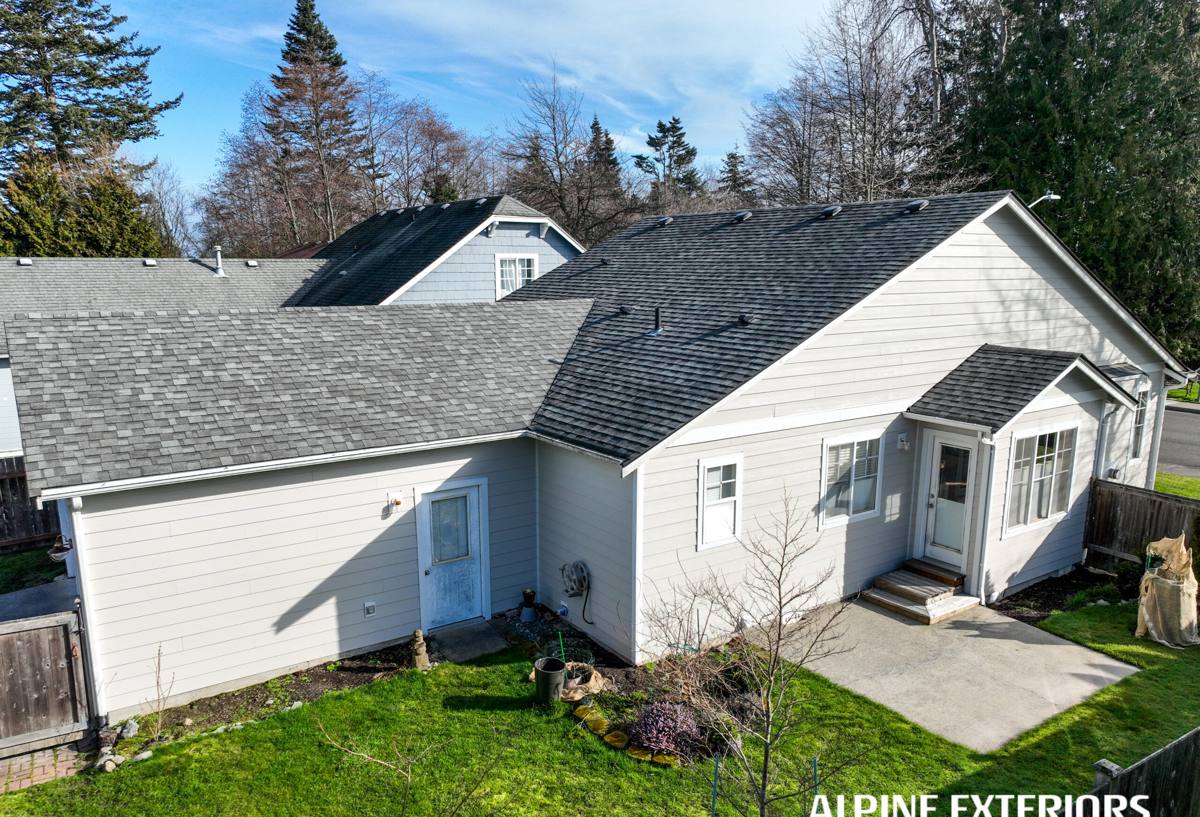
What the Marietta Climate Does to a Home's Exterior
Salt Air and Marine Moisture
Proximity to Semiahmoo Bay and the wider Salish Sea means the air itself carries salt and moisture, even blocks away from open water. Salt is corrosive to fasteners and hardware, and it accelerates the breakdown of finishes that aren't engineered to resist it. Over years, that means faster fading, chalking, and coating failure on siding and trim that wasn't built with a marine environment in mind.
Driving Rain and Wind-Driven Water
Whatcom County doesn't get the heaviest rainfall totals in the state, but it gets a lot of sideways rain — wind off the water pushes moisture into seams, laps, and fastener points that would stay dry in a calmer climate. Any siding product with weak seams, poor edge sealing, or a tendency to absorb water at cut ends is going to struggle here, and that struggle usually shows up as swelling, soft spots, or trapped moisture behind the cladding.
Moss, Algae, and Prolonged Shade
Between tree cover and the long grey stretch of a Pacific Northwest fall through spring, a lot of Marietta homes have north- and west-facing walls that rarely see direct sun for weeks at a time. That's ideal growing conditions for moss and algae, which hold moisture against the surface and accelerate whatever decay process is already underway. Siding that can't shed water quickly or resist organic growth ends up needing more frequent cleaning and repainting just to look presentable.
Temperature Swings and Material Movement
Coastal Whatcom County doesn't see extreme heat, but it does see a real seasonal swing between damp winters and drier summers. Materials that expand and contract significantly with moisture and temperature — wood-based products especially — are more prone to warping, cupping, and joint failure over time than a dimensionally stable material.
Why We Only Install James Hardie Siding
We get asked fairly often why we don't offer vinyl, LP SmartSide, or other engineered wood siding options. The honest answer is that we've made a professional judgment call based on what holds up in this specific climate, and we'd rather turn away a job than install something we don't believe will perform here.
- Non-combustible material: James Hardie fiber cement is cement-based, not wood-based, so it doesn't feed a fire the way wood products can.
- Moisture resistance: Fiber cement doesn't absorb and swell the way engineered wood siding can, which matters directly in a climate defined by driving rain and marine humidity.
- Factory-applied ColorPlus finish: The finish is baked on in a controlled factory environment rather than field-applied, which gives more consistent coverage and better resistance to fading and chalking than a job-site paint job.
- Climate-engineered product lines: Hardie makes region-specific formulations (HZ5 for our climate zone) designed around the moisture and temperature conditions of the Pacific Northwest specifically.
- Strong transferable warranty: A well-documented, transferable warranty matters to resale value, which matters in a market where buyers are paying close attention to exterior condition.
We're not going to tell you that other products are junk — LP SmartSide and vinyl both have legitimate uses and plenty of homes carrying them without major issues. But for the specific combination of salt air, sustained moisture, and shade that Marietta throws at an exterior, we consistently see fiber cement outperform engineered wood and vinyl over a 20-plus-year horizon, and that's the horizon we're building for.
How Our Process Works for Marietta Homes
Assessment Before We Talk Product
Every job starts with a walk of the house — checking existing siding for moisture intrusion, evaluating trim and window flashing, and looking at how much sun exposure each wall actually gets. A wall that's shaded most of the day and catches wind off the bay needs different attention at the seams and laps than a south-facing wall that dries out quickly.
Water Management First
Siding is only as good as what's underneath it. We pay close attention to house wrap, flashing at windows and doors, and proper drainage planes before the first piece of Hardie goes up. In a climate where wind-driven rain is a given, the water management layer is what actually keeps a home dry — the siding is the visible finish on top of that system.
Installation to Manufacturer Spec
James Hardie's warranty and performance depend on correct installation — proper fastening, clearances, caulking, and painted or factory-finished cut edges. A lot of the siding problems we see on older homes trace back not to the product itself but to shortcuts taken during installation. We install to spec because that's what makes the material perform the way it's designed to.
Beyond Siding
Siding rarely fails in isolation. Roofing, window flashing, and deck ledger connections all interact with how water moves around a home's exterior. Because we handle roofing, windows, and decks in addition to siding, we can look at a Marietta home as one connected system rather than patching one component while ignoring how it ties into the rest.
Comparing Exterior Siding Options for This Climate
| Factor | James Hardie Fiber Cement | Engineered Wood (LP SmartSide) | Vinyl |
|---|---|---|---|
| Moisture/salt air resistance | Strong — cement-based, resists swelling | Moderate — engineered but wood-based, sensitive to cut-edge exposure | Strong against moisture, but seams can allow water behind panels |
| Combustibility | Non-combustible | Combustible (wood-based) | Combustible, can deform under heat |
| Finish durability | Factory-baked ColorPlus finish | Factory or field-applied coating | Color is through-body but can fade/chalk over time |
| Moss/algae resistance | Good, especially with proper drainage detailing | Moderate | Good surface resistance, but seams trap debris |
| Typical lifespan (installed to spec) | 30-50+ years | 20-30 years | 20-40 years |
Maintenance Realities for a Marietta Property
No siding is maintenance-free in this climate, but the maintenance load differs a lot by material. Homeowners should expect to:
- Rinse siding periodically to clear salt residue and organic buildup, especially on shaded or wind-exposed walls
- Inspect caulking around windows, doors, and trim annually, since sealant is often the first thing to fail under constant moisture cycling
- Keep gutters and downspouts clear so water isn't dumping directly onto siding or foundation areas
- Trim back vegetation and tree cover where practical to reduce prolonged shade and moisture retention on exterior walls
- Watch for early signs of moisture intrusion — soft trim, bubbling paint, or dark staining at seams — and address them before they spread
What Local Experience Actually Changes
A crew that works Whatcom County's coastal communities regularly knows which walls on a given lot orientation tend to hold moisture, how far inland the salt exposure realistically extends, and which flashing details matter most given the region's rain patterns. That's not something you get from a general contractor who occasionally works this far north — it comes from repeatedly seeing how houses in this specific corner of the state age over time, and adjusting installation details accordingly.
We're not the cheapest option if you're comparing bare material and labor costs against vinyl or engineered wood. We're upfront about that. What we're offering instead is a single product standard we trust to hold up against Marietta's salt air, rain, and moss, installed by a crew that treats water management as the actual job, with the finish work as the visible result of doing that correctly.
Getting Started
If your siding is showing its age — chalking, staining, soft spots, or just a tired look that pressure washing won't fix — we're happy to take a look and give you a straightforward assessment. Reach out for a free, no-pressure estimate on siding, roofing, windows, or decks, and we'll walk the property with you and talk through what actually makes sense for your home.