 Semiahmoo
 Why Bellingham Siding Wears Differently Than Siding Inland
Bellingham sits close enough to salt water and open exposure that homes here take a different kind of beating than a house forty miles inland. It isn't one dramatic storm that does the damage — it's the daily grind of three things working together: salt-laden marine air, long stretches of driving rain off the water, and a moss and algae season that can run most of the year in shaded, north-facing spots. Any one of those a house could shrug off. All three at once, for years, is what actually breaks siding down.
Salt air is corrosive to exposed fasteners and metal trim, and it also holds moisture against a wall longer than dry inland air does. Driving rain — rain that comes in sideways, not straight down — finds every weak lap, every gap at a butt joint, every place where caulk was asked to do a job that flashing should have done. And moss doesn't just look bad; it holds water against the siding surface and keeps that surface from ever fully drying between rain events. Put those together over a Whatcom County winter and you get siding that looks tired years before its rated lifespan should allow.
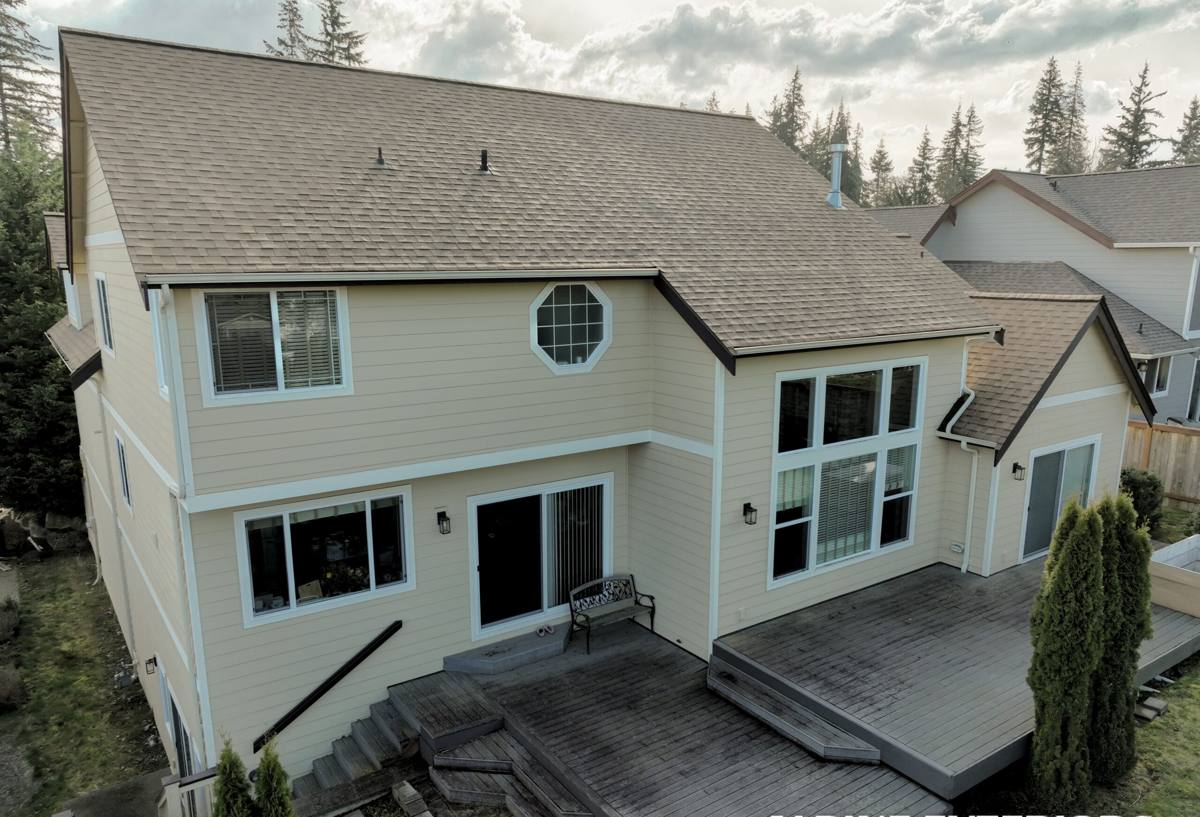
What This Actually Does to a House Over Time
The visible symptoms are usually the last thing to show up, not the first. By the time you can see problems from the sidewalk, moisture has often been working on the wall assembly underneath for a while.
- Paint failure and chalking — driving rain and UV cycle paint faster on exposed elevations, especially west- and south-facing walls that catch weather straight off the water.
- Swelling, delamination, or soft spots — common with wood-based or engineered wood products that absorb moisture at cut edges and butt joints that weren't properly sealed or primed.
- Persistent green or black staining — moss and algae growth on shaded walls, under eaves, and anywhere air doesn't move freely across the siding face.
- Corroded or streaking fasteners — nail heads and trim fasteners that weren't rated for coastal exposure, showing rust bleed down the face of the siding.
- Cupping, warping, or visible gaps at panel edges, a sign the material is moving with moisture more than it should.
None of these are cosmetic-only problems. Each one is a sign that water is getting past the siding's face and reaching the water-resistive barrier, the sheathing, or the framing behind it — and once it's there, it doesn't leave on its own.
Signs It's Time for Replacement, Not Another Repair
Not every issue means a full re-side. A cracked board here, a failed caulk joint there — those can often be repaired. But on a lot of Bellingham homes we look at, the damage is widespread enough, or old enough, that patching just delays a bigger job at a higher cost later.
- Soft or spongy spots when you press on the siding, especially near the bottom courses or under windows
- Siding that's original to a home built more than 20–25 years ago, particularly if it's wood, hardboard, or an older composite product
- Paint that won't hold — you repaint and it fails again within a couple of years
- Visible warping, cupping, or buckling across multiple courses, not just one board
- Moss or staining that returns immediately after cleaning, even in the same season
- Interior signs — musty smell, staining on interior walls near exterior corners, or unexplained drafts
If you're seeing two or more of these, it's worth a professional look before deciding between repair and replacement.
Repair vs. Replace: A Practical Comparison
| Situation | Repair usually makes sense | Replacement usually makes sense |
|---|---|---|
| Extent of damage | Isolated to one or two boards/areas | Spread across multiple elevations |
| Age of siding | Under 15 years, otherwise sound | Original to an older home, or already patched once |
| Moisture behind siding | None found on inspection | Sheathing or framing shows staining or softness |
| Paint/finish condition | Holding well elsewhere on the house | Failing broadly, not just where damage is |
| Product type | Fiber cement with isolated impact damage | Wood, hardboard, or aging composite showing systemic wear |
What a Correct Siding Replacement Job Actually Involves
A siding replacement is only as good as what's underneath it. In a climate like this one, cutting corners on the parts you can't see is exactly how a house ends up with the same problems again in ten years. A correct job on a Bellingham home includes:
Tear-off and inspection
Removing the old siding down to the sheathing and actually looking at what's there — not assuming it's fine. This is when hidden rot, soft sheathing, or old moisture damage gets found and dealt with, not covered over.
Water-resistive barrier and flashing
A properly lapped weather-resistive barrier, correctly integrated flashing at windows, doors, and every penetration, and attention to the details at inside and outside corners — these are the parts of the job that determine whether driving rain stays out or works its way in over the next twenty years.
Rainscreen and drainage plane
In a wet marine climate, giving the wall assembly a way to drain and dry — rather than trapping moisture flat against the sheathing — matters more here than it does in drier parts of the state. This is one of the details that separates a durable install from one that just looks good on install day.
Fastening and material selection
Corrosion-resistant fasteners, correct nailing patterns, and proper gapping at joints so the material can handle normal expansion and contraction without opening seams for water to enter.
Trim, caulking, and finish details
Caulk is a backup, not a strategy. The goal is a wall where flashing and correct laps do the real work of keeping water out, with sealant used only where it's actually appropriate.
Why We Install Only James Hardie Fiber Cement
We don't install vinyl, LP SmartSide, primed wood, or cedar, and it's not because those products have no place anywhere — it's because in this specific climate, with this much rain and salt exposure, we've made a standard for what goes on a house we're putting our name on. Fiber cement doesn't absorb water the way wood-based products do, so it doesn't swell, delaminate, or rot at cut edges the way engineered wood siding can when a joint fails. It's also non-combustible, which matters more every year given wildfire smoke seasons across the Northwest, even in a wetter county like Whatcom.
James Hardie specifically factors climate into its product line — their HZ5 products are engineered for the kind of moisture exposure Pacific Northwest homes see. The factory-applied ColorPlus finish is baked on under controlled conditions, which holds up to UV and rain far longer than a field-applied paint job, and it comes with its own multi-year finish warranty on top of the product warranty. For a house that's going to sit exposed to salt air and winter storms for the next several decades, that's the trade-off we think is worth making.
Our Process for a Bellingham Siding Replacement
- Walk the house — we look at every elevation, not just the side you called about, since moisture and moss damage often show up worse on walls you don't see from the street.
- Assess what's underneath — where existing siding gives us access, we check sheathing condition before quoting, so the estimate reflects reality, not guesswork.
- Written estimate — scope, product, color, and price, explained plainly, with no pressure to decide on the spot.
- Scheduling around the weather — we plan installs for stretches with a real weather window, since siding needs to go on dry and stay dry through the early stages.
- Tear-off, barrier, and install — done to the details above, not just "old siding off, new siding on."
- Final walkthrough — we go over the finished job with you before we consider it done.
Timing: Why the Time of Year Matters Here
Whatcom County's wet season runs long, and moss growth tends to pick up in fall and stay active through spring on shaded elevations. That affects two things: how urgently a failing siding job needs attention, and when installation can happen cleanly. We plan around realistic weather windows rather than rushing a job into a stretch of rain, because siding installed wet or during a poor window is more likely to trap moisture from day one.
Cost Factors for a Bellingham Siding Replacement
Every house is different, so we won't put a number here that doesn't mean anything without seeing your home. What actually moves the price on a real estimate:
| Factor | Why it matters |
|---|---|
| House size and elevation count | More wall area and more corners/details means more material and labor |
| Condition of existing sheathing | Rot or moisture damage found during tear-off adds repair scope |
| Siding profile and color | Lap width, shingle-style panels, and ColorPlus vs. field-painted options price differently |
| Trim and detail work | Corner boards, window trim, and fascia detail add labor time |
| Access and site conditions | Steep lots, tight setbacks, or multi-story walls affect scaffolding and labor |
| Story height | Second- and third-story work requires more equipment and time |
Why Hiring a Crew That Already Works This Area Matters
A crew that installs siding across a range of climates learns to build for the "average" house. A crew that works Bellingham and the surrounding Whatcom County coastline regularly learns to build for this house — the one getting rain off the water, sitting under moss-prone tree cover, dealing with salt in the air most of the year. That shows up in small decisions: how flashing gets lapped at a corner exposed to prevailing wind-driven rain, which elevations get extra attention for moss and algae exposure, and how installation gets scheduled around a wet season that doesn't always cooperate. It's not a different product — it's the same product installed by people who've already seen what this climate does to a house over ten and twenty years, not just on install day.
If your siding is showing wear, or you're just trying to get ahead of it before winter, we're happy to take a look and give you a straight, no-pressure estimate — no obligation, no pushy follow-up. Fill out the form below and we'll get back to you.