 Semiahmoo
 Blaine's Waterfront Exposure Is Not a Typical Siding Environment
Homes in Blaine and along the Semiahmoo waterfront sit in one of the more demanding siding environments in Whatcom County. You've got salt-laden air coming off Semiahmoo Bay and the Strait of Georgia, wind-driven rain that hits walls at an angle instead of falling straight down, and a wet season long enough that moss and algae get a real foothold on anything that stays damp. Any one of those factors is manageable on its own. Together, over years, they wear down the wrong siding materials faster than most homeowners expect.
This page is specifically about installing James Hardie fiber cement siding on Blaine homes — what the local climate demands from a siding system, what correct installation actually involves, and why we only install this one product rather than offering a menu of options.
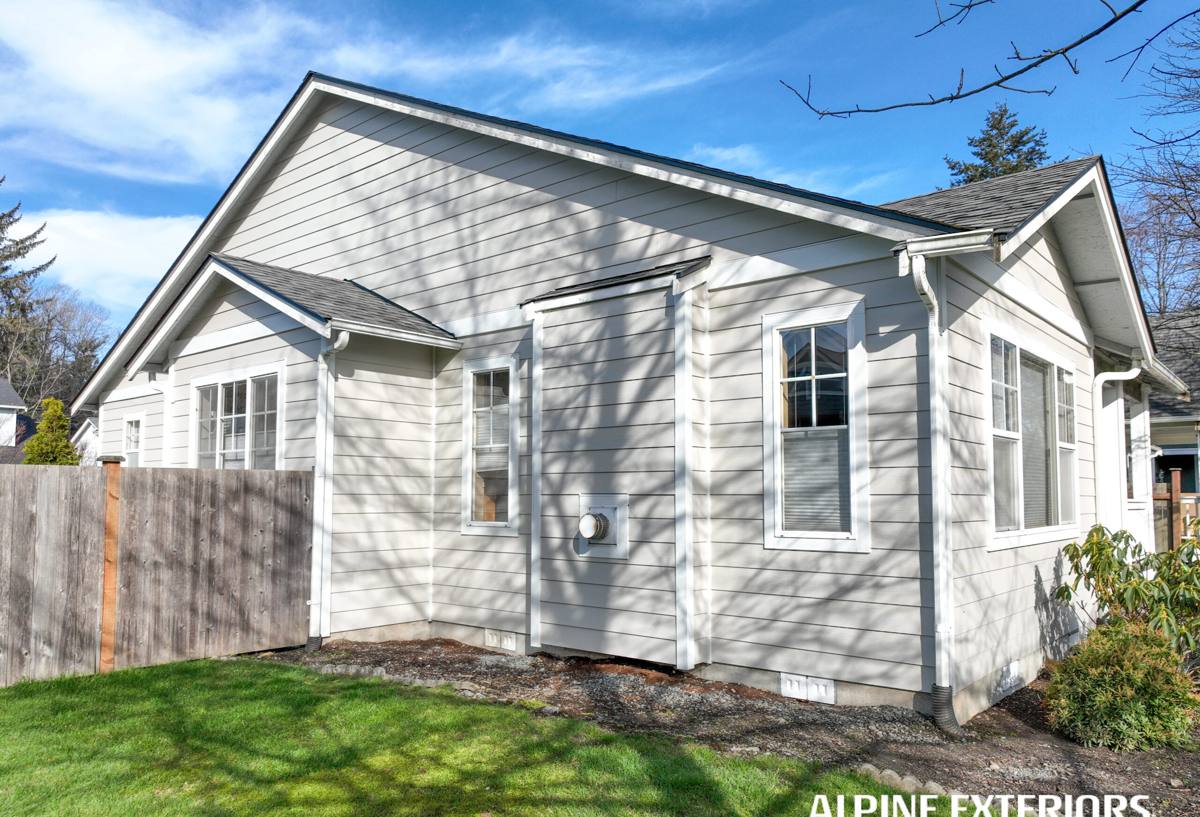
What Salt Air, Driving Rain, and Moss Actually Do to Siding
It helps to understand the failure modes before talking about the fix. In a coastal Whatcom County setting like Blaine, siding doesn't usually fail all at once — it degrades through a few specific, predictable mechanisms:
- Salt air corrosion: Airborne salt accelerates the breakdown of fasteners, trim, and lower-quality coatings, especially on walls facing the water or prevailing wind.
- Wind-driven rain intrusion: Rain that hits siding at an angle finds its way into laps, seams, and butt joints far more aggressively than vertical rainfall. Any gap in flashing or caulking becomes an entry point.
- Sustained dampness and moss growth: Shaded north walls and areas under tree cover stay damp for extended stretches. Moss and algae hold moisture against the siding surface, which is hard on any material that isn't dimensionally stable when wet.
- UV and coating fatigue: Even on a cloudy Pacific Northwest schedule, UV exposure over years breaks down paint film, especially on south and west-facing elevations.
None of these are exotic problems — they're the normal, cumulative conditions of living near Semiahmoo Bay. The question for a homeowner isn't whether their siding will face this exposure, it's whether the material and the installation are built to handle it.
Why We Install Only James Hardie in This Climate
We standardized on James Hardie fiber cement siding for every job we take on, including Blaine's waterfront and near-waterfront properties, for reasons specific to this climate:
It's non-combustible. Fiber cement doesn't feed a fire the way some other claddings can, which matters for insurance conversations and peace of mind regardless of where you sit in Whatcom County.
It's dimensionally stable when wet. Fiber cement doesn't swell, cup, or warp the way wood-based products can when they take on moisture from driving rain or prolonged damp shade. That stability is exactly what a moss-prone, rain-heavy environment rewards.
James Hardie engineers for specific climate zones. Their HZ5 product line is formulated for regions with harsher moisture and freeze-thaw cycling exposure, which fits the Pacific Northwest better than a generic, one-size-fits-all board.
The ColorPlus factory finish holds up to UV and salt air better than field-applied paint. Because the color coat is baked on at the factory under controlled conditions, it resists fading and chipping longer than paint applied on-site after installation — a real advantage when a wall faces the bay directly.
The ColorPlus Finish Advantage in a Marine Setting
It's worth spending a moment on why the factory finish matters more here than it might in a drier inland climate. Field-applied paint on siding depends heavily on weather conditions during application, the quality of the primer, and the substrate underneath. In a marine environment, salt residue and moisture in the air make it harder to get a durable bond with site-applied coatings, and touch-ups rarely match perfectly over time.
ColorPlus finishes are applied and cured in a factory setting before the boards ever reach the jobsite, which gives a more consistent, harder finish than most site-applied paint jobs achieve. It's backed by its own finish warranty separate from the substrate warranty, covering fading and peeling under normal conditions. For a Blaine home taking direct salt air and UV on exposed elevations, that's a meaningful difference over a 15-20 year horizon, not just a color-matching convenience.
What a Correct James Hardie Installation Involves
The product only performs as designed if the installation follows James Hardie's specifications exactly. This is where a lot of the real-world performance difference actually comes from — the material is only half the equation.
| Installation Element | Why It Matters in Blaine's Climate |
|---|---|
| Correct nail placement and fastening pattern | Over- or under-driven fasteners create gaps where wind-driven rain can work its way behind the siding |
| Proper water-resistive barrier and flashing details | The siding is one layer of a system; flashing at windows, doors, and penetrations is what actually stops driving rain from reaching sheathing |
| Correct clearance from grade, decks, and roof lines | Standing water and splash-back are common near the bay; clearance gaps prevent constant wicking at the base of the wall |
| Caulking only where specified (not over-caulking) | Hardie's lap siding is designed to shed water at the laps; over-sealing traps moisture instead of letting it drain |
| Field-cut edge sealing | Any cut edge exposes raw fiber cement; sealing it protects against moisture uptake at seams and corners |
Every one of these details is spelled out in James Hardie's installation manual, and every one of them is also the kind of thing that's easy to skip on a rushed job. On a Blaine property facing the water, a skipped detail doesn't show up as a problem in year one — it shows up as trapped moisture, premature caulk failure, or moss creeping into a joint a few years down the line.
Our Process, Start to Finish
- On-site assessment. We look at your home's specific exposure — which walls face the water or prevailing wind, where moss or moisture staining already shows, and the condition of the sheathing and trim underneath the existing siding.
- Product and color selection. We walk through Hardie's plank profiles, panel options, and ColorPlus palette so the finished look fits the home and the neighborhood.
- Written estimate. A clear scope covering removal, any sheathing repair found once old siding comes off, materials, and installation — no vague allowances.
- Tear-off and inspection. Removing the old siding is when hidden moisture damage gets found. We flag it before covering anything back up.
- Water-resistive barrier and flashing. This layer goes in before a single piece of Hardie board is hung, and it's the part of the job you won't see again once it's done right.
- Installation to James Hardie spec. Fastening, clearances, and joint treatment follow the manufacturer's requirements, not shortcuts.
- Final walkthrough. We go over the finished job with you directly, including care and maintenance basics for the first year.
Cost Factors for a Blaine James Hardie Project
Every home is different, so we won't quote a number without seeing the property, but these are the main variables that move a Blaine job's cost up or down:
| Factor | How It Affects the Project |
|---|---|
| Existing siding removal and disposal | Tear-off of old material, especially multiple layers, adds labor and disposal cost |
| Sheathing or framing repair | Moisture damage found during tear-off (more common on water-facing walls) requires repair before new siding goes on |
| Home size and wall complexity | Dormers, multiple gables, and cut-up wall lines take more labor per square foot than simple rectangular walls |
| Product line and profile | HZ5 boards, panel styles, and trim selections vary in material cost |
| Access and site conditions | Waterfront lots with limited staging space or steep grades can add time to the job |
The honest range for a full siding replacement on a typical home spans widely based on these factors — which is exactly why we do an in-person estimate rather than a phone quote.
Maintenance Checklist for Hardie Siding in Blaine's Climate
James Hardie siding is low-maintenance compared to wood or vinyl, but "low-maintenance" isn't "no-maintenance," especially this close to the water. A simple annual routine keeps it performing as designed:
- Rinse salt residue and grime off exterior walls once or twice a year, especially on water-facing elevations
- Check caulking at trim, windows, and corners annually for cracking or separation
- Watch shaded, damp-prone areas for early moss or algae growth and clean it before it spreads
- Keep gutters clear so overflow doesn't run down and pool against the siding base
- Trim back vegetation that keeps a wall shaded and damp longer than the rest of the house
- Inspect the base clearance near grade, decks, and patios to make sure it hasn't been reduced by landscaping changes over time
Why Hiring a Crew That Already Works Blaine Matters
Installation quality is the single biggest variable in how James Hardie siding performs over its lifespan, and that quality depends on a crew that understands the specific exposure Blaine and Semiahmoo waterfront homes deal with. A crew that mostly works drier, inland conditions may not weight flashing details, fastener corrosion resistance, or grade clearance the same way — because their typical jobs don't punish those shortcuts as quickly.
Working in Whatcom County's coastal areas regularly means we've seen where salt air and driving rain actually cause problems on real homes, not just in a manual. That shows up in the details: how flashing gets lapped at a window facing the water, how much clearance gets left at grade on a low-lying lot, and where moss-prone shaded walls get extra attention during installation rather than being treated the same as every other elevation.
Ready for a Straightforward Estimate
If your Blaine home's siding is showing salt staining, moss, cracked caulking, or you're simply planning ahead for a replacement, we're happy to come take a look. The estimate is free, there's no pressure, and you'll get a clear, written scope of what your home actually needs — use the form below to get started.