 Semiahmoo
 Decking in Laurel Has to Answer to the Weather First
Laurel sits inland enough from Semiahmoo Bay to avoid direct surf spray, but not far enough to escape what that salt air carries on the wind. Add Whatcom County's driving rain and a moss season that can stretch from October well into April, and you've got a climate that's hard on any outdoor surface — decks included. A composite deck built for a dry inland climate and one built for a Laurel backyard are not the same project, even if the boards look identical in a showroom.
Most of the deck problems we get called out to fix in this area aren't material failures. They're installation choices that ignored the local conditions: framing that couldn't drain, boards laid tight against a house wall with no airflow, or hardware that wasn't rated for a marine-influenced environment. Composite decking is genuinely low-maintenance compared to wood, but "low-maintenance" only holds true if the substructure and installation details were done right for where the deck actually sits.
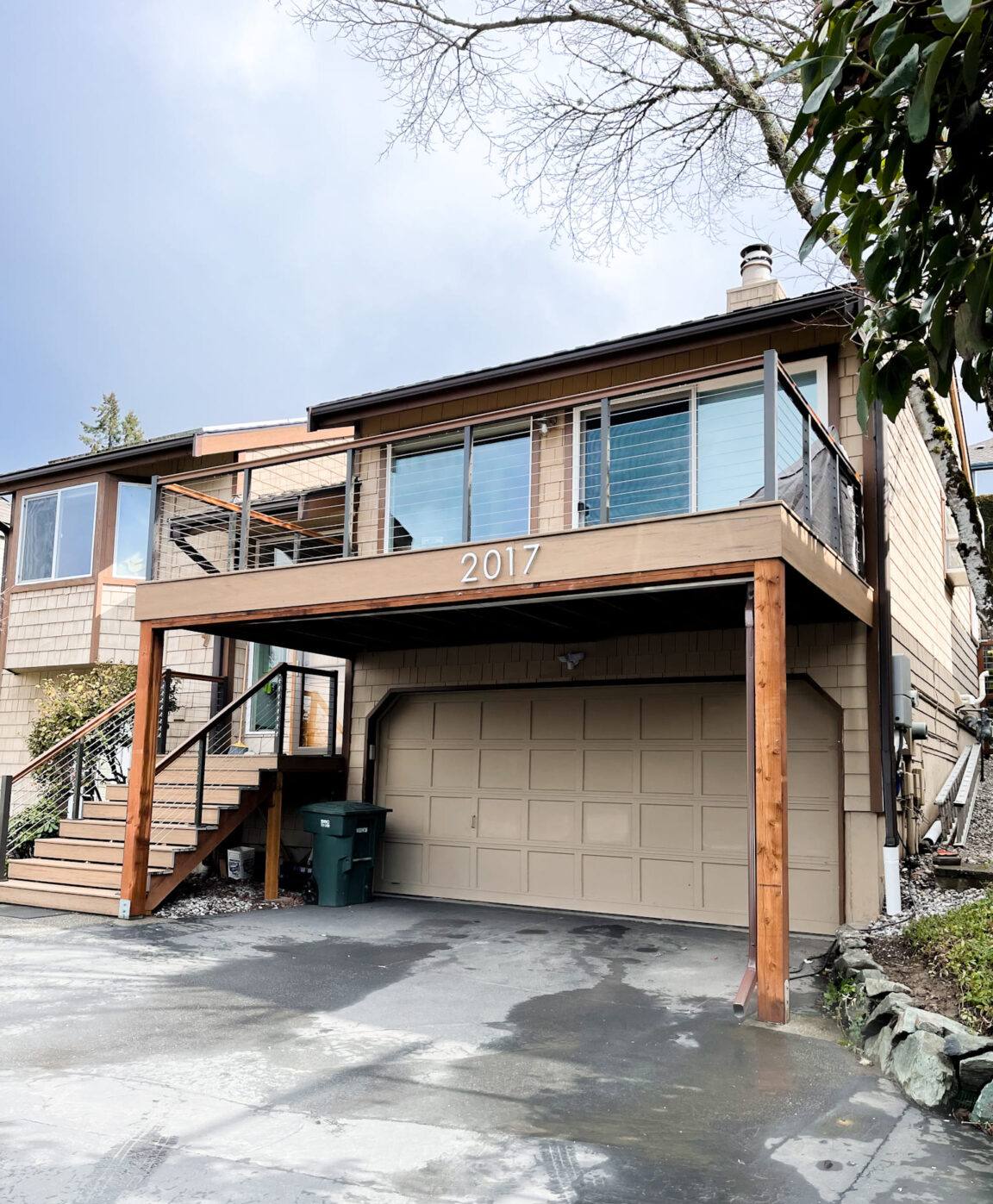
What Salt Air, Rain, and Moss Actually Do to a Deck
Salt Air
Airborne salt doesn't rot composite boards the way it can degrade untreated metal, but it does accelerate corrosion on fasteners, joist hangers, and railing hardware. A deck built with standard-grade hardware in a salt-influenced zone will show rust bleed and hardware failure years before a deck built with marine-grade or coated fasteners.
Driving Rain
Whatcom County rain rarely falls straight down — wind pushes it sideways into ledger boards, fascia, and the gap where decking meets the house. If flashing and drainage details are skipped or done poorly, water tracks behind the deck and into the wall assembly, which is a much more expensive problem than the deck itself.
Moss Season
Extended damp, low-light stretches let moss and algae take hold on any horizontal surface that doesn't get airflow or sun. Composite surfaces resist rot, but a slick moss film on a walking surface is a slip hazard, and moss holding moisture against a board's edge over months is exactly the kind of exposure composite manufacturers warn against.
What a Correct Composite Deck Build Involves
A composite deck is only as good as what's underneath it. The board is the visible 10%; the other 90% is framing, drainage, and fastening — and it's the part that's hardest to inspect once the project is "done."
- Joists spaced and sized to the manufacturer's span tables for the specific board profile being used — composite often needs tighter spacing than dimensional lumber framing would suggest
- Joist tape or a flashing membrane on top of every joist to keep fastener penetrations from becoming water entry points
- A ledger connection that's properly flashed and, where the deck attaches to the house, engineered for positive drainage away from the wall
- Fasteners and hardware rated for coastal/marine exposure, not general-purpose hardware
- Deck board gapping set for the local humidity range so boards aren't installed too tight in wet season and too loose in a dry stretch
- Ventilation under the deck — skirting or fascia that allows airflow rather than sealing the substructure into a damp, dark cavity
Skip any one of these and the composite board itself can outlast the structure holding it up.
Choosing a Board for This Climate
Not every composite product is built the same way, and the differences matter more in a wet, salt-influenced climate than they would somewhere dry. We look at moisture absorption rate, whether the board is fully capped (a protective shell on all sides) or only capped on the top face, and how the manufacturer's warranty treats staining and mold — because in this climate, that warranty language gets tested.
| Board Type | Moisture Behavior | Typical Trade-Off |
|---|---|---|
| Fully capped composite | Best resistance to moisture absorption and surface staining | Higher upfront material cost |
| Top-capped only composite | Good surface protection, but cut ends and the underside can absorb moisture over time | Requires diligent end-cap sealing at every cut |
| Uncapped composite | Absorbs moisture more readily; more prone to mold/mildew in extended wet seasons | Lower cost, but higher long-term maintenance in this climate |
| PVC/polymer decking | Effectively moisture-proof; very stable | Different look and feel than wood-composite blends; higher cost tier |
Our standard for Laurel installs is fully capped composite with sealed end cuts as a baseline, because the labor to install a lesser board correctly is nearly identical — the material is where the real difference in long-term performance shows up.
How We Approach a Composite Deck Project in Laurel
- Site visit and assessment — we look at drainage slope, sun exposure, proximity to grade, and how the deck will tie into the house before ever discussing board selection.
- Framing plan — span, joist spacing, and ledger flashing are specified to match the board and the site, not a generic template.
- Substructure build — framing, flashing, and joist protection go in first, with drainage checked before a single deck board is fastened down.
- Board installation — hidden or face fastening per manufacturer spec, correct gapping for the season, and sealed cuts at every board end.
- Railing and finish details — hardware selected for coastal exposure, fascia and skirting installed to allow ventilation rather than trap moisture.
- Final walkthrough — we go over drainage, maintenance expectations, and what the warranty on the board actually covers before we consider the job finished.
Mistakes We Commonly Find on Older Laurel Decks
When we're called to inspect or repair an existing deck in the area, the same handful of issues show up repeatedly:
- No joist tape or flashing, leading to rot in the framing underneath a perfectly fine-looking composite surface
- Skirting installed tight to the ground with no ventilation gaps, trapping moisture and encouraging mold underneath
- Standard (non-coated) screws and hangers showing rust streaks and early failure
- Boards butted tight with no expansion gap, causing buckling during temperature and moisture swings
- Ledger boards attached to the house without proper flashing, allowing water to migrate into the wall assembly over time
Every one of these is invisible from a normal walk-through and only shows up once there's a soft spot, a stain, or a structural issue. That's the argument for getting the substructure right the first time rather than treating it as the cheap, hidden part of the job.
Living With a Composite Deck Through a Whatcom County Winter
Composite decking cuts maintenance dramatically compared to wood, but "no maintenance" isn't accurate in this climate. A little seasonal attention keeps a correctly built deck performing the way it should for decades.
- Sweep and rinse debris out of board gaps before fall rains start — trapped leaves and needles hold moisture against the board
- Scrub visible moss or algae film with a soft brush and a composite-safe cleaner rather than a pressure washer set too aggressively, which can damage the cap layer
- Check that skirting and under-deck vents aren't blocked by landscaping, mulch, or stored items
- Inspect railing hardware annually for early rust bleed, especially on decks with a clearer line of sight to the water
- Confirm gutters and downspouts near the deck are directing water away rather than onto the deck surface or ledger connection
What Composite Decking Costs in Laurel
Every deck is different, but the factors that move the price are consistent. We'd rather walk through these honestly than quote a number with no context behind it.
| Cost Factor | Why It Matters |
|---|---|
| Deck size and shape | Square footage and complexity of cuts (angles, curves) both drive labor time |
| Framing condition | New build vs. reusing/repairing existing framing changes scope significantly |
| Board tier | Fully capped and PVC/polymer boards cost more upfront but reduce long-term maintenance in this climate |
| Height and access | Elevated decks need engineered footings, railing, and sometimes stairs |
| Ledger and flashing work | Proper waterproofing where the deck meets the house adds labor but protects the structure |
| Permit requirements | Whatcom County permitting depends on deck height, attachment, and size |
Broad ranges for composite decks run from a modest platform deck on simple framing up through a large, elevated deck with premium boards and full railing systems — the honest answer is that we can't give a real number without seeing the site, and we'd rather look first than guess.
Why a Crew That Already Works in This Area Matters
A contractor who works Whatcom County regularly already knows which board tiers hold up to the local moisture cycle, what hardware avoids early corrosion near the water, and how Laurel's drainage and grading tend to run. That's not something you can fully substitute with a spec sheet — it comes from having built and later serviced decks in these exact conditions. It also means when a warranty question or a maintenance question comes up two years down the road, there's a local crew that remembers the job and can actually show up.
If you're planning a new composite deck or replacing an aging one in Laurel, we're happy to take a look and talk through what the site actually needs — no pressure, no upsell script. Reach out for a free estimate using the form below.