 Semiahmoo
 Windows Built for the Peace Arch Climate, Not Just the Peace Arch Address
Homes in the Peace Arch area sit close enough to Semiahmoo Bay and the Strait of Georgia that salt-laden air is a daily fact of life, not an occasional nuisance. Add Whatcom County's long wet season, driving rain that comes in sideways off the water, and months of low light and moss growth, and you have one of the harder climates in the state for exterior wood, metal, and glazing. Windows take the brunt of it. They're the weak point in any wall assembly — the place where siding, flashing, framing, and glass all have to work together, and where a shortcut installer's mistakes show up first as a stuck sash, then as a soft sill, then as rot behind the trim.
"Custom" windows, in this context, doesn't mean fancy shapes or expensive glass for its own sake. It means windows sized, specified, and installed for the specific wall, exposure, and weather load of a Peace Arch home — not a stock size pulled off a truck and shimmed to fit.
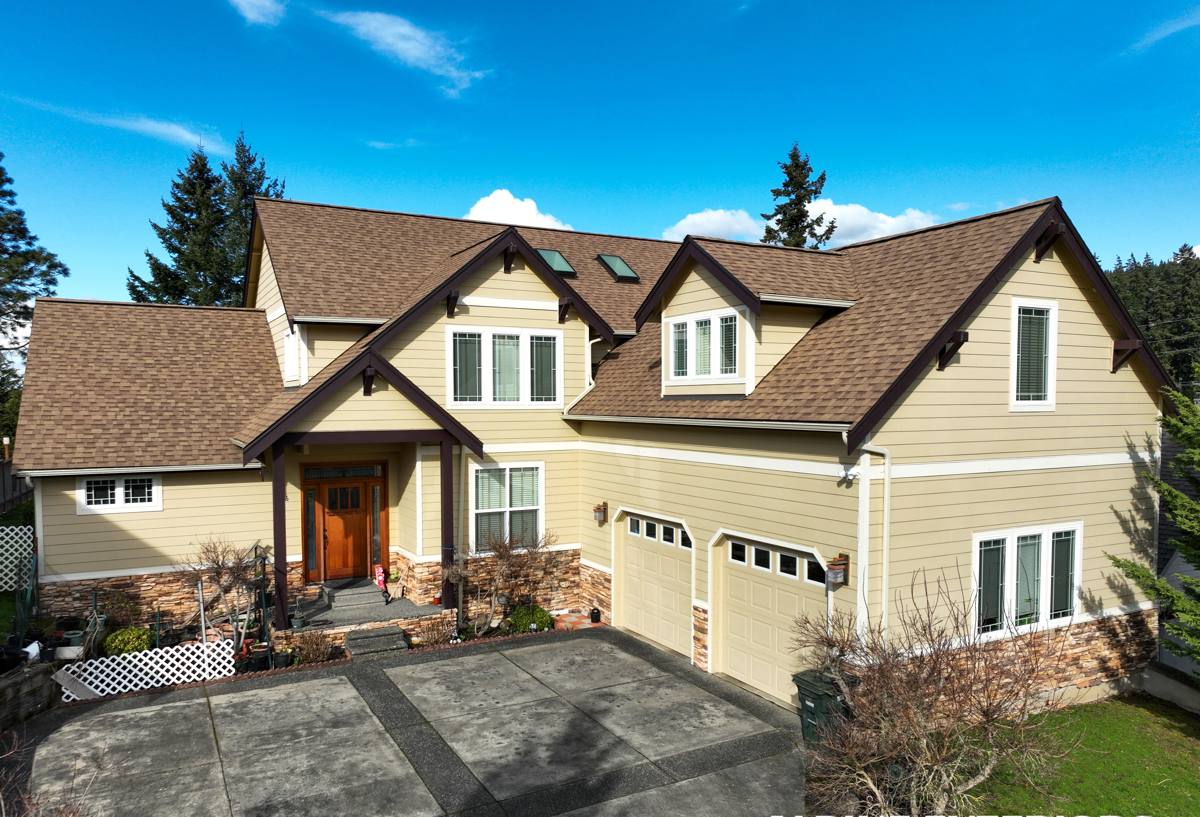
What Salt Air, Driving Rain, and Moss Season Actually Do to a Window
Salt Air
Airborne salt accelerates corrosion on anything metal — hinges, balance systems, screen frames, and especially lower-grade aluminum cladding or hardware. It also breaks down cheap finishes faster than inland exposure would, leaving pitted or chalky surfaces around locks and cranks years before a comparable window would show wear further from the water.
Driving Rain
Wind-driven rain doesn't just fall on a window, it gets pushed sideways into every gap, lap, and fastener hole. A window that's watertight in a light, straight-down rain can still leak in a Whatcom County southwester if the flashing details around it were never built for wind-driven exposure. Most water damage we find at windows isn't glass failure — it's water finding a path around the frame through poor flashing or a caulk joint standing in for real flashing.
Moss Season
Shaded, north-facing, and tree-adjacent walls in this area grow moss on horizontal surfaces for a good part of the year. On windows, that means sills, exterior stops, and the top of trim boards. Moss holds moisture against wood and painted surfaces far longer than the surface would otherwise stay wet, which is exactly the condition that starts rot and finish failure.
Frame Materials: What Holds Up Here and What Doesn't
We install a mix of materials depending on the home, budget, and exposure. None of them are maintenance-free in this climate — but some ask a lot less of the homeowner than others.
| Material | How It Handles Salt Air & Rain | Upkeep in This Climate |
|---|---|---|
| Vinyl | Won't corrode; quality varies a lot between grades | Low — occasional wash, check weep holes for debris |
| Fiberglass | Very stable dimensionally, resists moisture and salt well | Low — durable finish, minimal attention needed |
| Aluminum-clad wood | Good weather face, but clad seams and fasteners need correct detailing near salt exposure | Moderate — interior wood still needs normal upkeep |
| Painted wood | Handles rain fine if finish is maintained; salt air shortens repaint intervals | Highest — repainting and sealant checks on a regular cycle |
For homes closer to the water or in more exposed spots, we generally steer clients toward vinyl or fiberglass for the lower long-term maintenance burden. Where a wood look is important to the home's style, aluminum-clad wood is a reasonable middle ground — the trade-off is that the cladding seams and any exposed end grain need to be detailed correctly at installation, because that's where problems start if they're rushed.
Why the Window-Siding Connection Matters More Than the Window Itself
A high-end window installed with poor flashing will leak. A mid-grade window installed correctly, integrated properly with the siding, building paper, and sill pan, will usually outperform it. This is the part of the job that doesn't show up in a showroom and doesn't get discussed enough:
- A sloped sill pan under every window opening, so any water that gets past the frame drains back out instead of sitting on the sill
- Flashing tape or metal flashing that laps correctly with the water-resistive barrier — over at the top, under at the sides and bottom, following the same shingle-lap logic as the siding itself
- Head flashing or a drip cap sized to actually shed water past the window, not just sit decoratively above it
- Proper shimming and fastening so the frame stays square and the sash operates smoothly for years, not just on install day
- Sealant used as a backup to good flashing, never as the only line of defense against water
Because we do siding work throughout Semiahmoo and the wider Whatcom County area, window replacement isn't a separate trade bolted onto our schedule — it's part of the same wall assembly we already work with daily. That matters when a window opening needs new flashing, when siding has to be cut back and re-lapped around a new frame, or when trim needs to be rebuilt to shed water correctly. A window-only company that doesn't also do siding is often working around the existing siding rather than properly integrating with it.
Signs Your Current Windows Are Losing the Fight
Most window failure in this climate is gradual. Homeowners usually notice one or two of these before realizing the whole opening needs attention:
- Fogging or moisture between panes — a failed seal on double- or triple-glazed units
- Soft or spongy trim, sills, or the wall surface just below a window
- Paint or finish that's bubbling, peeling, or chalky specifically around window openings compared to the rest of the wall
- Moss or dark staining building up on sills or horizontal trim faster than elsewhere on the house
- Windows that stick, won't stay open, or let in a draft even when latched
- Visible corrosion on hardware, hinges, or screen frames
- Interior condensation on cold mornings that wasn't there a few years ago
Any one of these on its own might just mean the window needs attention. Several together, especially around the same opening, usually mean water has been getting behind the frame for a while.
How We Approach a Custom Window Job in Peace Arch
1. On-Site Assessment
We look at each opening individually — exposure to prevailing wind and rain, current flashing condition, any sign of hidden water damage, and how the window ties into the existing siding. Not every window on a house has the same problems or needs the same fix.
2. Honest Options, Not a Single Upsell
We'll tell you plainly when a window can be repaired versus when replacement is the better long-term value, and we'll explain material and glazing trade-offs in terms of this climate specifically, not generic sales language.
3. Correct Removal and Opening Prep
Old sealant, damaged sheathing, and compromised flashing get addressed before a new window ever goes in. Installing a new window into a bad opening just moves the same failure to a new frame.
4. Installation With Full Flashing Integration
Sill pan, side and head flashing, and re-lapped siding around the new opening — done in the sequence that actually sheds water, not just what's fastest.
5. Finish and Walkthrough
Trim, caulking, and touch-up siding work finished to match the surrounding wall, with a walkthrough so you understand what was done and what maintenance, if any, it'll need.
Cost Factors for Custom Windows in This Area
Every home and opening is different, but the factors that most often move the price on a Peace Arch window job are:
| Factor | Why It Matters |
|---|---|
| Frame material chosen | Vinyl is typically the most budget-friendly; fiberglass and clad-wood cost more up front but ask less maintenance over time |
| Condition of the existing opening | Rot or hidden water damage found during removal adds repair scope before the new window can go in |
| Siding integration needed | How much surrounding siding has to be cut back, re-flashed, and matched affects labor time |
| Window size and configuration | Larger units, custom shapes, or multi-unit combinations cost more than standard single openings |
| Glazing package | Upgraded low-E coatings or gas fills add cost but improve comfort and condensation resistance in our wet, cool climate |
We provide a written estimate that breaks these out so you can see where the cost is actually going, rather than a single lump number.
Maintaining Custom Windows Through a Whatcom County Winter
Even a correctly installed window in this climate benefits from a bit of seasonal attention. A short annual routine goes a long way:
- Clear moss and debris from sills and tracks before it holds moisture through the wet months
- Check weep holes on vinyl and clad frames so they can still drain
- Rinse salt residue off frames and hardware a few times a year, especially on wind-exposed walls
- Inspect exterior caulk lines each fall and touch up before winter rains set in
- Operate every window a few times a season so hardware doesn't seize from disuse
- Watch for early signs of trim or sill softness and address it before it spreads
Why Local Experience in This Area Matters
Semiahmoo and the Peace Arch area — right up against the border crossing and the water — see a specific combination of exposure that inland Whatcom County homes don't deal with in the same way. A crew that installs windows here regularly already knows which walls take the worst of the driving rain, how fast moss builds up on north-facing sills, and how much salt exposure changes the maintenance conversation before the first estimate is even written. That's the kind of judgment that only comes from doing the work in this specific area, season after season, not from a general window install checklist applied the same way everywhere.
If your windows are showing their age, or you're planning a siding project and want the window openings done right the first time, we're happy to take a look and give you a straightforward, no-pressure estimate using the form below.