 Semiahmoo
 Ferndale's Climate Puts Real Demands on Exterior Siding
Ferndale sits close enough to Semiahmoo Bay and the Strait of Georgia that salt-laden air reaches home exteriors year-round, and the broader Whatcom County weather pattern layers driving rain and a long wet season on top of that. Add the mild, damp winters that keep moss and algae active for most of the year, and you get a climate that wears on siding quietly rather than dramatically — not through one bad storm, but through months of sustained moisture exposure. Paint chalks and fades faster near the coast, laps and seams that weren't detailed correctly start holding water instead of shedding it, and any weak point in a siding system's moisture resistance tends to show up within a few wet seasons, not decades.
Homes here don't just need siding that survives a hard rain. They need a material and an installation built to handle sustained dampness, resist the organic growth that thrives in shade and moisture, and hold a factory finish despite salt air working on the surface year after year. That's the bar every Ferndale job gets held to.
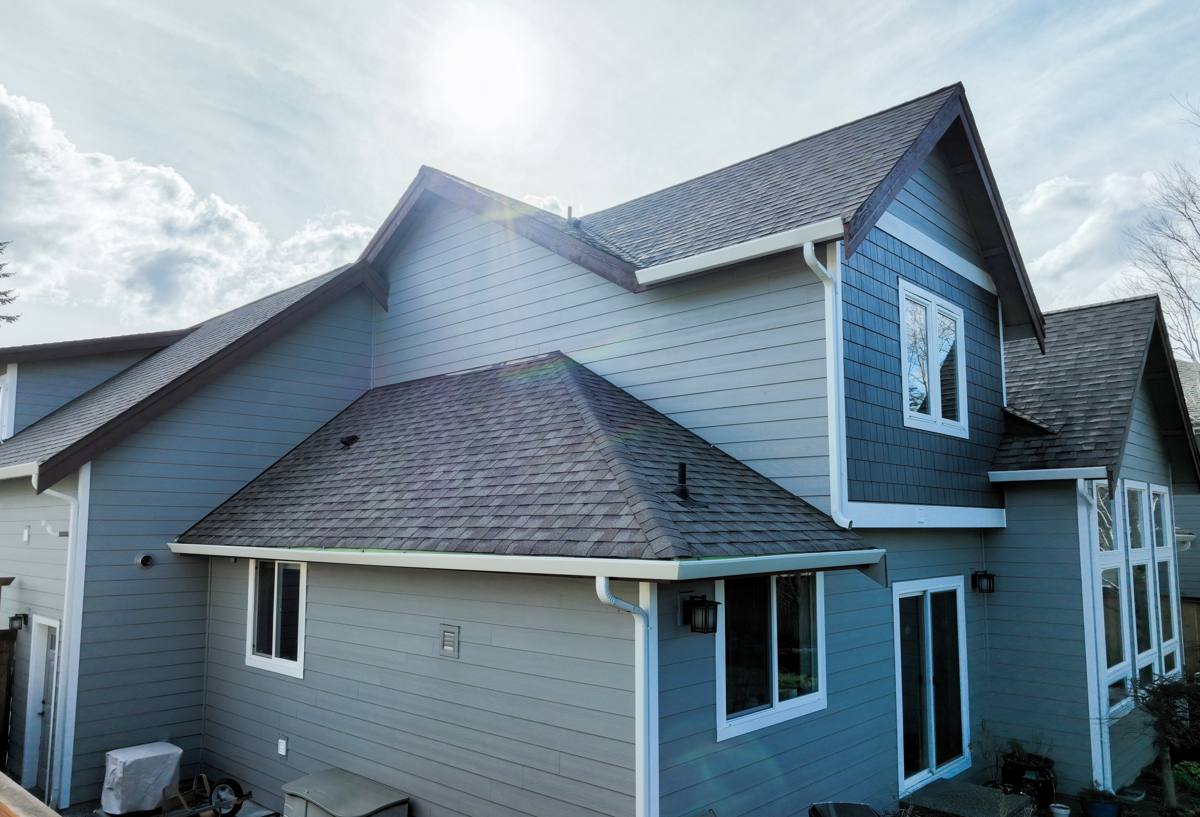
Why We Install Only James Hardie Fiber Cement Siding in Ferndale
We don't install vinyl, LP SmartSide, primed wood, cedar, or other fiber cement brands. That's a standard we apply everywhere we work, and it holds up especially well against Ferndale's climate specifically.
Non-Combustible and Dimensionally Stable
Fiber cement is cement, sand, and cellulose fiber — it doesn't burn, and it doesn't expand and contract with moisture the way wood-based products do. In a climate where siding stays damp for long stretches of the year, that dimensional stability matters: it's what keeps joints tight and paint from cracking along seams season after season.
A Finish Engineered to Handle the Coast
James Hardie's ColorPlus factory finish is baked on in a controlled environment rather than field-applied, which gives it better adhesion and more consistent coverage than a job-site paint job. Along the coast, where salt air and UV exposure both accelerate finish breakdown, that factory-cured finish is what keeps a home's color from chalking or fading unevenly within the first few years.
Built for This Climate Zone
James Hardie makes regional product formulations, and Western Washington falls into their wetter, colder climate zone rather than the hot, humid zone used in the Southeast. Homes here get the version of the product engineered around sustained rain and freeze-thaw cycles, not the version built for hurricane and heat exposure. That distinction is part of why we standardized on Hardie rather than a generic fiber cement product.
What a Correct Fiber Cement Installation Actually Requires
Fiber cement siding is only as good as the installation behind it. Most of the problems we see on older homes here didn't come from bad siding material — they came from shortcuts in the details that matter most in a wet climate.
Wall Prep and Weather-Resistive Barrier
Before a single plank goes up, the wall needs a continuous weather-resistive barrier with properly lapped and taped seams, and any rot or soft sheathing from the old siding needs to be found and repaired. Installing new siding over a compromised wall just hides the problem — it doesn't solve it, and in this climate it gets worse fast.
Flashing and Clearances
Every window, door, and roofline intersection needs flashing detailed to shed water outward, not into the wall assembly. Butt joints and inside corners need proper flashing behind them, and siding needs to maintain clearance from grade, roof lines, and decks — Hardie specifies minimum gaps for a reason, and closing them up to save a step is one of the most common causes of moisture damage we find.
Fastening and Joint Treatment
Fasteners need to hit framing at the correct spacing and depth — overdriven nails crack the board's edge and create a path for water. Butt joints should be caulked with a high-quality, paintable sealant or shadow-lined per Hardie's details, not just butted tight and left to gap as the building settles.
Field-Touch Painting
Any cut edge exposed during installation needs to be sealed and touched up with the correct paint system so the factory finish's protection isn't compromised at every trim line and corner — a detail that's easy to skip and easy to see the consequences of two winters later.
| Material | Behavior in Salt Air & Sustained Rain | Moss/Algae Resistance | Long-Term Finish |
|---|---|---|---|
| James Hardie Fiber Cement | Dimensionally stable; doesn't rot or swell with moisture | Resists surface growth better than porous wood | Factory-cured ColorPlus finish holds color for years |
| Vinyl | Can warp or become brittle with UV and temperature swings | Grime and algae show on textured surfaces | Color is baked into the material but can chalk and fade |
| Primed Wood / Cedar | Absorbs moisture; prone to swelling, rot, and paint failure in sustained damp conditions | Organic material is a natural food source for moss and mildew | Requires repainting on a recurring cycle |
| LP SmartSide | Engineered wood strand product; performs better than raw wood but still wood-based and moisture-sensitive at cut edges | Better than untreated wood, still organic substrate | Factory finish available but on a wood substrate |
Our Ferndale Installation Process
We run the same process on every fiber cement job in this area, adjusted for what we find once the old siding comes off.
- On-site assessment of existing siding, trim, and sheathing condition before any work is quoted
- Removal of old siding and inspection of the wall assembly underneath for rot or moisture damage
- Repair of any compromised sheathing or framing before new material goes up — never covered over
- Installation of a continuous weather-resistive barrier with correctly lapped and sealed seams
- Flashing installed at every window, door, and penetration to direct water outward
- James Hardie fiber cement installed to manufacturer fastening and clearance specifications
- Joint sealing and field touch-up painting on all cut edges and corners
- Final walk-through so the homeowner can see the finished work before we consider the job done
We don't skip the tear-off and inspection step even when the existing siding looks fine from the outside, because in this climate the damage that matters is usually behind the surface, not on it.
What Fiber Cement Siding Typically Costs in Ferndale
Every home is different, and an accurate number only comes from seeing the house, but a few factors consistently move the price on jobs in this area.
| Cost Factor | Why It Matters Here |
|---|---|
| Condition of existing sheathing | Homes with hidden moisture damage from prior siding need repair before installation, which adds labor |
| Home size and wall complexity | More corners, dormers, and trim details mean more cutting, flashing, and finish work |
| Siding profile and accessories | Lap width, trim boards, and soffit or fascia work all factor into total material cost |
| Access and site conditions | Tight lots, mature landscaping, or multi-story walls affect equipment and labor time |
| Color and finish selection | Factory ColorPlus finishes and premium color choices carry different material pricing |
We give homeowners a real number after walking the property, not a phone estimate — in a climate where hidden moisture damage is common, guessing at scope from a photo does nobody any favors.
Moss, Algae, and Long-Term Care in a Wet Climate
Even the right material needs a little upkeep in a climate this wet. Moss and algae growth on siding is mostly a maintenance issue, not a material defect — it shows up wherever shade, moisture, and dirt buildup combine, which describes a lot of north-facing walls and areas under tree cover around Ferndale. A rinse with a garden hose and soft brush once or twice a year, keeping gutters clear so water isn't sheeting down the wall, and trimming back vegetation that keeps siding shaded and damp will keep fiber cement looking like new for a long time. Because the ColorPlus finish is factory-cured into the board rather than surface-applied, it holds up to this kind of routine cleaning far better than a field-painted surface would.
Why a Crew That Already Works Ferndale Matters
Installation quality is what actually determines how siding performs here — the product only gets you halfway. A crew that regularly works in Ferndale and the surrounding Whatcom County coastline already knows which walls take the worst weather exposure, where moisture tends to hide behind older siding, and how to detail flashing and clearances so the work holds up through a full wet season, not just until the first inspection. That local pattern recognition is the difference between a siding job that looks good on installation day and one that still looks good in five winters.
If you're considering fiber cement siding for a home in Ferndale, we're happy to take a look and give you a straightforward, no-pressure estimate — just fill out the form below.