 Semiahmoo
 Why Bellingham Homes Need Siding Built for This Climate
Bellingham sits close enough to the water that salt air is a daily fact of life for a lot of homes here, not an occasional nuisance. Add Whatcom County's long, wet winters — driving rain that comes in sideways off Puget Sound and the Strait of Georgia — and a moss season that can run eight or nine months out of the year on shaded, north-facing walls, and you have one of the tougher environments in the country for exterior siding. Products that hold up fine in a dry climate, or even in a milder coastal market, can start showing problems here in a handful of years: swelling at the seams, paint failure, soft spots at the bottom courses, moss and algae staining that never fully rinses off.
We install James Hardie fiber cement siding exclusively, and we do it because it is engineered for exactly this kind of exposure. This page is specifically about what that means for a Bellingham home — what the climate does to siding here, what a correct James Hardie installation involves, and how our process is built around the realities of this area rather than a generic national install.
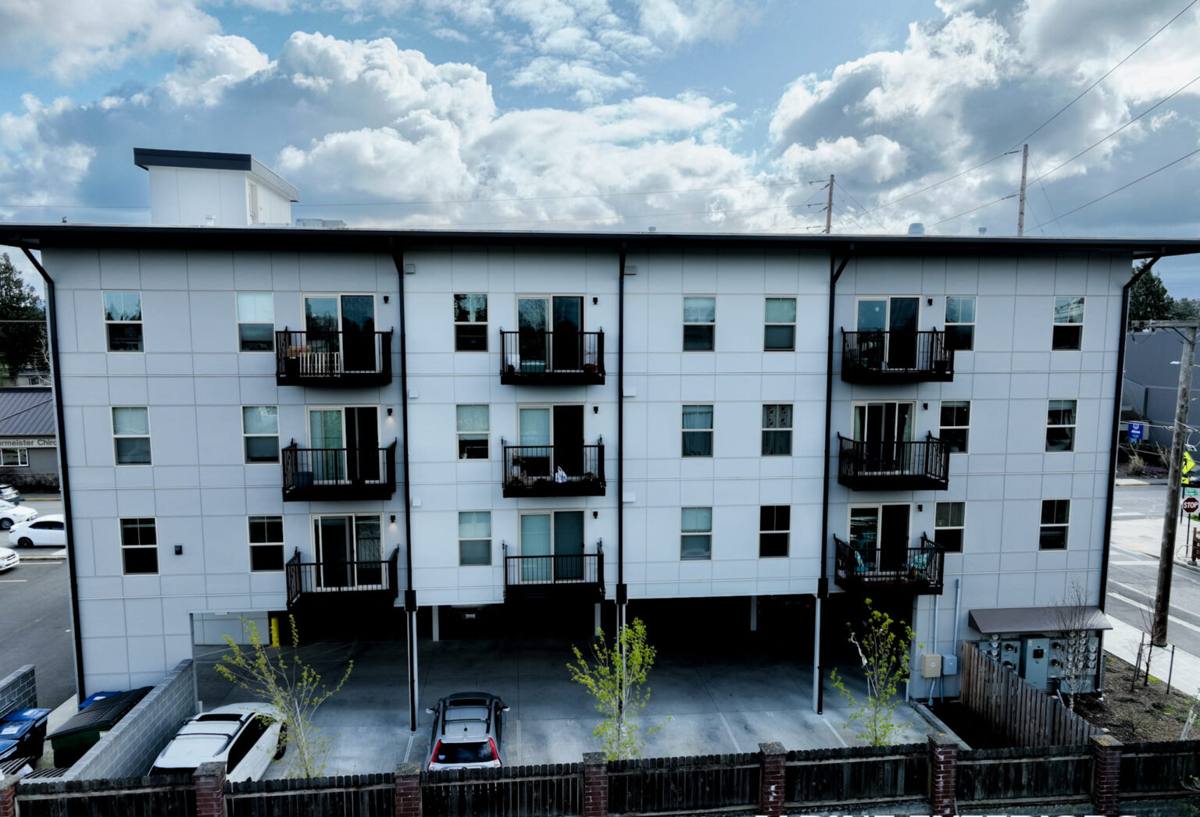
What Bellingham's Climate Actually Does to Siding
Salt Air and Coastal Exposure
Homes closer to the water deal with airborne salt that settles on exterior surfaces and accelerates corrosion of fasteners, staples, and any exposed metal trim. It also breaks down cheaper paint films faster than inland exposure would. Fiber cement itself does not corrode, but every siding job has fasteners, flashing, and trim pieces — and those details matter more here than they would forty miles inland.
Driving Rain and Wind-Driven Moisture
Whatcom County storms rarely fall straight down. Wind-driven rain gets pushed sideways into wall assemblies, which means the water-resistive barrier, flashing, and siding overlaps behind the visible surface are doing as much work as the siding itself. A siding product that swells, delaminates, or wicks moisture at cut edges is a liability in this kind of weather pattern, because water finds every gap and holds against the wall for days at a time rather than drying out between rain events.
Moss Season and Shaded Walls
Bellingham's tree cover and marine humidity mean moss and algae growth on north- and east-facing walls is close to a certainty over time, especially near roof lines, under eaves, and anywhere siding stays damp longer than it gets sun. Wood-based and wood-composite products are especially vulnerable here because moss holds moisture against the surface and accelerates rot from the back side, where you can't see it until the damage is done.
Why We Install Only James Hardie Fiber Cement
We made a deliberate decision as a company to standardize on James Hardie and not offer vinyl, LP SmartSide, Cemplank, Allura, primed spruce, or cedar as alternatives. That is not a marketing position — it is a professional judgment based on what actually holds up in this climate over decades, not just the first few years after installation.
Non-Combustible and Dimensionally Stable
James Hardie siding is fiber cement, not wood or wood-composite, so it does not swell, rot, or feed insects the way organic siding materials can. It is also non-combustible, which matters increasingly for insurance underwriting and wildfire-adjacent building codes, even in a wetter region like Whatcom County.
The HZ Climate-Engineered Product Line
James Hardie manufactures different product formulations for different climate zones — HZ5 for the wetter, colder regions like the Pacific Northwest and HZ10 for hot, humid, or high-UV zones. The HZ5 formulation used in our area is engineered specifically for freeze-thaw cycling and sustained moisture exposure, which is precisely what a Bellingham winter delivers. This is a meaningful difference from a generic fiber cement product that is not climate-zoned at all.
ColorPlus Factory Finish
Most of what we install uses James Hardie's ColorPlus finish — a baked-on, factory-applied finish that is more UV- and moisture-resistant than field-applied paint, and that comes with its own finish warranty separate from the substrate warranty. In a climate where paint failure from constant damp exposure is one of the most common siding complaints, starting with a factory finish instead of a job-site paint job is a real advantage, not a marketing detail.
What a Correct James Hardie Installation Involves
James Hardie siding is only as good as its installation. The manufacturer's own warranty can be voided by incorrect installation, and in a wet climate like this one, installation mistakes show up faster than they would somewhere dry. The details below are where jobs succeed or fail over the following ten to twenty years.
| Installation Element | Common Mistake | Correct Practice for Bellingham's Climate |
|---|---|---|
| Clearance to grade, decks, roofs | Siding installed tight to hardscape or roofing with no gap | Minimum manufacturer-specified clearances maintained so water can't wick up into the bottom edge |
| Fastener pattern | Over-driven nails, wrong fastener type for the substrate | Corrosion-resistant fasteners, correctly set to manufacturer spec so panels can move slightly without cracking |
| Flashing at windows and penetrations | Caulk used in place of proper flashing | Head flashing and properly lapped water-resistive barrier at every penetration, with caulk only as a secondary seal |
| Panel and plank joints | Butt joints with no gap or backer, painted over the seam | Correct gapping, joint treatment, and factory-primed or ColorPlus-finished cut edges sealed before installation |
| Cut edge sealing | Field cuts left unsealed | Every field-cut edge sealed with the manufacturer-approved product before it goes on the wall |
None of this is exotic — it is the manufacturer's published installation standard. The problem is that it takes longer and costs more labor to do correctly, which is exactly where corners get cut on jobs bid too low or crewed by installers who don't work with fiber cement often.
Our Installation Process for Bellingham Homes
- On-site assessment. We look at the existing wall assembly, sheathing condition, moisture history, sun and shade exposure on each elevation, and any moss or rot damage before quoting anything.
- Tear-off and substrate check. Old siding comes off and we inspect the sheathing underneath. Any soft or water-damaged sheathing gets addressed before new siding goes up — covering over a compromised wall assembly just hides the problem.
- Water-resistive barrier and flashing. A new weather barrier is installed with correctly lapped seams, and flashing is set at every window, door, and penetration before siding starts.
- Furring or rainscreen where called for. On shaded or heavily exposed elevations, a rainscreen gap behind the siding gives trapped moisture a path to drain and dry, which matters more here than in a drier climate.
- Installation to manufacturer spec. Correct clearances, fastener patterns, and joint treatment throughout, with cut edges sealed as they're cut, not after the fact.
- Trim, caulking, and final finish check. Trim details are finished and every seam and penetration gets a final inspection before we consider the job complete.
Choosing Profiles and Colors for a Bellingham Home
James Hardie offers several profiles — lap siding in various exposures, shingle-style panels, and vertical board-and-batten — and all of them are available in ColorPlus factory finishes or as primed for field painting. For homes closer to the water or in heavy tree shade, we typically walk owners through how a given color and sheen will actually read under Bellingham's grey-sky light for most of the year versus how it looks in a bright showroom sample. Darker colors show less algae staining on shaded walls over time; lighter colors tend to show moss and pollen streaking sooner and need more frequent rinsing to stay looking clean. Neither is wrong — it's a maintenance trade-off worth thinking through before you commit to a color.
Cost Factors for a James Hardie Project in Bellingham
Every home is different, and we don't quote sight-unseen, but the factors that actually move the price on a Bellingham job are fairly consistent.
| Cost Factor | Why It Matters Here | |
|---|---|---|
| Existing wall condition | Rot or moisture damage found under old siding adds repair scope before new siding can go on | |
| Home elevation exposure | Walls facing prevailing wind and rain need more careful flashing and detailing than sheltered elevations | |
| Rainscreen/furring need | Heavily shaded or moss-prone walls often benefit from a drainage gap, which adds labor and material | |
| Trim and detail complexity | Multiple gables, window trim, and transitions all add installation time regardless of siding brand | |
| Product line and finish | ColorPlus factory finish versus primed-for-paint changes material cost and long-term maintenance |
As a rough starting point, full James Hardie installations on most homes in this region land in a similar general range to other premium siding systems once labor, tear-off, and detailing are included — exact numbers depend entirely on square footage, wall condition, and design complexity, which is why we walk the house in person before giving a number.
Maintenance in a Salt Air, High-Moss Climate
James Hardie siding is low-maintenance compared to wood, but "low-maintenance" doesn't mean "no maintenance," especially in this climate. A little attention once or twice a year keeps a correctly installed job looking right for decades.
- Rinse siding gently once or twice a year to remove salt residue, pollen, and moss spores before they take hold, especially on shaded elevations
- Keep gutters and downspouts clear so overflow doesn't run down the wall and feed moss growth at the top courses
- Trim back shrubs and tree limbs that keep siding shaded and damp longer than necessary
- Check caulking at trim and penetrations annually and re-caulk any cracked or separated joints promptly
- Watch for moss or algae buildup at the bottom courses and clean it before it spreads, using a soft wash rather than high-pressure spray
- Have any impact damage or cracked panels repaired quickly rather than left exposed through a wet winter
Why Hiring a Crew That Already Works Bellingham Matters
Fiber cement installation is not forgiving of shortcuts, and a crew that mostly installs vinyl or works in drier inland markets will not have the same instincts for flashing details, rainscreen decisions, and elevation-by-elevation planning that a Whatcom County home actually needs. A crew that works this area regularly has already seen what happens to poorly detailed siding after a few Bellingham winters — the moss patterns, the failure points, the elevations that always need extra attention — and builds that knowledge into every quote and every install, rather than learning it on your house.
If you're weighing a siding replacement or new construction project in Bellingham, we're happy to walk the property, look at what your home's exposure actually calls for, and give you a straightforward, no-pressure estimate. There's a form below to get that conversation started.