 Semiahmoo
 Building Decks in Lynden the Right Way
Lynden sits inland from the water compared to Semiahmoo Spit itself, but it's still squarely in Whatcom County's marine-influenced climate. That means a deck built here has to handle the same core problems every structure in this corner of Washington deals with: months of steady rain, humidity that never really drops, and a moss/algae season that can run from October through May. A deck that looks great in July can be slick, gray, and swelling at the joints by the following spring if it wasn't built with that reality in mind. Custom deck work in Lynden isn't about picking a pretty board — it's about getting the substructure, drainage, fastening, and material choice right so the deck still looks and performs well five and ten years out.
We build and repair decks across the Semiahmoo service area, and Lynden properties come with their own set of considerations: mixed tree cover that keeps some yards shaded and damp longer than open lots, older homes with ledger connections that need a hard look before a new deck gets tied in, and a mix of lot sizes that range from tight in-town yards to larger acreage properties on the edges of town. A custom deck should be designed around the specific lot, not a catalog plan.
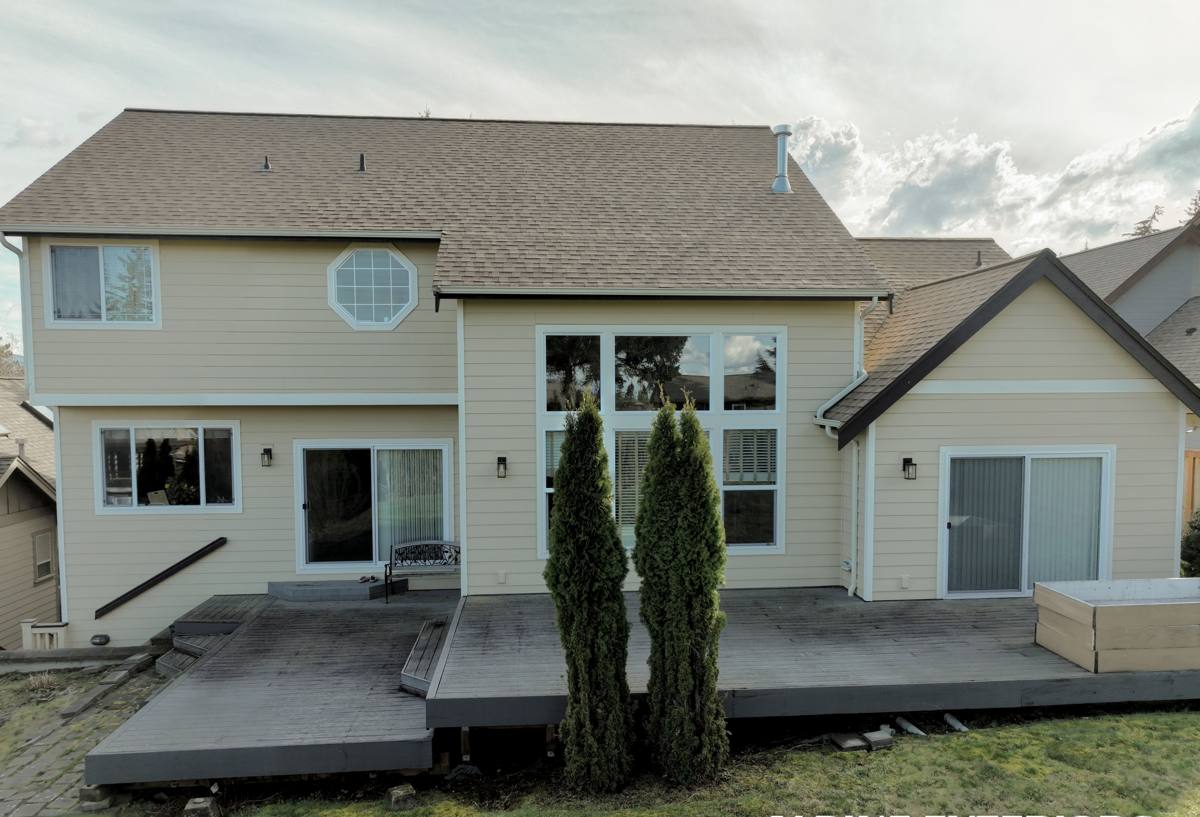
What Whatcom County Weather Does to a Deck
The biggest threats to a deck in this climate aren't dramatic — they're slow. Understanding them is what separates a deck that needs major repair in year six from one that's still solid at year twenty.
Moisture that never fully leaves
Wood, wood-composite, and even the metal fasteners holding a deck together are all affected by how long they stay wet. In a climate where it can rain on and off for days at a stretch and humidity stays high in between, the parts of a deck that don't get sun and airflow — under the boards, around post bases, behind ledger boards — can stay damp for weeks. That's where rot starts, and it's almost always invisible until it's advanced.
Moss and algae
Northwest moss doesn't just make a deck look neglected — it holds moisture against the wood surface and makes boards dangerously slick underfoot, especially on stairs. Moss growth is heaviest on decks with poor sun exposure or drainage, which describes a lot of shaded Lynden backyards.
Freeze-thaw cycling
Whatcom County doesn't get brutal winters, but it does get repeated freeze-thaw swings — cold snaps followed by rain and thaw. Water that's worked its way into a crack or a fastener hole expands when it freezes, which slowly widens the damage. Over several seasons this is what turns a small check in a board into a split.
What a Correct Deck Build Involves
A deck that's going to hold up here starts below the decking boards, not at them. Here's what we treat as non-negotiable on every custom deck we build.
Footings and framing
Footings need to be sized and set to local frost depth and soil conditions, not guessed at. Framing lumber should be pressure-treated and rated for ground contact where it's near or in soil, and every structural connection — beam to post, joist to ledger, joist to beam — needs the correct hardware, not just nails or deck screws doing a structural fastener's job.
The ledger connection
On decks attached to the house, the ledger board is the single most important — and most commonly botched — connection on the whole structure. It needs proper flashing that sheds water away from the house's wall assembly, not toward it, plus correct lag or through-bolt spacing. A poorly flashed ledger is one of the most common causes of hidden rot damage to a home's rim joist and wall framing, and it's a problem that stays hidden until someone finds soft wood during an unrelated repair.
Drainage and airflow under the deck
Every deck needs a way for water to get out from underneath it, not pool there. That means correct board spacing, joist tape or flashing on top of framing members to keep water out of end grain and fastener penetrations, and grading underneath the deck so water moves away from the house rather than sitting against footings.
Fasteners and hardware
In a humid coastal-influenced climate, fastener corrosion is a real issue. Hot-dip galvanized or stainless hardware, matched to the wood treatment chemical being used, prevents the kind of fastener failure and black staining that shows up within a couple of years when the wrong hardware gets used to save a few dollars.
Decking Material Options for This Climate
There's no single "best" decking material — there's a best material for a given budget, look, and maintenance appetite. Here's how the common choices actually perform in Whatcom County conditions.
| Material | Moisture/Moss Behavior | Maintenance | Typical Lifespan |
|---|---|---|---|
| Pressure-treated wood | Resists rot when properly maintained; can still hold surface moisture and grow moss/algae if not cleaned or sealed | Annual cleaning; re-seal or stain every 2-3 years | 15-25 years with upkeep |
| Cedar | Naturally rot- and insect-resistant; still needs sealing to prevent graying and moisture uptake | Cleaning plus sealant every 2-3 years | 20-25 years with upkeep |
| Composite decking | Doesn't rot, but can still grow surface moss/algae in shaded, damp spots — needs periodic cleaning | Occasional washing; no sealing or staining | 25-30+ years, manufacturer-dependent |
| PVC decking | Fully moisture-resistant, cleans easily, most moss-resistant option | Occasional washing | 25-30+ years, manufacturer-dependent |
Composite and PVC cost more up front than wood, but for a shaded Lynden lot where moss and moisture are a constant fight, the reduced maintenance often pays for itself over time in labor and re-sealing costs alone. For homeowners who want the look and feel of real wood and are willing to keep up a cleaning and sealing schedule, cedar or quality pressure-treated lumber is still a solid, honest choice — it just needs to be maintained on schedule, not "when it starts looking bad."
Design Choices That Matter Here Specifically
Orientation and sun exposure
Where possible, deck layout should account for how much direct sun different sections will get. A deck tucked under mature trees or on the north side of a house will dry out slower after rain and will need moss-resistant material or a more disciplined cleaning schedule than a sun-exposed deck.
Stair and railing safety
Stairs are where moss buildup turns from cosmetic to dangerous. Grooved or textured board profiles on stair treads, and railing systems that don't trap moisture at their base connections, are worth the small added cost in a climate like this.
Covered vs. open decks
A partial roof or pergola over a deck cuts down significantly on how much rain and moss exposure the boards see, which extends the life of any material. It's not required, but for homeowners planning to use the deck through the wetter months, it's worth discussing at the design stage rather than adding later.
Our Process for a Lynden Deck Project
- On-site assessment — we look at the lot's grading, drainage, sun exposure, and — for attached decks — the condition of the house's existing rim joist and siding where the ledger will connect.
- Design and material selection — we walk through layout, decking material, railing, and stair options based on budget, maintenance preference, and how the space will actually be used.
- Permitting — most custom decks in Whatcom County require a building permit; we handle that process so footings, framing, and railings meet current code.
- Footings and framing — footings set to proper depth, structural framing installed with correct hardware and ledger flashing.
- Decking, stairs, and railing installation — boards and railing installed to manufacturer spec, with attention to spacing and fastening for drainage.
- Final walkthrough — we go over the finished deck with the homeowner, including a maintenance rundown specific to the material chosen.
Maintenance Checklist for Local Decks
Whatever material a deck is built from, a few habits go a long way in this climate:
- Sweep leaves and debris off the deck surface regularly, especially in fall — trapped organic matter holds moisture and feeds moss
- Clean the deck surface at least once a year with a deck-safe cleaner to remove moss, algae, and mildew before it embeds in the wood or composite surface
- Check and clear gaps between boards so water and debris aren't building up between them
- Inspect the ledger flashing and house connection point annually for signs of staining or softness
- Re-seal or re-stain wood decking every 2-3 years, or sooner if water stops beading on the surface
- Check railing posts and stair stringers for looseness or soft spots each spring
- Keep nearby shrubs and tree branches trimmed back to improve airflow and sun exposure on shaded sections
Repair, Rebuild, or Replace?
Not every deck problem means starting over. If the framing and footings are sound and the issues are limited to surface wear, board replacement or a resurface can extend a deck's life for a fraction of a full rebuild. But if there's rot at the ledger connection, undersized or corroded structural hardware, or footings that were never properly set, patching the surface just hides a structural problem that will eventually need to be addressed anyway. Part of our assessment on any existing deck is being straightforward about which situation a homeowner is actually in before recommending a scope of work.
Why a Crew That Knows Lynden Matters
Deck-building advice that works in a dry climate doesn't always translate here. A crew that regularly builds and repairs decks across the Semiahmoo area already knows how local lots drain, how shaded yards behave differently than open ones, and which ledger and flashing details actually hold up through a Whatcom County winter — because they've gone back and seen which ones didn't. That local track record matters more on a deck than almost any other exterior project, since a deck's structural problems are largely invisible until they've already caused damage.
If you're planning a new custom deck in Lynden or need an honest look at an existing one, we're happy to walk the property with you and talk through what actually makes sense for your lot, budget, and how you use the space. Reach out for a free, no-pressure estimate using the form below.