 Semiahmoo
 Building New in Laurel Means Building for the Coast
New construction gives you one real advantage over a remodel: you get to install windows correctly the first time, before siding, trim, and interior finishes cover up the details that determine whether a window lasts 10 years or 40. In the Laurel area, that first-time correctness matters more than most inland builds ever have to consider. This part of Whatcom County sits close enough to the Strait of Georgia and Semiahmoo Bay that salt-laden air, driving wind-driven rain, and a moss season that can run eight or nine months out of the year all work on a building envelope simultaneously. A window that's simply "installed" isn't the same as a window that's installed for this climate.
We install new-construction windows on homes throughout the Semiahmoo and greater Whatcom County area, and the Laurel builds we work on tend to share a few things: exposed or semi-exposed elevations that catch weather off the water, mixed tree cover that keeps things shaded and damp longer than homes further inland, and owners who want the window package done right once rather than revisited in year six.
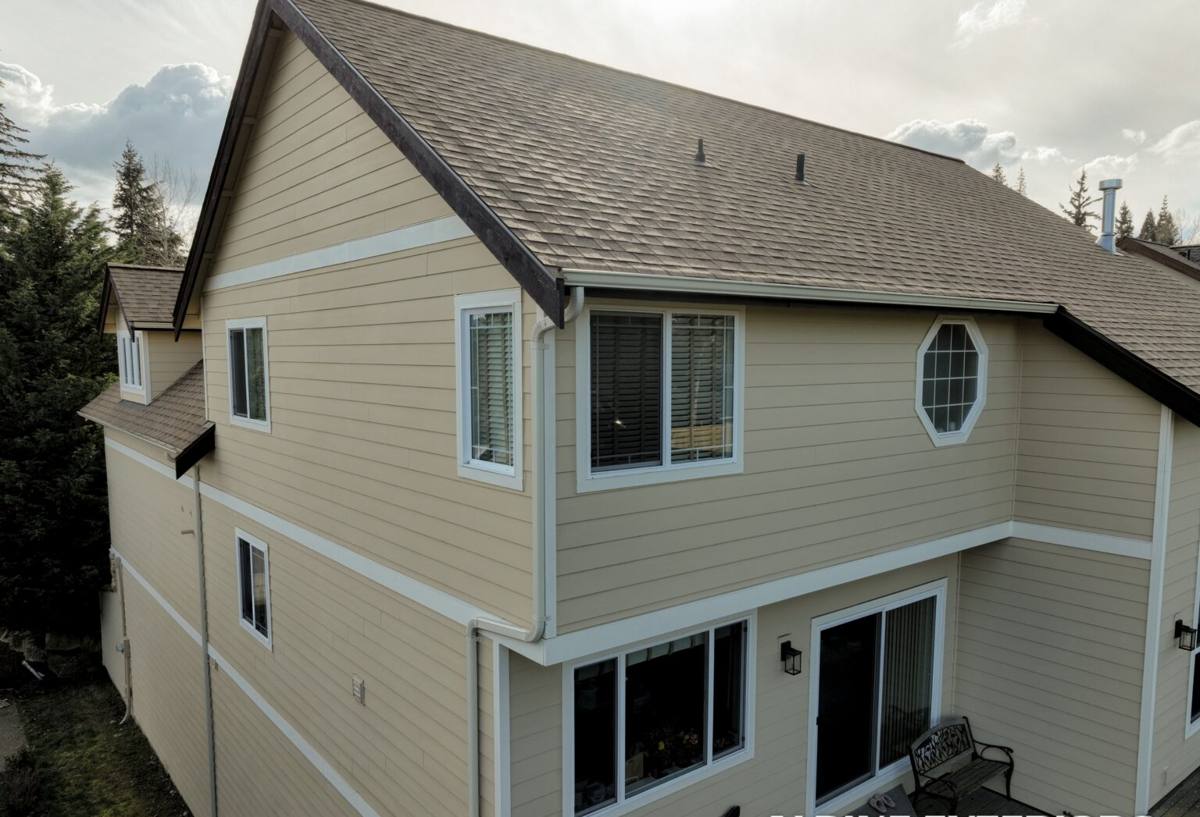
New-Construction Windows vs. Replacement Windows: Why the Distinction Matters
These are two different jobs with different failure points, and conflating them is where a lot of window problems start.
Replacement windows
Replacement windows go into an existing rough opening, usually with the original exterior trim and cladding staying in place. The install leans on the window's own frame and a careful seal against what's already there.
New-construction windows
New-construction windows have a nailing flange and go in before the exterior weather-resistive barrier (WRB) and siding are closed up. This is a real advantage — it means the flashing, the WRB laps, and the drainage plane can all be built around the window as one continuous system instead of patched in afterward. Done correctly, it's the strongest, most weathertight window installation there is. Done carelessly, it's also the fastest way to trap water behind a wall where nobody sees it until there's a problem.
For a Laurel build, that second point is the whole ballgame. New construction only pays off if the flashing sequence and WRB integration are done to spec, every time, on every opening — not just the ones facing the weather.
What Salt Air, Driving Rain, and Moss Actually Do to a Window System
Salt air
Airborne salt accelerates corrosion on any exposed metal — screws, flashing tape edges, hardware, and lower-grade cladding finishes. It doesn't destroy a window outright, but it shortens the service life of anything not rated or finished for a marine-adjacent environment.
Driving rain
Wind-driven rain off the water doesn't just fall — it pushes sideways and upward under laps that would shed water fine in a calmer climate. This is why flashing lap direction and sill pan design matter more here than in a sheltered inland lot.
Moss and sustained moisture
Whatcom County's long wet season keeps north- and west-facing walls damp for extended stretches. Moss and algae growth on siding near a window opening holds moisture against the wall longer, which is exactly the condition that punishes a poorly sealed flashing detail. A window that's 95% correctly installed can still fail at the 5% gap, and in this climate that gap gets tested constantly rather than occasionally.
Choosing Window Specs for a Coastal Whatcom County Build
Frame material, glazing package, and hardware finish all interact with this climate differently. There's no single "best" answer — it depends on exposure, budget, and how much long-term maintenance the homeowner wants to take on.
| Frame Material | Coastal Performance | Maintenance | Typical Trade-off |
|---|---|---|---|
| Vinyl | Good moisture and corrosion resistance | Low | Less rigid over large spans; color/finish options more limited |
| Fiberglass | Very good — stable in temperature swings, low corrosion risk | Low to moderate | Higher upfront cost than vinyl |
| Wood-clad | Handsome, but the interior wood core is vulnerable if any water gets past the cladding | Higher — finish and seal checks matter | Best suited to protected elevations, not full weather exposure |
| Aluminum | Strong but conducts cold and is prone to corrosion near salt air unless properly finished | Moderate | Usually reserved for specific architectural or commercial applications |
For fully exposed elevations facing the water or prevailing wind, we generally steer builds toward vinyl or fiberglass for the frame, paired with corrosion-resistant hardware and a glazing package rated for the wind and moisture load. For more protected elevations, wood-clad or other finishes become reasonable options where a homeowner wants that look. We'll walk through the actual exposure of your lot before recommending anything — a window spec that's overkill on a sheltered wall is a wasted cost, and one that's undersized on an exposed wall is a future callback.
Glazing and hardware notes
Double-pane, low-E glazing is standard for this region's energy code and performs well against Whatcom County's temperature swings. Hardware — hinges, locks, cranks — should be a finish rated for coastal or marine-adjacent use; standard interior-grade hardware will show corrosion faster this close to the water than it would twenty or thirty miles inland.
What a Correct New-Construction Install Actually Involves
This is the part that doesn't show once the siding goes on, which is exactly why it has to be right the first time.
- Rough opening check. Confirm the opening is square, plumb, and sized correctly before the window ever gets set — a slightly out-of-square opening causes operational problems and seal gaps later.
- Sill pan flashing. A sloped or pre-formed sill pan directs any water that does get past the window to the exterior instead of into the wall cavity. This is the single most important detail on a coastal build.
- Window set and flange fastening. The window is set into the opening and fastened per the manufacturer's schedule — skipping fasteners or over-driving them both cause problems.
- Flashing tape sequence. Side flanges are taped, then the head flashing laps over the top — always in a shingle-style overlap so water sheds down and out, never sideways into a seam.
- WRB integration. The weather-resistive barrier is lapped over the flashing at the head and sides, maintaining a continuous drainage plane behind the future siding.
- Interior air seal. A proper interior seal (not just exterior caulk) stops conditioned air loss and reduces condensation risk at the frame.
- Final check. Operation, level, and seal integrity confirmed before trim and siding close the opening up.
Every step in that sequence exists because of a specific failure mode. Skip the sill pan and water pools at the bottom corners. Reverse the flashing lap and wind-driven rain gets pushed uphill under the tape. It's not complicated work, but it's unforgiving work — and it's the kind of detail that's cheap to do right during construction and expensive to fix after the siding's up.
How We Handle New-Construction Window Installs in Laurel
We coordinate directly with builders, GCs, or homeowners managing their own build, and we treat each opening as part of one continuous water-management system rather than a standalone product install.
- Site walk to assess exposure by elevation — which walls face prevailing wind and rain, which are more sheltered
- Window spec recommendations by elevation, not a one-size package for the whole house
- Flashing and sill pan installation to manufacturer spec, verified before WRB and siding close it up
- Photo documentation of flashing details at each opening before they're covered
- Coordination with your builder's schedule so windows go in at the right sequence point, not rushed ahead of the WRB
- Final walkthrough and operational check on every unit before we call it done
That photo documentation step matters more than it sounds like it should. On a new build, the flashing work gets covered within days. Having a record of what's actually behind the siding is useful for the homeowner, the builder, and for any warranty questions years down the road.
Why a Crew That Already Works This Area Is Worth Choosing
Window installation isn't regionally exotic work, but the judgment calls around it are. Knowing which elevations in a given Whatcom County build take the worst of the wind and rain, how long moss actually sits on a shaded wall before it becomes a moisture concern, and which hardware finishes hold up near the water instead of pitting in a couple of seasons — that's the kind of thing you learn by doing the work here repeatedly, not by reading a spec sheet. A crew installing its first coastal Washington build is guessing at exposure severity. A crew that's done it dozens of times in this specific corner of the county isn't guessing.
Maintenance: What New Windows in This Climate Actually Need
Correct installation gets you most of the way to a long-lasting window system. The rest is basic upkeep — none of it difficult, but easy to skip until it isn't.
- Rinse salt residue off frames and glass a few times a year, especially on wind-exposed elevations
- Keep gutters and downspouts clear so water isn't sheeting down past window heads
- Check caulking and exterior sealant annually — sun and moisture cycles break it down faster here than in drier climates
- Clear moss or algae buildup on siding near window trim before it holds moisture against the wall long-term
- Test operation of hardware once a year — hinges and locks near salt air benefit from an occasional light lubrication
- Watch for condensation between panes, which signals a failed seal and warrants a warranty call, not a wait-and-see approach
Getting Your Window Package Right From the Start
New construction is the one point in a home's life where the window installation can be done with full access to the wall system — no cutting into finished siding, no guessing what's behind the existing trim. For a Laurel-area build sitting in Whatcom County's coastal weather pattern, that's worth taking seriously from the first window schedule meeting, not just at final inspection.
If you're planning a new build or working with a general contractor who needs a window subcontractor familiar with this area's exposure conditions, we're happy to walk the site, review your window schedule, and put together a straightforward, no-pressure estimate. Use the form below to get started.