 Semiahmoo
 Why Birch Bay Roofs Wear Differently Than Roofs Inland
Birch Bay sits right on the water, and that changes what a roof has to deal with day after day. Salt-laden air drifts off the bay and settles on every exposed surface, including shingle granules and exposed metal fasteners. Add Whatcom County's long wet season — months of low-angle driving rain pushed sideways by wind off the Strait of Georgia — and you have a roof that's rarely given the chance to fully dry out between storms. That constant dampness, combined with shade from mature evergreens on many Birch Bay lots, is exactly what moss and algae need to take hold.
None of this means asphalt shingles are the wrong choice for Birch Bay. They're still the most practical, cost-effective roofing option for most homes here. It means the installation details matter more than they would in a drier, inland climate, and cutting corners shows up faster — usually as premature granule loss, soft decking at the eaves, or moss working its way under shingle tabs within a few years instead of a decade or more.
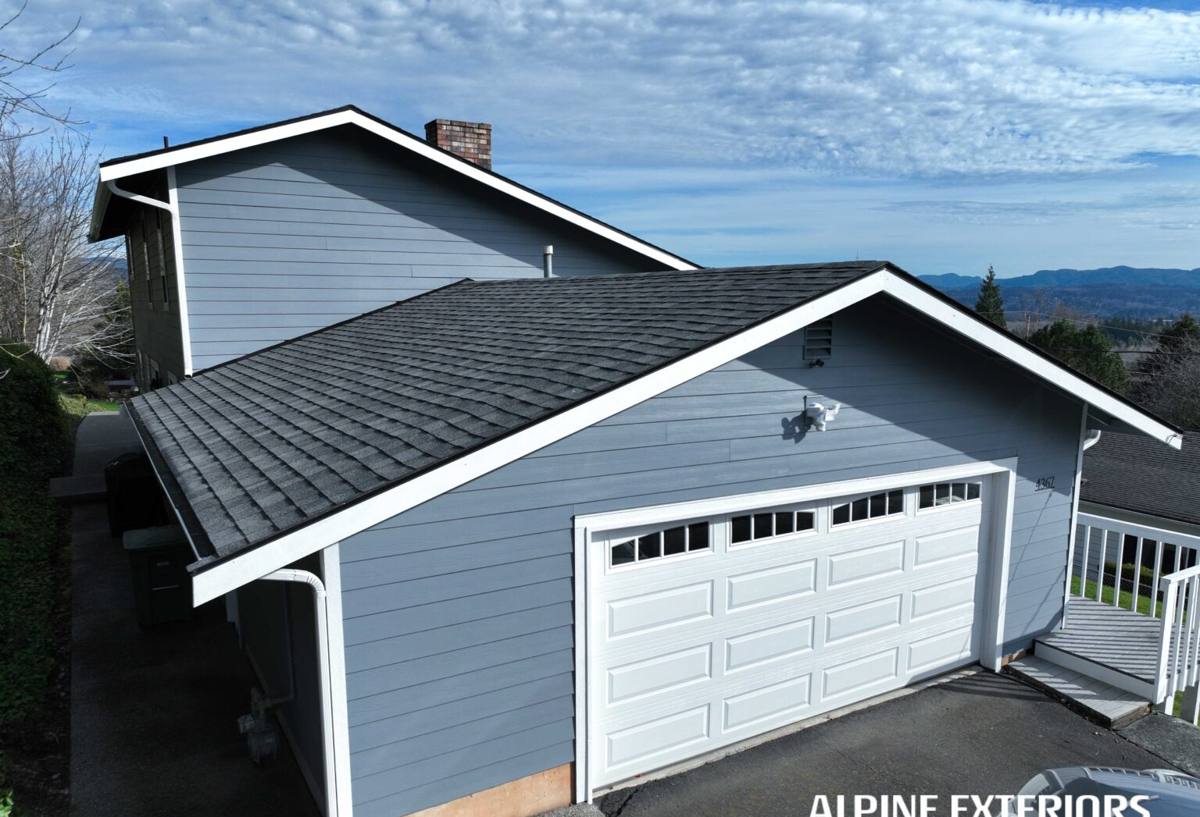
What a Roof Actually Needs to Hold Up in This Climate
Waterproofing at the Vulnerable Points
Most leaks don't happen in the open field of a roof — they happen at transitions: valleys, chimney flashing, skylight curbs, and the first few feet above the gutter line. In a climate with as much sustained rain as Whatcom County sees, we treat those areas as the places where the job is actually won or lost. Self-adhered waterproof underlayment at eaves and valleys, properly lapped and step-flashed intersections, and correctly sealed penetrations are not upgrades here — they're the baseline for a roof that's supposed to last.
Ventilation That Matches the Moisture Load
A roof deck that can't breathe stays damp longer, which accelerates moss growth from underneath as much as from the surface. Balanced intake and exhaust ventilation — soffit vents paired with a ridge vent or equivalent exhaust — lets the attic and roof deck dry out between rain events instead of staying saturated. Skipping this is one of the most common shortcuts we see on older Birch Bay roofs, and it's usually invisible until the decking underneath starts to fail.
Fasteners and Flashing That Won't Corrode
Salt air corrodes standard fasteners and thin flashing faster than most homeowners expect. We spec corrosion-resistant nails and flashing metals for anything within reach of the marine air coming off the bay, rather than treating it as an optional upgrade only for waterfront lots.
Choosing a Shingle That Makes Sense for Birch Bay
Not every asphalt shingle product is built the same way, and the differences matter more here than in a mild, dry climate. We generally steer Birch Bay homeowners toward algae-resistant architectural shingles rather than basic 3-tab products, and we're upfront about why.
| Factor | 3-Tab Shingles | Architectural (Laminate) Shingles |
|---|---|---|
| Algae/moss resistance | Standard granules, limited resistance | Copper- or zinc-infused granules widely available, actively resist algae growth |
| Wind performance | Lower wind rating | Higher wind rating, better for coastal gusts |
| Expected lifespan (climate-adjusted) | Shorter in wet, shaded conditions | Longer, holds up better under repeated saturation |
| Upfront cost | Lower | Moderate |
| Appearance | Flat, uniform | Dimensional, closer to a shake or slate look |
We don't install lower-grade products as a rule on this coastline, not because they're defective, but because the maintenance burden and shortened service life they carry in a wet, shaded, salt-air environment usually cost a homeowner more over time than the difference in install price. If budget is the deciding factor, we'll talk through the honest trade-offs rather than just quoting the cheapest option.
Our Asphalt Shingle Roofing Process in Birch Bay
1. On-Site Inspection and Honest Assessment
We start by getting on the roof, not just looking at it from the ground. That means checking decking condition, existing ventilation, flashing details, and how much moss or granule loss is already present. We'll tell you plainly whether you need a full replacement, a repair, or whether the roof has more life left in it than you think.
2. Tear-Off and Deck Inspection
Full tear-off lets us actually see the decking, not guess at its condition through old shingles. Any soft, rotted, or delaminated plywood gets replaced before anything new goes down — installing over compromised decking is how a new roof fails early.
3. Underlayment and Ice/Water Protection
Synthetic underlayment across the field, with self-adhered waterproof membrane at eaves, valleys, and around penetrations. This is the layer that keeps water out even if wind-driven rain gets under a shingle tab, which happens more often on exposed coastal lots.
4. Flashing and Ventilation Work
New step flashing at walls and chimneys, correctly lapped valley metal, and a ventilation path that actually balances intake and exhaust — not just vents added for appearance.
5. Shingle Installation
Manufacturer-specified nailing pattern and exposure, properly aligned courses, and attention to the details that keep wind and rain from finding a way in at the edges, ridges, and hips.
6. Cleanup and Final Walkthrough
Magnetic sweep for stray nails, full site cleanup, and a walkthrough so you understand what was done and what to watch for going forward.
Repair or Replace? What We Look At
Not every roof issue in Birch Bay means a full replacement. We look at the whole picture before recommending one direction over the other.
- Age of the roof relative to its expected service life in this climate
- Extent of moss and granule loss — isolated patches versus roof-wide coverage
- Decking condition found during any exposed area or attic inspection
- Number and location of leaks — one flashing failure versus multiple failure points
- Ventilation adequacy — poor ventilation often means a repair won't hold long-term
- Remaining warranty coverage on the existing shingles or a prior install
If a repair genuinely solves the problem, that's what we'll recommend. We don't push a full replacement when a targeted fix will hold up.
What Affects the Cost of a Birch Bay Roofing Project
| Cost Factor | Why It Matters Here |
|---|---|
| Roof size and pitch | Steeper pitches and larger areas take more material and labor time |
| Decking replacement needed | Coastal moisture exposure makes rotted decking more common than inland |
| Shingle grade chosen | Algae-resistant architectural shingles cost more upfront than basic 3-tab |
| Ventilation upgrades | Older homes often need added intake or exhaust vents to meet current standards |
| Access and site conditions | Tree cover, tight lot access, or steep driveways can add labor time |
| Tear-off layers | Removing multiple existing layers adds disposal and labor cost |
We give a written, itemized estimate before any work starts, so you know exactly what you're paying for and why — not a vague lump-sum number.
Living With an Asphalt Shingle Roof in a Moss-Prone Climate
Even a well-installed roof needs some ongoing attention in a climate like this. A few habits go a long way toward protecting the investment:
- Keep overhanging branches trimmed back to reduce shade and debris buildup
- Clear gutters and valleys of needles and leaves at least twice a year
- Address small moss patches early with a gentle, roof-safe treatment rather than pressure washing, which can strip granules
- Have the roof looked at after major windstorms, which are common along the Whatcom County coastline
- Watch for granules collecting in gutters, a sign the shingle surface is wearing
None of this requires a big time investment, but skipping it in a wet, shaded coastal environment shortens a roof's useful life more than most homeowners expect.
Why Local Experience in Birch Bay Actually Matters
A roofing crew that mainly works drier, inland areas doesn't always default to marine-grade fasteners, algae-resistant shingles, or the ventilation balance a coastal Whatcom County home needs. Working Birch Bay and the surrounding Semiahmoo area regularly means we're not guessing at how salt air, prevailing wind direction, and shade patterns from local tree cover affect a roof — we've seen it firsthand, on homes with the same exposure yours has. That translates into fewer surprises during the job and a roof that's actually specified for the conditions it has to survive, not a generic install that happens to be located near the water.
What to Expect From Us
We provide a clear written estimate, a realistic project timeline, and straight answers about material choices and their trade-offs. We stand behind our workmanship, and we'll walk you through manufacturer warranty terms on whatever shingle product you choose so you know what's actually covered and for how long. If something isn't right, we address it — that's part of doing the job correctly the first time.
If you're dealing with moss buildup, a roof that's showing its age, or you just want an honest read on where things stand, we're happy to take a look. Reach out for a free, no-pressure estimate using the form below.