 Semiahmoo
 Composite Decking for Bellingham Homes: Built for This Climate
A deck in Bellingham doesn't sit in a mild, dry backyard the way a deck in an inland climate does. It sits under marine air off Bellingham Bay and the Salish Sea, catches wind-driven rain that comes in sideways as much as straight down, and spends a long stretch of the year under moss and mildew pressure that a drier part of the state never has to deal with. Whatcom County's combination of salt exposure, sustained moisture, and shaded, tree-covered lots is hard on any outdoor building material, and decking takes more of that punishment than almost anything else on a house because it's horizontal, walked on, and exposed to standing water in a way vertical siding never is.
Composite decking exists specifically to handle that kind of exposure better than wood does, but "composite" isn't one product with one performance level. The board composition, the cap technology, the substructure underneath it, and the way it's fastened all determine whether a composite deck actually outperforms wood in this climate or just fails in a different, slower way. This page walks through what Bellingham's climate actually does to a deck, what a correct composite installation requires here, and how we approach the job.
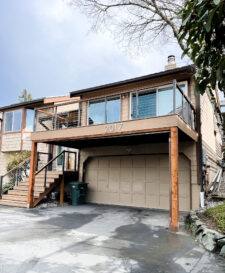
What Bellingham's Climate Does to a Deck
Salt Air and Marine Moisture
Bellingham's bay-facing setting means a steady flow of salt-tinged, moisture-laden air moving across the city, not just on days with an obvious storm rolling through. That kind of sustained, low-level exposure is harder on fasteners, connectors, and lower-grade finishes than most homeowners expect, and it works slowly enough that the damage often isn't visible until it's already well established underneath the surface.
Driving Rain and Standing Water
Rain in this part of Whatcom County frequently comes in at an angle, pushed by wind off the water rather than falling straight down. On a deck, that means water reaches board ends, fastener holes, and framing connections that a purely vertical rainfall pattern wouldn't reach as often. Add in the fact that a deck surface is horizontal and can pool water if it isn't sloped and gapped correctly, and you get a structure that's fighting standing moisture far more than a wall ever does.
A Long Moss and Mildew Season
Mild temperatures, consistent dampness, and heavy tree cover across much of Bellingham add up to an extended moss and algae season, especially on shaded decks or ones tucked under overhangs and mature trees. Any decking surface that holds moisture against itself, or that has enough texture and porosity to give moss something to grip, becomes a growth surface. On wood decking that usually means a slick, degrading surface within a few seasons; on lower-grade composite it can mean surface staining that's difficult to fully clean off.
Why Composite Decking Fits This Climate
Composite decking is built from a blend of wood fiber and recycled plastic, and on the better products that core is wrapped in a polymer cap that keeps moisture from being absorbed into the board itself. That's the trait that matters most in a climate like this one. Wood decking absorbs water, swells, and dries out repeatedly through the wet season, and that expansion and contraction cycle is what eventually splits boards, pulls fasteners loose, and opens up the exact cracks and gaps that moss and rot get started in. A quality capped composite board doesn't go through that cycle the same way, because the cap is there specifically to stop water absorption at the surface.
That doesn't make composite decking maintenance-free or immune to every problem this climate throws at it. Composite boards can still stain if debris and organic matter are left sitting on the surface, and the substructure underneath a composite deck, the joists, ledger, and framing, is still typically wood and still needs to be protected and detailed correctly. The composite surface solves one part of the moisture problem; the installation has to solve the rest.
What This Means Compared to Wood and Other Materials
| Material | How It Handles This Climate | Trade-Off |
|---|---|---|
| Capped composite decking | Resists moisture absorption at the surface; holds up well against moss, staining, and repeated wet-dry cycling | Higher upfront material cost than wood; substructure still needs proper moisture detailing |
| Pressure-treated wood | Affordable and familiar, but absorbs moisture readily in a climate this wet | Requires regular sealing or staining; more prone to splitting, warping, and fastener pull-through over time |
| Cedar | Attractive natural material with some natural rot resistance | Still absorbs moisture and needs ongoing maintenance; softer surface shows wear faster under heavy foot traffic and rain exposure |
| Uncapped composite | Better moisture resistance than raw wood, but exposed core can still absorb some water at cut ends | More prone to staining and mold in shaded, damp conditions than fully capped boards |
What a Correct Composite Deck Installation Requires
Buying a good composite board is only part of building a deck that actually performs in Bellingham. The installation details underneath and around that board are what determine whether the deck stays dry, stable, and moss-free for the long haul or develops problems within a few wet seasons.
Substructure and Ledger Attachment
Where a deck attaches to the house, at the ledger board, is one of the most common places water tracks into a wall assembly if it isn't flashed correctly. That connection needs proper flashing that sheds water away from the house rather than trapping it against the rim joist, and it needs to be treated as seriously as any roof or siding flashing detail, because a leak here can damage framing and siding long before it's visible from the deck surface.
Fastening and Hidden-Fastener Systems
Most composite decking today is designed for hidden fastener systems rather than face-screwing, which keeps water from pooling in exposed screw heads and gives a cleaner surface for moss and debris to be washed off rather than catching in fastener recesses. Fastener and connector hardware also needs to be rated for the moisture and, closer to the water, the salt exposure this region sees, since standard hardware can corrode faster here than it would inland.
Drainage and Airflow Beneath the Deck
A deck surface needs a slight slope away from the house and consistent board spacing so water actually drains instead of sitting on the surface or wicking sideways between boards. Just as important is airflow underneath the deck. A low deck with poor ventilation underneath traps humidity against the joists and the underside of the decking, which is exactly the environment moss, mold, and slow wood rot in the substructure need to get started, even when the composite surface above looks fine.
Composite Decking Cost Factors in Bellingham
| Factor | What It Affects | Why It Matters Here |
|---|---|---|
| Deck size and layout complexity | Total material and labor | Multi-level decks and stair sections common on Bellingham's sloped lots add framing and cut complexity |
| Substructure condition | Whether framing can be reused or needs replacement | Years of trapped moisture under an old wood deck can rot joists and ledger framing before it's visible from above |
| Board and cap quality | Material cost and long-term moisture performance | Fully capped boards resist this climate's moss and staining pressure better than uncapped or lower-grade composites |
| Railing and fastener hardware | Material cost and corrosion resistance | Salt-tinged marine air accelerates corrosion on lower-grade hardware near the bay |
| Site access and lot terrain | Labor time and equipment needs | Sloped hillside lots and mature tree cover common around Bellingham can add staging time and require extra care around root systems |
Real numbers depend on the specific property, which is why we walk the site and look at the existing structure before quoting rather than pricing off square footage alone.
Signs Your Existing Deck Needs Attention
- Moss or dark staining that returns quickly after cleaning, especially on shaded sides of the deck
- Soft, spongy, or springy boards, particularly near the house connection or stair stringers
- Fasteners that are backing out, rusting, or leaving dark streaks on the board surface
- Gaps between boards that have widened or narrowed unevenly, a sign of moisture cycling in the wood core
- Standing water on the surface after rain instead of draining off
- Visible gaps or staining at the ledger board where the deck meets the house
Our Process for a Bellingham Composite Deck
- Site walk and assessment: We look at the existing structure if there is one, the grade, drainage, sun and shade exposure, and how the deck will connect to the house before talking materials.
- Material and layout planning: We go over board options, railing choices, and layout with you in plain terms, including the real trade-offs between products rather than steering you toward whatever has the best margin.
- Substructure work: Framing, ledger flashing, footings, and any needed repairs to existing structure happen before a single composite board goes down, since this is the part of the job that determines how long the whole deck lasts.
- Composite installation: Boards go down with hidden fastener systems and correct spacing for drainage, with hardware rated for this region's moisture and salt exposure.
- Final walkthrough: We check the finished deck with you, covering realistic care expectations so you know what normal weathering looks like versus something worth calling us about.
Roofing, Siding, and Decks as One Connected Exterior
A deck rarely fails in isolation. A ledger board that's leaking can send water into the wall behind it, and siding or trim near a deck connection can show moisture damage that actually started at the deck framing, not the wall itself. Because we work across siding, roofing, and decking, we look at how these systems connect on your specific property instead of treating the deck as a standalone project disconnected from the rest of the house.
Why a Local Crew Matters for Decking in Bellingham
A crew that builds decks across this stretch of Whatcom County regularly sees how salt air, driving rain, and moss actually behave on real structures over a full year, not just how a composite product performs in a manufacturer's spec sheet. That shows up in practical choices on build day: where extra flashing attention at the ledger pays off, how much airflow a low deck actually needs underneath it, and which hardware is worth the extra cost near the bay. Bellingham's mix of hillside lots, mature tree cover, and bay-facing exposure isn't uniform from property to property, and a crew with hands-on local experience accounts for that instead of building every deck the same way regardless of site conditions.
If you're planning a new composite deck, replacing an aging wood deck, or want an honest opinion on whether your current deck is still sound, we're glad to take a look. Reach out using the form below to schedule a free, no-pressure estimate.