 Semiahmoo
 Why Bellingham Siding Takes More Punishment Than People Expect
Homes around Semiahmoo and Bellingham sit close enough to the water that salt-laden air is a daily fact of life, not an occasional weather event. Add Whatcom County's long wet season, driving rain that comes in sideways off the Strait, and months where north-facing walls barely see direct sun, and you have a climate that is quietly hard on exterior building materials. Moisture gets pushed into seams and laps by wind-driven rain. Salt air accelerates corrosion on fasteners and trim metal. And the shaded, damp conditions that persist from fall through spring are exactly what moss and algae need to take hold.
None of this is dramatic on its own. It's cumulative. A siding product that's marginal in a drier inland climate can fail years earlier here, and the failure usually shows up as something homeowners misread as a cosmetic problem — dark streaking, soft spots at the bottom courses, paint that won't hold — when it's actually the siding losing its fight with moisture.
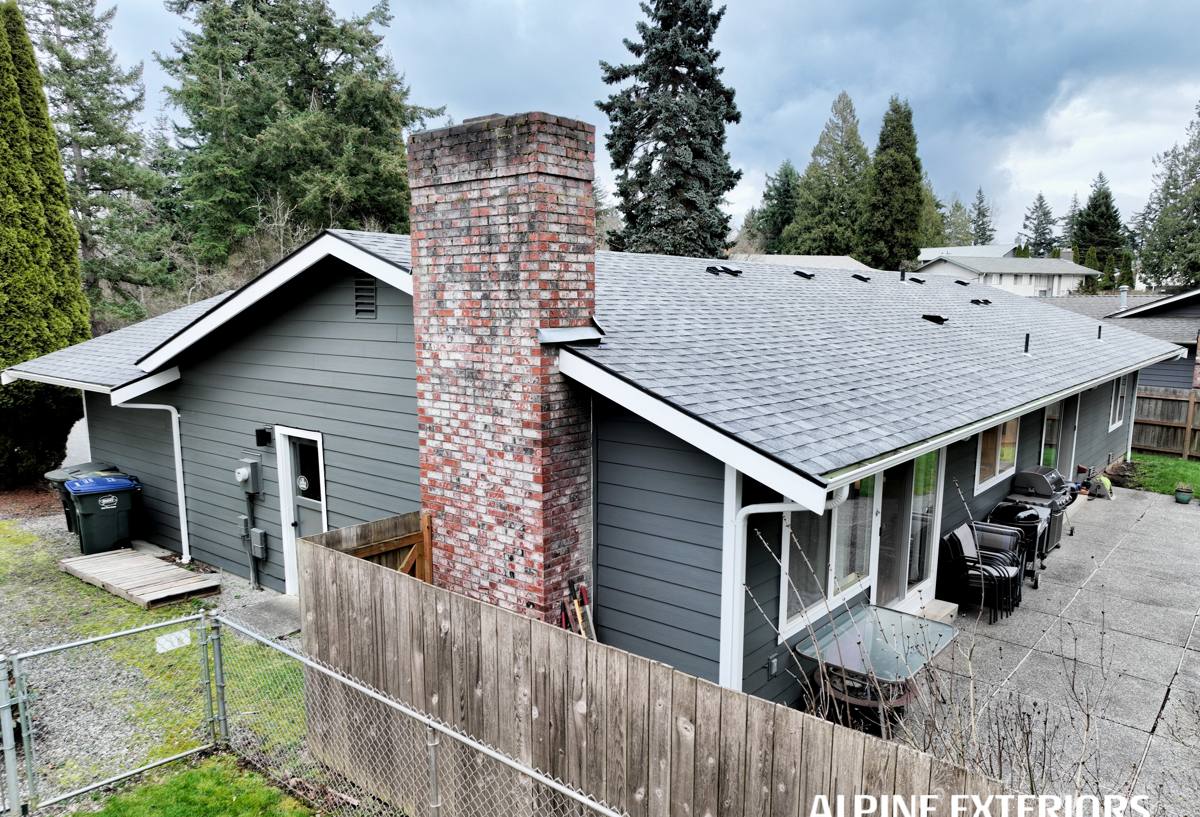
What Bellingham Homes Actually Need From Their Siding
Given the local conditions, the siding on a Bellingham home has a specific job to do, and it's more demanding than "look good and keep the weather out":
- Resist moisture absorption at butt joints, corners, and anywhere two pieces meet
- Hold a factory finish through repeated wet-dry cycles without chalking, peeling, or fading
- Stay dimensionally stable so caulk lines and paint don't crack from swelling and shrinking
- Shed the surface moisture that feeds moss and algae growth, rather than holding it against the wall
- Stand up to salt air without accelerating corrosion at fastener heads and trim
This is the standard we hold every Bellingham job to, and it's the reason we install only James Hardie fiber cement siding. Fiber cement — cellulose fiber, sand, and cement pressed and cured into a dense, stable board — doesn't absorb and swell the way wood-based products can, and it doesn't degrade under UV and moisture the way vinyl can over a long service life. It's also non-combustible, which matters in a region where wildfire smoke and fire-season concerns have become a normal part of the calendar even west of the Cascades.
Why James Hardie, Specifically, for This Climate
Fiber cement isn't a single product — quality and engineering vary by manufacturer, and that variation matters more in a marine climate than in a mild, dry one. James Hardie builds its siding in climate-specific formulations, and for the Pacific Northwest that means HZ5 boards, engineered for regions with significant moisture exposure and freeze-thaw cycling. That's a meaningfully different product than a fiber cement board formulated for the Southwest or the Gulf Coast, and it's part of why we don't treat "fiber cement" as an interchangeable commodity.
The other piece is the factory finish. Hardie's ColorPlus finish is baked on under controlled conditions, which gives it better adhesion and UV stability than field-applied paint, and it comes with its own finish warranty separate from the substrate warranty. In a climate where a poorly bonded finish will show chalking and fade within a few seasons, that factory process is doing real work, not just marketing.
We get asked from time to time about LP SmartSide, vinyl, or unfinished wood products like primed spruce or cedar. Each has legitimate uses elsewhere. But LP SmartSide is a wood-strand product, and wood-strand products are more sensitive to sustained moisture exposure at cut edges and joints than cement-based board — exactly the failure point our climate stresses hardest. Vinyl can work loose and distort in sustained wind-driven rain and doesn't carry the same fire rating. Unfinished wood siding demands a maintenance schedule — recoating, caulking, spot repairs — that most homeowners underestimate until they're three years in and behind on it. We're not saying those products are junk; we're saying we've drawn a line on what we're willing to put on a Bellingham home and stand behind, and Hardie is on the right side of that line for this climate.
What a Correct Installation Actually Involves
Fiber cement siding is only as good as the installation behind it. A huge share of the problems we get called out to inspect on other contractors' work trace back to installation shortcuts, not the material itself.
Moisture Management Behind the Boards
Everything starts with the water-resistive barrier and flashing details, because the siding is the second line of defense, not the first. Correct work means properly lapped house wrap, flashing integrated at every window, door, and roof-to-wall transition, and a drainage plane that lets any moisture that does get behind the siding find its way back out instead of sitting against the sheathing. Skipping or rushing this step is invisible on installation day and expensive five years later.
Fastening, Clearance, and Joints
Hardie's installation instructions specify fastener type, spacing, and placement for a reason — get it wrong and you compromise both the warranty and the board's performance. Equally important in our climate is ground clearance and clearance from roof lines, decks, and grade: siding installed too close to the ground or to a horizontal surface stays wet longer and invites exactly the moss and mildew growth this region is known for. Butt joints need to be properly flashed or sealed, not just butted and caulked, and caulk itself needs to be a product rated for the movement and moisture cycling the region puts it through.
Trim and Corner Detailing
Salt air is hardest on exposed metal and on any detail that traps water. Corner boards, window trim, and transitions to other materials need to be detailed so water sheds away from the wall assembly rather than pooling or wicking into end grain. This is where experienced crews and inexperienced ones look identical from the curb the day the job finishes — and look very different three winters later.
Signs a Bellingham Home Needs Attention Now
Because failure in this climate tends to be gradual, it's worth knowing what to watch for before a small issue becomes a full re-side:
- Dark green or black staining that keeps returning to the same wall sections after cleaning
- Paint that's chalking, peeling, or bubbling, especially on north- and west-facing elevations
- Soft, spongy, or visibly swollen siding near the bottom courses or around window sills
- Caulk lines that have cracked, shrunk, or pulled away from joints and trim
- Visible gaps or warping at butt joints and corners
- A musty smell or discoloration on interior walls that back up to exterior siding
Any one of these on its own isn't necessarily an emergency, but they're worth a professional look rather than a wait-and-see approach, given how quickly moisture problems compound here.
How Our Process Works
Estimate and Inspection
We start with an on-site look at the existing siding, the condition of the sheathing and trim where accessible, and the specific exposures on your home — which walls take the worst of the weather, where moss has already established, and where prior repairs or caulk may be masking a bigger issue. You get a written estimate, not a verbal ballpark.
Prep and Tear-Off
Old siding comes off and we inspect the sheathing underneath before anything new goes on. If there's rot or water damage, we address it before covering it back up — installing new siding over a compromised wall doesn't fix the problem, it just hides it for a while.
Installation
House wrap and flashing go in to current best practice, then the Hardie boards are fastened, jointed, and trimmed to spec. We're not cutting corners on fastener spacing or clearance to hit a faster timeline.
Final Walkthrough
We walk the finished job with you, cover care and cleaning basics for this climate, and make sure the warranty paperwork is registered correctly on your behalf.
Cost Factors to Understand Before You Budget
Fiber cement siding costs vary by project, and anyone quoting a firm number before seeing the house is guessing. What actually drives the price on a Bellingham job:
| Factor | Why It Matters Here |
|---|---|
| Home size and wall complexity | More corners, dormers, and transitions mean more cutting, flashing, and labor time |
| Condition of existing sheathing | Rot or moisture damage found during tear-off adds repair scope before new siding goes on |
| Board profile and trim selection | Lap width, shingle-style panels, and trim details affect material cost and install time |
| ColorPlus vs. field-painted finish | Factory finish costs more up front but removes a recurring repaint cycle |
| Access and site conditions | Tight lots, retaining walls, or waterfront exposure can affect staging and crew time |
The honest way to think about it: fiber cement from a manufacturer engineered for this climate, installed correctly, costs more up front than vinyl or unfinished wood, and less over a 20- to 30-year window once you account for repainting, repair, and premature replacement that lower-cost options tend to need in a marine climate.
Why Local Experience with Bellingham Homes Matters
A crew that mostly works drier inland climates can install fiber cement correctly on paper and still miss the details that matter specifically here — clearance choices that ignore how long walls stay wet after a Pacific storm, caulk products that aren't suited to our humidity swings, or trim details that don't account for how salt air treats exposed metal. Working Bellingham and the Semiahmoo area regularly means we see how a given detail actually performs a few winters later, not just how it looks on installation day, and we adjust our standard practices accordingly rather than following a generic install guide.
If you're weighing a re-side, dealing with siding that's showing its age, or just want a straight answer on whether repair or replacement makes sense for your home, we're glad to take a look. Request a free, no-pressure estimate using the form below and we'll walk the property with you and tell you what we actually see.