 Semiahmoo
 Why Birch Bay Roofs Age Differently Than Roofs Inland
A roof in Birch Bay does not live the same life as a roof twenty miles inland. Sitting right on the water means homes here take on salt-laden air almost constantly, along with driving rain that comes in sideways off the Strait during winter storms. Add in a moss season that can stretch from late fall through spring under the region's mild, damp weather, and you have three separate forces working against a roof at the same time: corrosion, water intrusion, and organic growth. A roof system that would hold up fine in a drier, more sheltered part of Whatcom County can wear out faster here if it wasn't built with these conditions in mind.
This isn't a reason to panic about your roof — it's a reason to be specific about how a replacement is built. The materials, fasteners, underlayment, and ventilation choices that make sense for a Birch Bay home are not always the "standard" choices a crew might default to on a job somewhere drier. That's the gap we focus on closing.
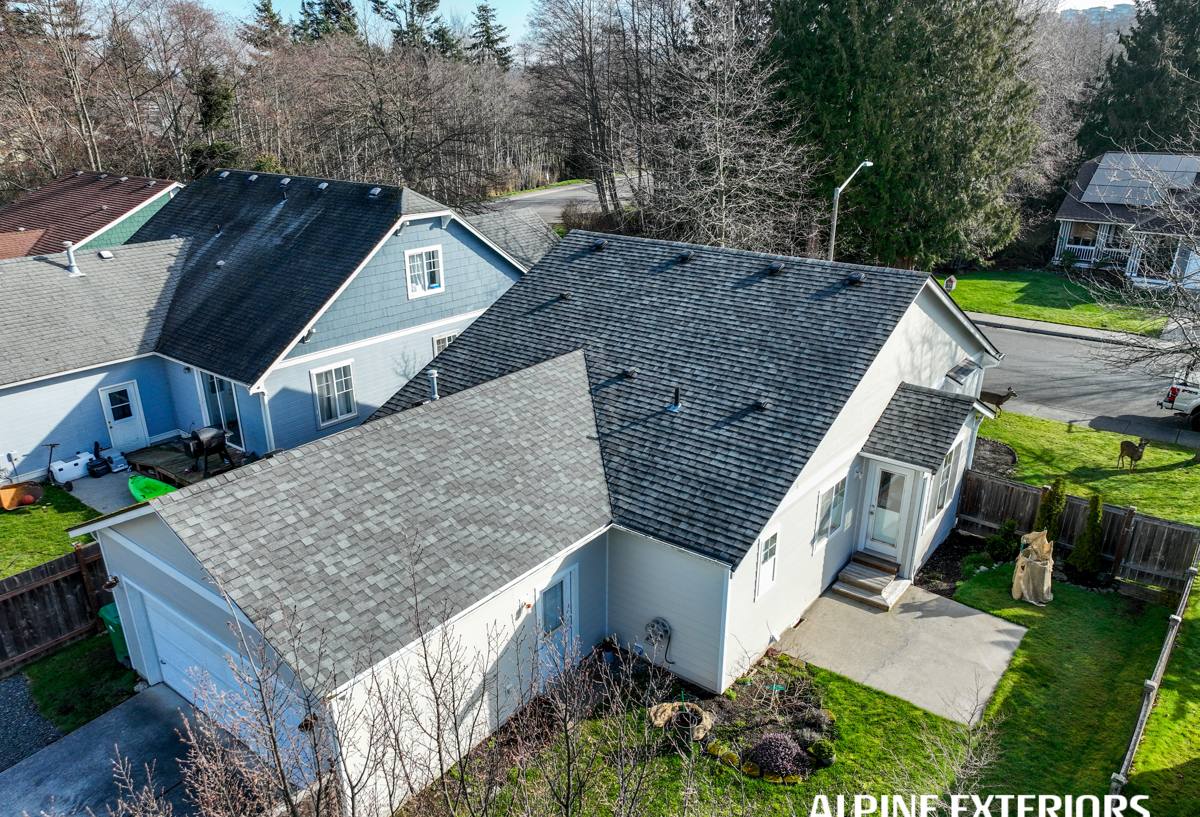
Signs a Birch Bay Roof Needs Full Replacement, Not Another Repair
Patching has a place, but there's a point where repeated repairs cost more over a few years than one correct installation. Here's what we look for during an inspection to make that call honestly:
- Granule loss heavy enough that you can see bald patches or find granules collecting in gutters
- Shingles that are cupping, curling, or cracking, especially on south- and west-facing slopes exposed to wind-driven rain
- Soft or spongy decking felt underfoot in the attic, or daylight visible through the roof boards
- Moss that keeps returning within a season or two of cleaning, especially in shaded valleys and north-facing sections
- Rust streaking or pitting on flashing, roof vents, or exposed fasteners — a common early sign of salt-air corrosion
- Interior stains on ceilings or attic sheathing after storms with strong onshore wind
- A roof approaching or past 20-25 years old, which is a realistic ceiling for standard asphalt shingle roofs in this coastal exposure
If you're only seeing one or two of these and the roof is younger, a repair may genuinely be the right call — we'll tell you that instead of pushing a replacement you don't need yet.
What a Correct New Roof Installation Actually Includes
Tear-Off and Deck Inspection
We remove the old roofing down to the deck rather than layering over it. This is the only way to actually see the sheathing, catch soft or delaminated boards, and confirm there's no hidden rot from past leaks — which is common on older Birch Bay homes where a slow leak went unnoticed for years under heavy tree cover. Any damaged decking gets replaced before anything new goes down; installing new roofing over a compromised deck just guarantees an early failure.
Underlayment Built for Wind-Driven Rain
Standard felt underlayment is not enough for this exposure. We install synthetic underlayment across the full roof for its tear strength and water resistance, plus self-adhered ice-and-water shield membrane at the eaves, valleys, ridge, and around every penetration — the spots where wind-driven rain is most likely to force its way under the shingle line. This detail matters more in Birch Bay than in a sheltered inland neighborhood, because horizontal rain pushed by onshore wind behaves differently than rain falling straight down.
Flashing and Fastener Choices for Salt Air
Salt air corrodes ordinary fasteners and thin flashing faster than most homeowners expect. We use corrosion-resistant fasteners — hot-dipped galvanized or stainless steel, depending on the material — and properly formed step flashing, counter-flashing, and chimney/skylight flashing rather than relying on caulk or sealant to do a flashing detail's job. Sealant has its place as a finishing touch, not as a substitute for correctly lapped metal.
Ventilation That Fights Moss and Condensation
A poorly ventilated attic traps moisture, and trapped moisture feeds both moss growth on the roof surface and condensation damage inside the attic. We check intake (soffit vents) and exhaust (ridge vent or equivalent) balance as part of every installation, because a new roof on top of bad ventilation just resets the clock on the same underlying problem.
Choosing the Right Roofing Material for This Climate
There isn't one "best" material for every Birch Bay home — it depends on your roof's exposure, your budget, and how much long-term maintenance you want to take on. Here's how the common options compare for this specific climate:
| Material | Typical Lifespan | Moss/Algae Resistance | Salt-Air Considerations | Best Fit |
|---|---|---|---|---|
| Architectural asphalt shingle | 20-30 years | Good with algae-resistant granules; needs periodic cleaning | Corrosion risk is in the fasteners and flashing, not the shingle itself | Most homes; best balance of cost and performance |
| Standing seam metal | 40-60 years | Excellent — sheds moss and debris well due to smooth, steep-shed surface | Requires marine-grade coated panels and stainless fasteners near the water | Homes wanting long-term, low-maintenance performance |
| Synthetic/composite shingle | 30-50 years | Very good; resists organic growth better than standard asphalt | Minimal corrosion exposure; check manufacturer warranty for coastal use | Homeowners wanting shake or slate appearance without the upkeep |
| Cedar shake | 20-30 years with upkeep | Poor without frequent treatment; retains moisture | High maintenance burden in a wet, salt-air environment | Homeowners committed to regular maintenance for a specific look |
We're upfront that cedar shake, while attractive, is the hardest material to keep performing well in a climate this wet — it holds moisture and needs consistent treatment to resist moss and rot. That's a maintenance-burden and moisture-behavior tradeoff worth knowing before you commit, not a knock on the material itself.
Color and Surface Considerations
Darker shingle colors show algae streaking more visibly than lighter, granule-blended colors, and steeper roof pitches shed moisture (and moss spores) faster than low-slope sections. Neither of these should be the deciding factor over what fits your home, but they're worth knowing when you're picking a color and style.
What Drives the Cost of a New Roof
Every roof is priced on its own specifics, but these are the factors that move the number most:
| Factor | Why It Matters |
|---|---|
| Roof size and pitch | More surface area and steeper pitches both increase material and labor time |
| Number of existing layers | Extra tear-off work if the roof has been layered over before |
| Decking condition | Rotten or soft sheathing found during tear-off requires replacement before installation |
| Material choice | Asphalt, synthetic, and metal carry different material and installation costs |
| Ventilation upgrades | Adding or correcting ridge/soffit ventilation adds labor but reduces future moss and moisture problems |
| Roof complexity | Valleys, dormers, skylights, and chimneys all add flashing detail work |
We give a written, itemized estimate so you can see exactly what you're paying for — not a single lump number. If your budget requires phasing certain upgrades, we'll tell you honestly which ones matter most for a coastal exposure like Birch Bay's and which can reasonably wait.
Our Installation Process, Step by Step
- On-site inspection and estimate — we assess the current roof, attic ventilation, and any problem areas, and provide a written scope and price
- Material selection — we walk through the material and color options that fit your budget and this climate
- Permitting — we handle the Whatcom County permit process required for roof replacement
- Tear-off and deck inspection — full removal of old roofing, with any deteriorated decking replaced
- Underlayment and flashing installation — synthetic underlayment, ice-and-water shield at vulnerable areas, and properly formed flashing throughout
- Roofing material installation — installed per manufacturer specification with corrosion-resistant fasteners
- Ventilation and final details — ridge vent, gutter apron, and trim work completed
- Cleanup and walkthrough — job site cleared, magnetic sweep for debris, and a final walkthrough so you know exactly what was installed and how to maintain it
Permits and Whatcom County Requirements
Roof replacement in Whatcom County typically requires a building permit, and inspections may apply depending on the scope of work. We handle this as part of the job rather than leaving it on the homeowner's plate, and we build the timeline for permit approval into the overall project schedule so there are no surprises about when work can start.
Why Hiring a Crew That Already Works in Birch Bay Matters
A roofing crew that mostly works inland may not think twice about fastener grade, flashing metal, or underlayment coverage — because inland, those shortcuts often don't show up as failures for years. On a home exposed to salt air and driving rain right off the water, the same shortcuts show up much sooner: rusted fasteners, lifted shingle tabs, and moss that keeps coming back no matter how often it's cleaned. Working in this specific area regularly means we've already seen which details matter here and build them in from the start, rather than learning it from a callback.
Keeping a New Roof Performing After Installation
A correctly installed roof still benefits from basic upkeep in this climate:
- Clear gutters and downspouts at least twice a year, more often under heavy tree cover
- Have moss growth removed gently before it spreads, rather than waiting until it's established
- Trim back overhanging branches that keep sections of the roof shaded and damp
- Check attic ventilation isn't blocked by insulation at the soffits
- Schedule a periodic visual inspection after major storms, especially ones with strong onshore wind
None of this is heavy maintenance — it's the kind of routine care that lets a correctly installed roof reach its full expected lifespan instead of falling short of it.
If your Birch Bay roof is showing its age or you're planning ahead rather than waiting for a leak, we're happy to take a look and walk you through what we find. Use the form below to request a free, no-pressure estimate.