 Semiahmoo
 Board & Batten in a Place Where the Weather Doesn't Let Up
Drayton Harbor sits in one of the more exposed pockets of Whatcom County. Homes here take on marine air off the harbor and Semiahmoo Bay, wind-driven rain that comes in sideways more often than straight down, and a moss season that can stretch from fall through spring in a wet year. Board & batten siding — with its bold vertical lines and deep shadow reveals — is one of the most requested looks for coastal and craftsman-style homes in this area, and for good reason: it reads clean, modern, and substantial against a backdrop of water and evergreens. But the same design that makes it attractive also makes it less forgiving of moisture mistakes than standard horizontal lap siding, which is exactly why the material and the installation details matter more here than almost anywhere else we work.
Why the Local Climate Changes the Calculation
Salt-laden air accelerates corrosion on fasteners and metal flashing. Driving rain finds horizontal laps and batten seams that a calmer inland climate would never test. And moss thrives in the shaded, moisture-retentive conditions along the harbor's tree lines and north-facing walls, holding dampness against siding surfaces for weeks at a time. None of these factors are unique to Drayton Harbor, but the combination — salt, wind-driven rain, and a long moss season, all at once, on a peninsula — is more concentrated here than in drier parts of Whatcom County.
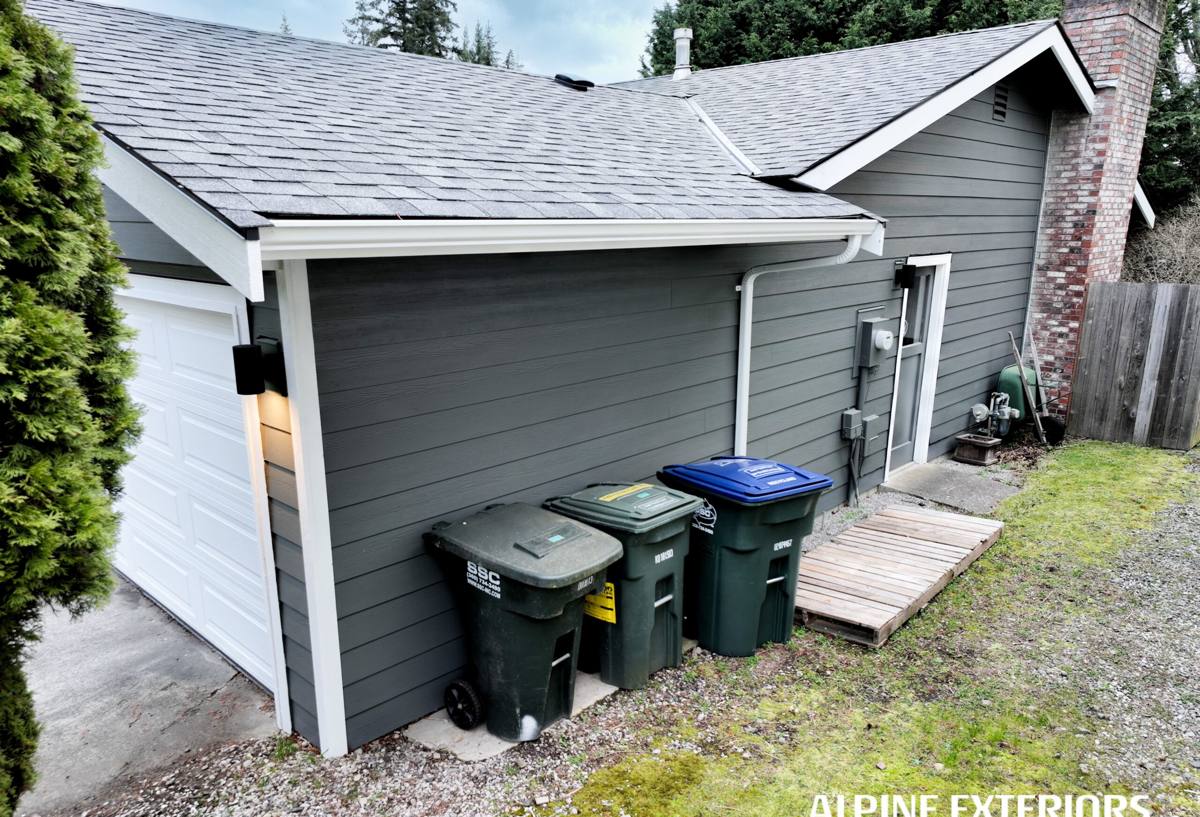
What Driving Rain and Salt Air Actually Do to Vertical Siding
Board & batten works by covering the seams between wide panels with narrow vertical strips (the "battens"). That seam is the whole game. If water gets behind a batten and can't drain back out, it sits against the substrate, the housewrap, or the sheathing — and it stays there far longer than water on a flat wall would, because gravity and airflow work against it rather than for it.
The Specific Failure Points We Watch For
- Battens face-nailed directly through both boards without allowing for expansion or drainage behind the seam
- No rainscreen gap, so any moisture that gets past the batten has nowhere to go and no way to dry
- Caulk used as the primary water barrier instead of proper flashing and lap details
- Butt joints in board runs that aren't backed or flashed, becoming entry points during wind-driven rain
- Bottom edges too close to grade, decks, or roof lines, where splash-back and standing moisture concentrate
Any one of these can look fine for a year or two. In a driving-rain, salt-air environment like Drayton Harbor's, they tend to show up as staining, soft spots, or paint failure well before a homeowner would expect to be dealing with siding problems at all.
Why We Only Build Board & Batten in James Hardie Fiber Cement
We don't install this pattern in vinyl, engineered wood, or primed spruce, and we won't cut a board & batten job into those materials even when a homeowner is set on the look. It isn't that those products can't be installed — it's that the pattern itself concentrates moisture risk at every seam, and we've made fiber cement our standard specifically because it holds up to that risk without the maintenance burden or failure modes we're not willing to put our name behind.
How the Materials Actually Compare for This Application
| Material | Behavior at seams/battens | Salt air / moisture performance | Long-term maintenance |
|---|---|---|---|
| James Hardie fiber cement | Dimensionally stable; won't swell, cup, or rot if water reaches the substrate | Non-combustible, doesn't corrode; factory ColorPlus finish resists salt-air fading | Occasional wash-down; repaint not required for decades with ColorPlus |
| Engineered wood / LP-style products | Wood-based core can swell or delaminate at exposed seam edges if moisture intrudes | Vulnerable to prolonged dampness; edge sealing is critical and easy to miss | Requires vigilant caulk/paint upkeep, especially at cut edges |
| Vinyl board & batten | Battens can warp or bow with temperature swings; not a true water-managed seam | Doesn't rot, but can crack or fade; seams rely on lap-and-lock fit rather than flashing | Low upkeep but limited repair options if damaged; color can't be refreshed |
| Primed spruce / solid wood | Real wood movement at every seam; battens loosen as boards shrink and swell seasonally | Highest risk in this climate; end grain and seams absorb moisture readily | Frequent repainting and caulk maintenance; shortest realistic service life here |
Fiber cement doesn't eliminate the need for good installation — nothing does — but it removes the material itself as a point of failure. That matters when the pattern you're choosing is inherently seam-heavy and the climate is this consistently wet.
What a Correct Board & Batten Job Involves
Board & batten is a system, not a look you nail onto a wall. Getting it right in a Drayton Harbor exposure means treating water management as the primary design consideration, not an afterthought.
Drainage Plane and Rainscreen Gap
A vertical furring strip or engineered rainscreen product behind the boards creates a gap that lets any incidental moisture drain and the wall assembly breathe. Without it, board & batten in a wet climate is essentially sealing moisture against the sheathing rather than shedding it.
Fastening That Accounts for Movement
Battens and boards need fastening patterns that account for fiber cement's minimal but real thermal movement, using corrosion-resistant fasteners rated for the material — not general-purpose nails that will streak or fail faster in salt air.
Flashing at Every Transition
Water tables, window and door heads, inside and outside corners, and the base of the wall near grade or a deck all need proper flashing, not caulk. Caulk is a maintenance item; flashing is the actual water-management layer, and it has to be right the first time because you can't inspect it once the siding is closed up.
Our Process for Drayton Harbor Projects
- On-site assessment — we look at wall orientation, exposure to prevailing wind and rain, moss and moisture staining on the existing siding, and any signs of trapped water at seams or trim
- Substrate and sheathing check — tear-off reveals whether the wall assembly underneath needs repair before new siding goes on; we don't cover up rot or compromised sheathing
- Rainscreen and weather-resistive barrier installation — set correctly before a single board goes up
- Board & batten installation to Hardie's fastening and clearance specifications — including proper gaps at grade, roof lines, and penetrations
- Flashing and trim detailing — the part that determines whether the job still looks and performs well in ten years
- Final walkthrough — we go over the finished work with the homeowner and point out any maintenance items specific to the site's exposure
Living With Board & Batten Through a Whatcom County Moss Season
No siding is maintenance-free in a climate this damp, but the maintenance burden should be light and predictable, not a recurring repaint-and-recaulk cycle.
What We Recommend to Drayton Harbor Homeowners
- Rinse siding annually, focusing on shaded, north-facing, or tree-covered walls where moss and algae take hold first
- Keep gutters and downspouts clear so overflow doesn't run directly down battens and seams
- Trim back vegetation and tree cover that keeps a wall section shaded and damp longer than the rest of the house
- Check caulking at trim and penetrations once a year, even with fiber cement, since sealant is still a wear item
- Watch for staining right after storms with sustained wind-driven rain — it's the earliest sign of a flashing or seam issue, not something to wait out
With James Hardie's factory ColorPlus finish, you're not on a repainting schedule the way you would be with wood or engineered wood board & batten, which is one of the most meaningful practical differences for a home exposed to this much salt air and moisture.
Cost Factors Specific to This Job
| Factor | Why it matters in Drayton Harbor |
|---|---|
| Wall exposure and orientation | Walls facing prevailing wind and rain need more rigorous flashing detail, which affects labor time |
| Condition of existing sheathing | Coastal moisture exposure sometimes means hidden repair work is found once old siding comes off |
| Batten spacing and reveal design | Narrower, more frequent battens mean more seams to flash and fasten correctly |
| Access and site conditions | Waterfront and sloped lots common near the harbor can affect scaffolding and staging |
| Trim and corner detailing | More architectural corners and transitions mean more flashing points, which is where quality separates jobs |
Why It Matters to Hire a Crew That Already Works This Area
Board & batten forgives almost nothing when it's installed by someone unfamiliar with how a specific site behaves through a wet season. A crew that has already worked walls along Drayton Harbor and the surrounding Semiahmoo area knows which orientations take the worst of the wind-driven rain, where moss tends to establish first, and how to detail flashing for a climate that doesn't give siding much of a break. That local pattern recognition — not just general installation skill — is what keeps a board & batten job looking sharp and performing well well past the point where a generic installation would start showing problems.
If you're weighing board & batten for a home in the Drayton Harbor area, we're happy to walk the property, look at your exposure and existing siding condition, and give you a straightforward assessment. Reach out for a free, no-pressure estimate using the form below.