 Semiahmoo
 Why Siding Along California Creek Wears Differently
Homes near California Creek sit in a spot where several tough conditions overlap instead of taking turns. The creek corridor holds moisture longer than open, sun-exposed lots — tree cover and low-lying ground slow evaporation after every storm, which stretches the region's already long wet season into something closer to a year-round dampness problem for exterior surfaces. Add in the salt-carrying air that moves inland off Semiahmoo Bay and Drayton Harbor, and siding here is dealing with a corrosive, moisture-loaded environment that a home twenty miles inland simply doesn't face in the same way.
Whatcom County's driving rain doesn't help. Wind-driven storms push water sideways into seams, laps, and fastener points that were designed for water running down a wall, not water being forced into it horizontally. Over years, that repeated wind-driven soaking finds every weak point in a siding system — a hairline crack, a caulk joint that's given up, a nail that backed out a sixteenth of an inch.
Then there's moss. Shaded, damp siding near tree lines and creek banks grows moss and algae for a much larger part of the year than siding on an open, sun-facing lot. Moss doesn't just look bad — it holds water against the surface, keeps siding from drying between rains, and on the wrong materials it accelerates rot, delamination, or paint failure. Any repair plan for a California Creek home has to account for all three of these factors at once, not just patch the visible damage and move on.
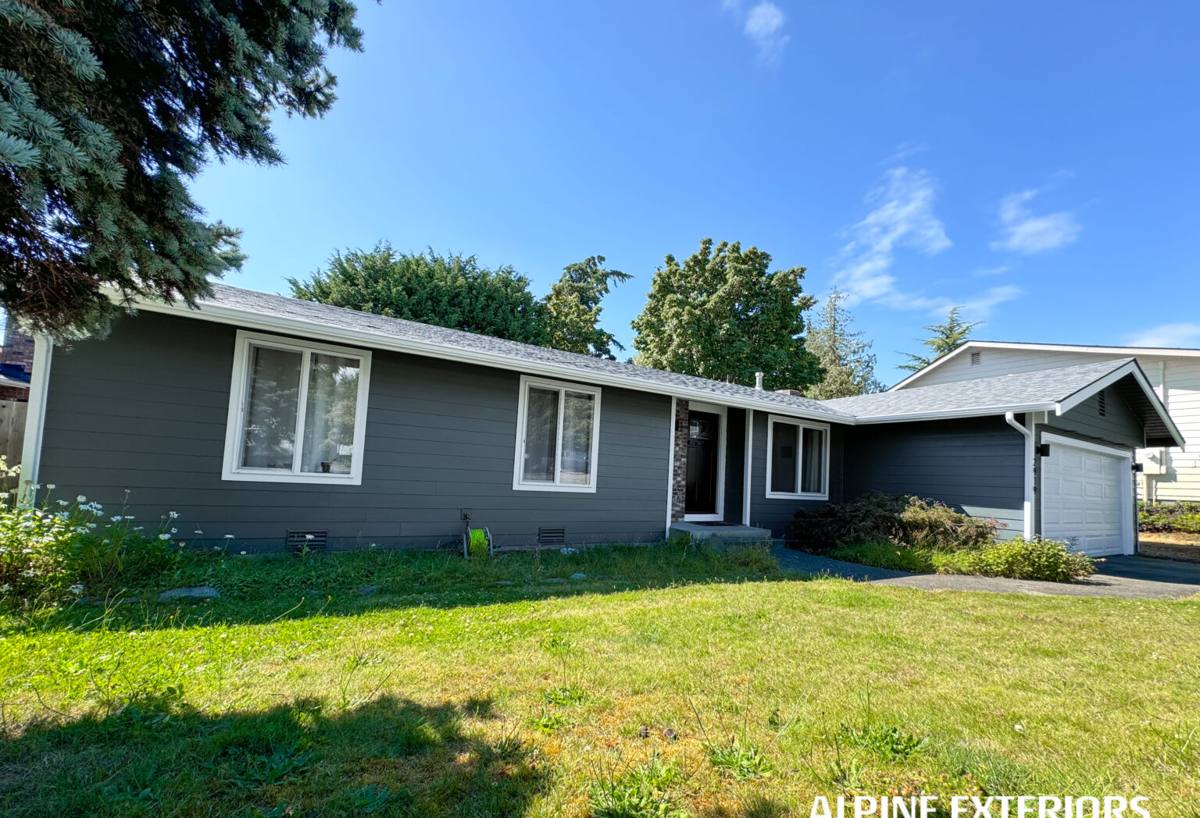
The Early Warning Signs Homeowners Miss
Siding damage in this climate rarely announces itself with a hole in the wall. It shows up as small, easy-to-dismiss changes that add up over a season or two. Homeowners who catch these early save real money, because a board replaced in year one is a repair — the same problem ignored until year four is often a rot repair that involves sheathing and framing too.
- Dark streaking or persistent green/black staining that comes back within weeks of cleaning
- Soft or spongy spots when you press on a board, especially near the bottom courses and around windows
- Visible gaps at butt joints, corners, or where siding meets trim, flashing, or the foundation
- Paint that's bubbling, peeling, or wearing unevenly in patches rather than across the whole wall
- Warping, cupping, or boards that no longer sit flat against the wall
- Caulk that's cracked, shrunk, or pulled away from a joint it used to seal
- A musty smell near an exterior wall inside the house, which often means moisture has already gotten past the siding
What "Correct" Siding Repair Actually Involves
A lot of siding repair is done as a surface fix — caulk over a gap, a dab of paint over a stain, a new piece face-nailed over the old one. In a dry climate that might hold up for a while. In a wet, salt-influenced, moss-prone area like this, surface fixes almost always fail early, because they don't address what let moisture in to begin with.
A repair done right starts by finding out why the damage happened, not just where it happened. That usually means pulling the damaged section, checking the condition of the water-resistive barrier and flashing behind it, and confirming there's no hidden rot in the sheathing before anything new goes back up. Skipping that step is the single most common reason a "repaired" wall shows the same problem again within a year or two.
It also means matching the repair to the original siding correctly — same reveal, same fastening pattern, same butt joint treatment — so the new section sheds water the way the rest of the wall does. A patch that's slightly proud of the surrounding boards, or fastened differently than the original installation, creates a new place for wind-driven rain to catch and pool.
Repair or Replace? Weighing the Real Factors
Not every damaged section needs a full re-side, and not every problem should be treated as "just a repair." The honest answer depends on how much of the wall is affected, what's causing the damage, and how old the existing siding is relative to its expected service life.
| Factor | Leans Toward Repair | Leans Toward Replacement |
|---|---|---|
| Extent of damage | Isolated boards or a single wall section | Damage scattered across multiple elevations |
| Root cause | A one-time issue (impact damage, a failed caulk joint) | Systemic moisture intrusion behind the siding |
| Age of siding | Well within its expected lifespan | Near or past the end of its service life |
| Underlying sheathing | Sound, dry, no rot found | Soft, discolored, or rotted sheathing discovered |
| Siding material | Fiber cement or sound wood in good condition | Chronic-issue material nearing failure across the board |
The middle ground matters too: if a wall has one bad section but the rest of the siding is old and starting to show the same early warning signs, a repair buys time but shouldn't be sold as a long-term fix. We'll tell you honestly which situation you're in rather than defaulting to whichever job is bigger.
Repair Considerations by Siding Material
What a repair involves — and how long it holds up in this climate — depends heavily on what's already on the house. Not every material repairs the same way, and that's worth knowing before you decide how to move forward.
| Existing Material | What Repair Looks Like Here | What to Know |
|---|---|---|
| Vinyl siding | Sections unclip and swap in relatively easily | Older color runs are hard to match exactly; brittle in cold snaps and prone to cracking on impact |
| LP SmartSide / OSB-based products | Damaged panels must be fully removed, including checking for edge swelling on neighboring boards | Once moisture gets into a cut edge or fastener hole, the board can swell from the inside out — repair success depends entirely on catching it early |
| Cedar or primed wood | Requires cutting back to sound wood, re-priming all cut edges, and repainting | Needs the most ongoing maintenance of any option in a moss-heavy, damp environment |
| James Hardie fiber cement | Section replacement with factory-matched ColorPlus finish or field-applied touch-up | Non-combustible, doesn't swell or rot, and holds its repair far more predictably than wood-based products |
We repair what's on your house today, whatever it is — but when a repair isn't worth it anymore, or when enough of the wall needs replacing that it makes sense to upgrade the material at the same time, we only install James Hardie fiber cement. It's engineered for exactly this kind of climate, and it's the one product we're willing to stand behind long-term.
Our Siding Repair Process
- On-site assessment. We look at the damaged area and the surrounding wall, check for moisture behind the surface, and identify the cause — not just the symptom.
- Honest scope and options. You get a clear explanation of what we found, whether it's a straightforward repair or something that points to a bigger issue, and what each path costs.
- Careful removal. Damaged material comes off without tearing up more of the wall than necessary, and we inspect the water-resistive barrier and flashing underneath before closing anything back up.
- Correct rebuild. Any compromised sheathing or flashing gets addressed first — a new piece of siding over a wet or rotted substrate is not a repair, it's a delay.
- Matched installation. New material is fastened, lapped, and sealed to match the performance of the original wall, so the repair blends in and sheds water the way it's supposed to.
- Final walkthrough. We show you what was done and what to watch for going forward, especially if other areas of the siding are showing early wear.
Why Local California Creek Experience Matters
A siding repair crew that mostly works drier, more sheltered neighborhoods will treat every job the same way. A crew that regularly works the creek corridors and bay-adjacent properties around Semiahmoo knows to check specific things first — the north- and shade-facing walls where moss builds up fastest, the lower courses closest to grade where splashback and standing moisture do the most damage, and the joints most exposed to wind-driven rain off the water. That familiarity shortens the diagnostic part of the job and means fewer surprises once a wall is opened up.
It also means we're not guessing about how a repair will hold up here — we've seen how each material and each type of patch performs after a few Whatcom County winters, and we build the repair to survive the next one, not just to look right the day we finish.
Keeping Repaired Siding From Failing Again
A good repair is only half the equation in this environment — what happens afterward matters just as much. A few habits go a long way toward protecting the work and the rest of the siding around it:
- Rinse moss and algae off shaded walls at least once a year before it gets a chance to establish and hold moisture
- Trim back tree limbs and brush that keep siding shaded and slow to dry after rain
- Check and refresh caulking at joints and trim on a regular schedule, since sealant fails well before siding does
- Keep gutters and downspouts clear so runoff isn't sheeting down the wall it should be routed away from
- Have any new staining or soft spots looked at promptly rather than waiting for the next scheduled maintenance
If you're noticing any of the early warning signs on a California Creek home, or you just want an honest read on whether what you're looking at is a simple repair or something bigger, we're happy to come take a look. The estimate is free, there's no pressure either way, and you'll get a straight answer about what your siding actually needs.