 Semiahmoo
 Why Roofs Age Faster in Custer's Marine Climate
Custer sits close enough to Semiahmoo Bay and the Strait of Georgia that salt-laden air is a constant factor, not an occasional one. Add Whatcom County's long stretch of driving rain each fall and winter, plus a moss season that can run from October through April, and you have three separate stresses working on a roof at the same time. None of them show up as a single dramatic failure — they show up as a slow trade of granule loss, softened decking, and lifted flashing that eventually adds up to a roof that's done well before its rated lifespan.
Salt Air and Metal Components
Salt air corrodes exposed metal faster than it corrodes almost anything else on a house. Nails, staples, flashing, and vent caps that aren't rated for coastal exposure can start showing rust streaks and pinholes years ahead of schedule. Once a fastener or flashing seam fails, water has a path into the roof deck, and that's when a roof that looked fine starts to show soft spots or interior staining.
Driving Rain and Wind-Driven Water
Rain that falls straight down is easy for any roof to shed. Rain that comes in sideways off the water is a different problem — it gets pushed up under shingle tabs, into open valleys, and around chimney and vent flashing that would be fine in calmer weather. A roof built for this area needs underlayment and flashing details that assume wind-driven rain is normal, not a rare event.
Moss and Trapped Moisture
Whatcom County's moss season is long, and Custer's tree cover and marine humidity give moss plenty of reasons to take hold on north-facing slopes and shaded valleys. Moss doesn't just look bad — it holds moisture against the shingle surface, works its way under tabs, and can lift edges enough for wind and rain to get a foothold. A roof with poor moss resistance built into the material and detailing will age noticeably faster than one that accounts for it from the start.
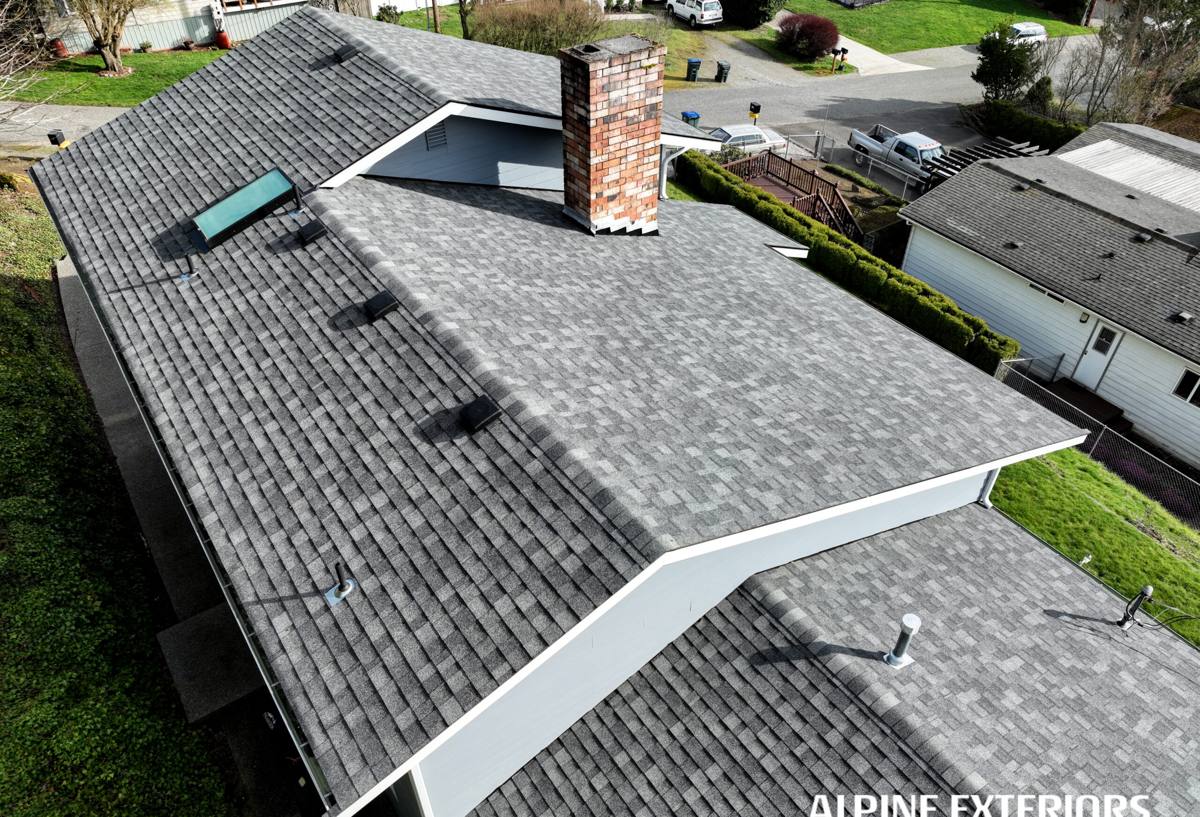
Signs a Custer Roof Needs Replacement, Not Just Repair
Not every roof problem calls for a full tear-off. But there's a point where patching individual issues costs more over time than doing the job once, correctly. Here's what tends to separate a repair situation from a replacement situation on homes in this area:
- Granule loss heavy enough that you can see bare asphalt on multiple slopes, not just one worn patch
- Moss and algae staining that returns within a year or two of cleaning, even after treatment
- Soft or spongy decking you can feel underfoot, usually near valleys, chimneys, or the eaves
- Daylight visible through the roof deck from inside the attic
- Curling, cupping, or cracked shingles across more than one section of roof
- Flashing around vents, chimneys, or skylights that's rusted, lifted, or was never properly sealed
- A roof approaching or past 20–25 years old with no major work done, especially on the sides that face prevailing weather
- Rising energy bills paired with poor attic ventilation — a sign the roof system as a whole isn't performing
If you're only seeing one or two of these, a targeted repair may still make sense. If several apply at once, that's usually the roof telling you it's past patching.
What a Correct Roof Replacement Actually Involves
A roof replacement is more than stripping old shingles and nailing down new ones. In a climate like Custer's, the parts you don't see matter as much as the shingles you do.
Full Tear-Off and Deck Inspection
We remove the existing roofing down to the deck rather than layering over it. That's the only way to actually see the plywood or plank sheathing underneath, catch any soft or delaminated sections caused by long-term moisture, and replace only what needs replacing before anything new goes down.
Underlayment Built for Wind-Driven Rain
Given how often rain here arrives at an angle, we treat underlayment as a real second layer of defense, not a formality. That means synthetic underlayment across the field and self-adhering, waterproof membrane at eaves, valleys, and anywhere water is likely to be pushed by wind rather than gravity.
Flashing Detail Work
Chimneys, skylights, sidewall intersections, and vent penetrations are where most leaks actually start. Correct step flashing, counter-flashing, and sealed penetrations matter more here than almost anywhere else on the roof.
Ventilation That Matches the Climate
Balanced intake and exhaust ventilation keeps moisture from condensing inside the attic — a real risk in a humid marine climate — and helps shingles run cooler and last longer. A roof replacement is the right time to correct ventilation that was undersized or mismatched the first time around.
Choosing a Roofing Material for This Climate
There's no single "best" roofing material for every home, but some hold up better than others against salt air, driving rain, and moss. Here's how the common options compare for a property like this:
| Material | Salt Air Resistance | Moss Resistance | Maintenance |
|---|---|---|---|
| Architectural asphalt shingle | Good, with corrosion-resistant fasteners and flashing | Moderate; benefits from copper or zinc strips at ridges | Low to moderate; periodic moss treatment recommended |
| Standing seam metal | Very good when using coastal-rated, coated panels | Very good; moss struggles to grip a smooth metal surface | Low; occasional fastener and seam checks |
| Cedar shake | Fair; needs regular treatment and inspection | Poor without diligent upkeep; wood holds moisture | High; requires ongoing maintenance to avoid premature decay |
| Composite/synthetic shake | Good | Moderate to good, depending on product design | Low to moderate |
We're upfront about the trade-offs of each option rather than pushing one product on every roof. Cedar shake, for example, can look great, but it asks for more ongoing attention in a climate this wet and mossy than most homeowners want to commit to. Architectural asphalt shingle remains the most common choice locally because it balances upfront cost, appearance, and reasonable maintenance — as long as the underlayment and flashing details are done right underneath it.
Our Roof Replacement Process
- On-site evaluation — we walk the roof, check the attic, and look at ventilation, flashing, and deck condition before quoting anything.
- Written scope and material selection — you get a clear breakdown of what's being replaced, what materials are proposed, and why, in language that doesn't require a roofing background to understand.
- Tear-off and deck repair — old roofing comes off, the deck gets inspected, and any soft or damaged sheathing is replaced before anything new goes down.
- Underlayment and flashing installation — waterproof membrane at vulnerable areas, synthetic underlayment across the field, and new flashing at every penetration and transition.
- New roofing installation — installed to manufacturer specifications, with attention to nailing pattern and exposure since both affect wind and rain performance.
- Ventilation check and final walkthrough — we confirm intake and exhaust are balanced and walk the finished roof with you before calling the job done.
- Cleanup — magnetic sweep for nails, debris removal, and a final site check.
What Affects the Cost of a Roof Replacement in Custer
Every roof is priced on its own specifics, but the same handful of factors drive most of the variation between one project and the next:
| Factor | Why It Affects Cost |
|---|---|
| Roof size and number of slopes | More square footage and more complex slope layouts mean more material and labor time |
| Roof pitch and accessibility | Steeper or harder-to-access roofs require more safety equipment and slower, more careful work |
| Number of existing layers | Removing multiple old layers takes longer than a single tear-off and increases disposal costs |
| Deck condition | Rotten or soft sheathing found during tear-off needs replacement, which isn't always visible until the old roofing is off |
| Material choice | Standing seam metal and cedar shake cost more upfront than architectural asphalt shingle |
| Flashing and ventilation upgrades | Correcting undersized ventilation or outdated flashing adds labor but reduces future problems |
| Permitting and disposal | Whatcom County permit requirements and dump fees are part of every legitimate quote |
We'd rather walk your roof and give you a number based on what's actually there than quote a price over the phone. Roofs that look similar from the ground can have very different decking conditions once the old material comes off.
Why Local Experience in the Semiahmoo Area Matters
A crew that only occasionally works this far north in Whatcom County will treat salt air and driving rain as edge cases. A crew that works Custer and the surrounding Semiahmoo area regularly treats them as the baseline — because they are. That shows up in small decisions: which fastener grade gets used without being asked, where extra underlayment goes even when it's not the cheapest option, and which roofing details actually hold up to a winter of wind off the water. It also means familiarity with Whatcom County permitting and the realities of scheduling around this area's weather windows, so a project doesn't stall out waiting on a dry stretch that a more experienced local crew would have planned around from the start.
Keeping Your New Roof Performing After Installation
A correctly installed roof still benefits from basic upkeep in this climate:
- Have moss growth treated at the first sign of it rather than waiting for a visible mat to form
- Keep gutters clear so water isn't backing up under the shingle edge during heavy rain
- Trim back overhanging branches that keep shaded areas of the roof damp longer than the rest
- Check attic ventilation isn't blocked by insulation or debris
- Schedule a visual roof check after major windstorms, especially ones with sustained wind off the water
None of this requires a contractor visit every year, but a quick look after the first winter or two catches small issues while they're still small.
If your roof is showing signs of wear, or you just want an honest read on how much life it has left, we're glad to take a look. Fill out the form below for a free, no-pressure estimate on roof replacement for your Custer home.