 Semiahmoo
 Building a Deck That Actually Holds Up in Laurel
Laurel sits inland from Semiahmoo Bay but still squarely inside the same wet, marine-influenced weather system that soaks Whatcom County most of the year. That means any deck built here has to deal with long stretches of driving rain, salt-tinged air moving up from the water on windier days, and a moss season that can run from October clear through April. A deck that would hold up fine in a dry inland climate can start failing here in five or six years if it wasn't built with this specific weather in mind. A deck built right for Laurel can go two to three times that long.
We build and replace custom decks for homes in Laurel as part of our regular service area, and the lessons we've learned here are pretty consistent: most deck failures aren't about the decking boards themselves — they're about what's underneath and behind them. Flashing, fasteners, drainage, and framing choices matter more than which decking product ends up on top.
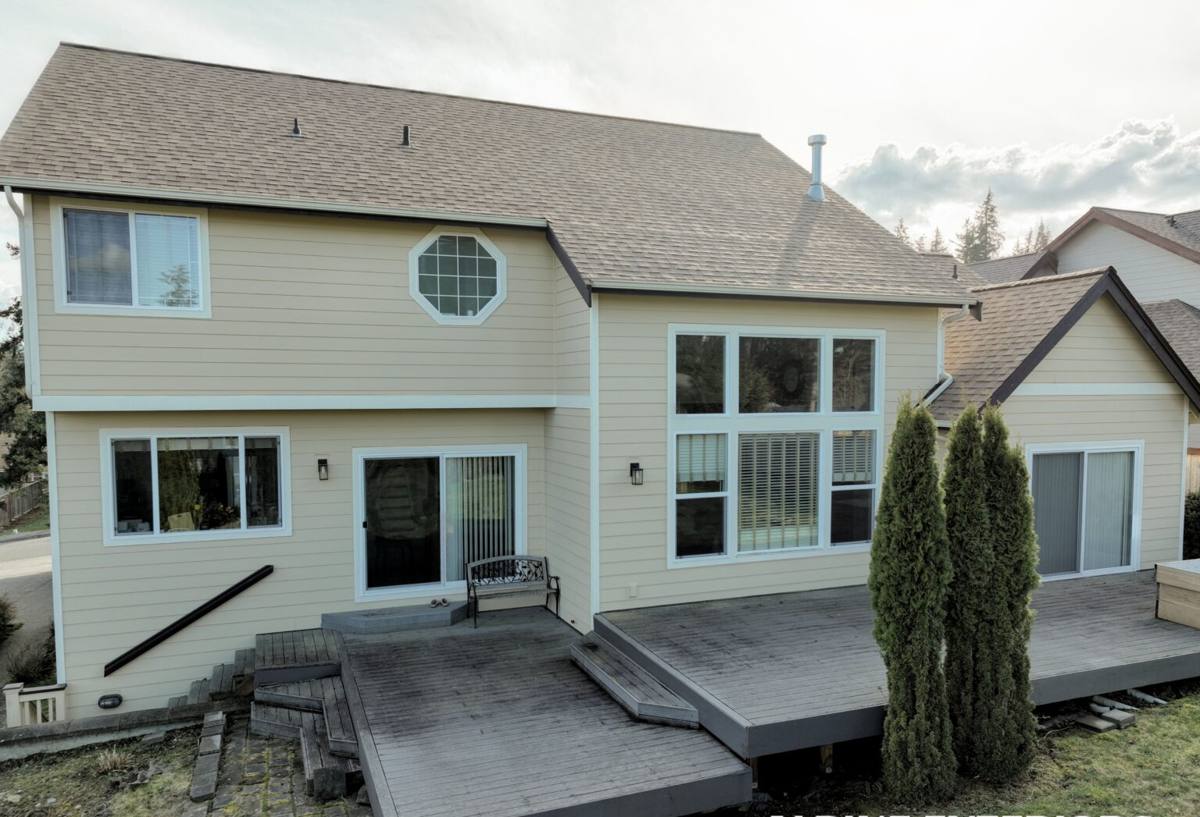
What Whatcom County's Climate Does to an Unprotected Deck
Moisture That Never Fully Dries Out
In a lot of the country, decks get a hard freeze-thaw cycle and then months of dry heat that lets wood shed moisture. Here, we get long grey stretches where humidity stays high and framing members never get a real chance to dry between rains. Untreated or poorly sealed wood framing under a deck can sit damp for weeks at a time, which is exactly the condition rot fungus needs.
Moss and Algae Buildup
Moss doesn't just make decking slippery — on wood decking especially, moss and algae hold moisture against the board surface and accelerate graying, checking, and softening. North-facing decks and decks shaded by trees or the house itself are the worst affected, and Laurel has plenty of both tree cover and homes with north-side deck exposure.
Salt-Influenced Air
Being close to Semiahmoo Bay and the Strait of Georgia means fasteners, hardware, and metal flashing here see more corrosive exposure than the same materials would inland. Standard zinc-coated screws and generic flashing can start showing rust streaks and pitting well before a wood-framed deck's structural life is up.
What a Deck Built for This Region Needs to Get Right
Regardless of what decking material ends up on the surface, a deck built correctly for Laurel's climate gets these things right:
- Ledger board flashing that fully sheds water away from the house rim joist, not just a bead of caulk behind the ledger
- Stainless steel or heavy hot-dip galvanized fasteners and structural hardware rated for coastal/marine exposure
- Joist tape or a butyl flashing membrane on top of every joist to keep decking fasteners from creating a rot point
- Footings poured below the local frost line and sized for the soil conditions on the specific lot
- Deck board spacing and slope that actually lets water run off instead of pooling
- Under-deck airflow — skirting that doesn't seal the underside off from ventilation
Skip any one of these and you're not saving much time or money up front — you're just moving the failure point from the decking surface down into the framing, where it's far more expensive to fix.
Choosing a Decking Material for Laurel Conditions
There's no single "best" decking material — it's a real trade-off between upfront cost, maintenance commitment, and how the material actually behaves in a wet, moss-prone climate. Here's how the common options compare for a Laurel installation:
| Material | Upfront Cost | Maintenance | Moisture/Moss Behavior | Typical Lifespan Here |
|---|---|---|---|---|
| Pressure-treated fir/hem-fir | Lowest | Annual cleaning + re-sealing recommended | Prone to graying, checking, and moss buildup without upkeep | 10-15 years |
| Cedar | Moderate | Periodic staining/sealing for appearance and rot resistance | Naturally rot-resistant but softens if neglected in shade | 15-20 years |
| Capped composite | Higher | Occasional wash, no staining or sealing | Sheds moisture well, resists moss staining, doesn't absorb water into the core | 25-30+ years |
| PVC decking | Highest | Wash only | Essentially impervious to moisture; can still get slick with moss film | 30+ years |
We're upfront with Laurel homeowners about this trade-off rather than pushing one product line: wood costs less to install but costs more in upkeep and shorter lifespan in this climate. Composite and PVC cost more upfront but remove most of the maintenance burden that our weather otherwise demands. There's no wrong answer here as long as the choice matches how much upkeep you actually want to do.
Framing, Footings, and Ledger Details That Matter Here
The part of a deck nobody sees is the part that determines whether it's still standing solid in fifteen years. On every Laurel deck we build, we treat these as non-negotiable:
Ledger Attachment
The ledger board — where the deck attaches to the house — is the single most common source of hidden rot in this climate. Proper flashing directs water down and away from the house sheathing rather than letting it wick behind the ledger, which is where slow, invisible rot damage usually starts.
Footings Sized for Whatcom County Conditions
Footing depth and diameter need to account for local frost depth and the soil conditions on the actual lot, not a generic assumption. Undersized or shallow footings are a common shortcut on lower-cost deck builds, and they show up years later as a deck that's noticeably bouncy or has started to shift.
Joist Protection
Every joist top should get a protective tape or membrane before decking goes down. It's a small material cost that prevents the single most common spot for framing rot to start — right where a fastener penetrates the joist and creates a channel for water.
Railings, Code, and Permits
Custom deck work in Whatcom County is subject to building code requirements that we handle as a standard part of the job, including guardrail height, baluster spacing, and structural attachment requirements for any deck above a certain height off grade. Permitting requirements can vary depending on the deck's size, height, and whether it's a replacement versus new construction. We pull the necessary permits and build to code as a matter of course — not an upsell — because a deck that doesn't pass inspection is a liability for the homeowner down the line, whether that's a resale issue or an insurance issue after the fact.
How We Approach a Laurel Deck Project
- On-site assessment — we look at sun/shade exposure, drainage on the lot, existing structure if it's a replacement, and how the deck will actually be used
- Material discussion — honest walk-through of the wood-versus-composite trade-off for that specific spot and budget
- Design and permit prep — sizing footings, framing layout, and railing plan to code before any digging starts
- Demo of the old deck (if replacing) — including an honest look at whether the ledger and rim joist behind it have hidden damage
- Framing and flashing — the structural work described above, done the same way regardless of whether it's a small deck or a large one
- Decking, railing, and finish work — installed per manufacturer spacing specs for whichever material was chosen
- Final walk-through — so the homeowner understands what maintenance (if any) their specific decking choice actually needs
Maintenance Checklist for a Longer-Lasting Deck
Whatever material a Laurel deck ends up with, a short annual routine goes a long way in this climate:
- Clear leaves and debris from between deck boards before fall rains set in
- Wash off moss and algae film in early spring before it gets a foothold for the season
- Check railing posts and stairs for any looseness once a year
- Inspect the ledger flashing area for staining or gaps, especially after a hard winter
- Re-stain or re-seal wood decking on the schedule the product actually needs — don't stretch it
- Keep under-deck skirting vents clear so airflow can keep the framing dry
Why a Crew That Already Works Laurel Matters
A deck built by a crew that doesn't build regularly in this specific climate will often make reasonable-sounding decisions that just don't hold up here — standard fasteners instead of coastal-rated hardware, a ledger flashing detail that works fine in a drier region, or a footing depth based on a different area's frost line. None of those choices look wrong on the day the deck is finished. They show up as problems three, five, or ten years later, usually as a repair bill that's larger than the cost difference would have been at the start. Working in Laurel and the surrounding Semiahmoo-area communities regularly means we're not guessing at how this specific weather treats a deck over time — we've seen it.
If you're planning a new custom deck or replacing one that's showing its age, we're happy to come take a look and talk through what makes sense for your specific spot and budget. There's no pressure and no cost to get an estimate — the form below gets you started.