 Semiahmoo
 Why Peace Arch Decks Wear Out Faster Than the Manufacturer's Warranty Suggests
Decks in the Peace Arch area take a harder beating than the same deck would a hundred miles inland. Sitting this close to the water, homes here get salt-laden air pushed in off the strait on a regular basis, and that salt finds every exposed fastener, every cut end of a board, and every spot where two pieces of wood or composite meet. Add Whatcom County's long, wet winters — months of driving rain that comes in sideways as often as straight down — and you've got a structure that's rarely fully dry from October through April. Then there's moss. It doesn't just grow on roofs here; it takes hold on deck boards, railings, and especially on the shaded north sides of houses, where it holds moisture against the wood long after the rain stops.
None of this means a deck can't last. It means a deck built without those three factors in mind — salt, rain, and moss — will fail early, usually starting at the framing and fasteners long before the surface boards look obviously bad. We've replaced decks in this area that looked fine from ten feet away but had soft joists, rusted-out hangers, and rotted ledger connections underneath. That's the gap between a deck that looks okay and one that's actually sound.
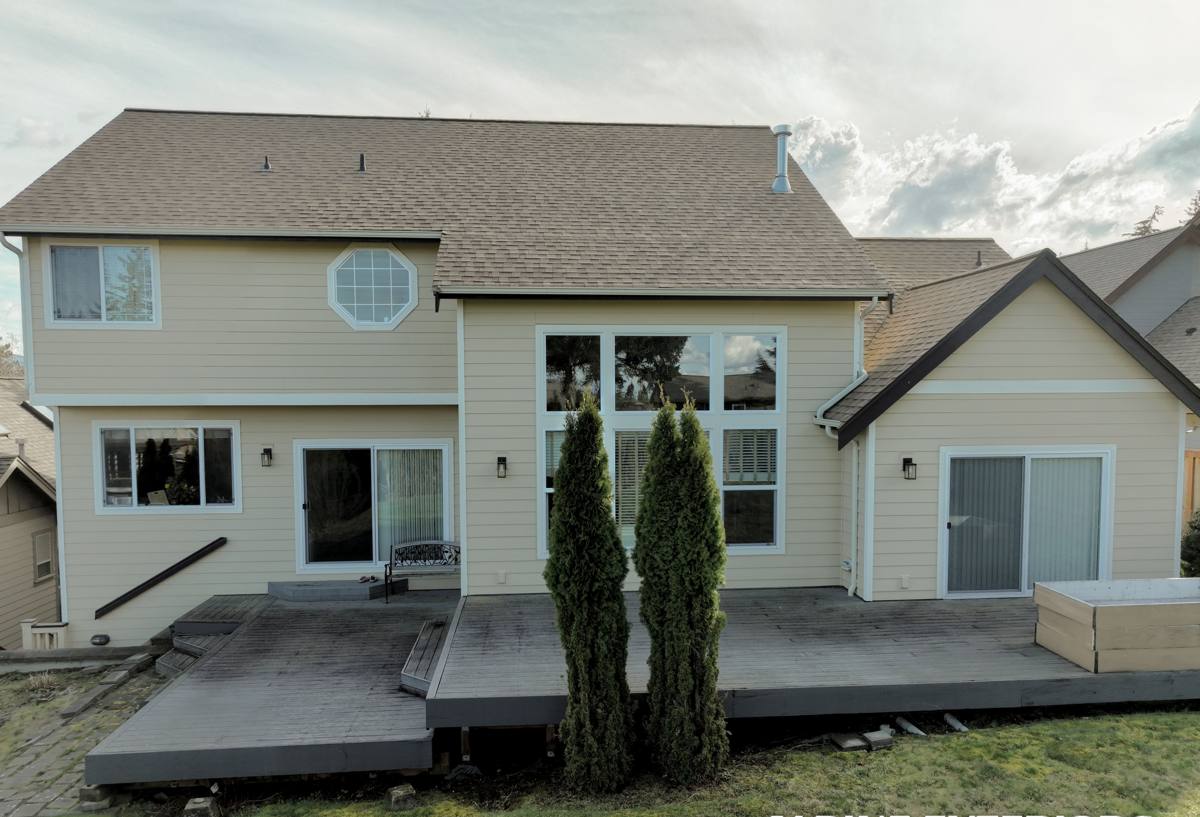
Signs a Peace Arch Deck Needs Replacement, Not Just Repair
Repair makes sense when the problem is isolated. Replacement is the honest call when the damage has spread into the structure itself. Here's what we look for during an inspection:
- Soft or spongy spots when you walk the deck, especially near the house or along the rim joist
- Rust streaking below joist hangers, screws, or bolts — a sign moisture has been sitting on the metal for a while
- Gaps or separation where the ledger board meets the house, which often means water has been getting behind it
- Persistent green or black growth that comes back within weeks of cleaning, particularly on shaded boards
- Railings that flex or feel loose at the post base, which usually points to rotted blocking or a failed post connection
- A deck more than 15-20 years old built before improved flashing tape and coated fastener standards were common
If two or more of these show up, we'll usually recommend pulling the decking to look at the frame before quoting anything. A deck that needs new joists, new ledger flashing, and new footings isn't really a repair anymore — it's a replacement with the same footprint.
What a Correct Deck Replacement Involves Here
The Frame Comes First
The part of the job nobody sees after it's done is the part that matters most in this climate. Joists get resized where code and load require it, hardware is stainless or coated for salt exposure rather than standard galvanized, and every joist top gets protected with flashing tape before decking goes down. That tape is a small material cost that prevents the single most common failure point we find on older decks — rot starting at the top of the joist where fasteners puncture it.
Ledger Attachment and Flashing
Where the deck attaches to the house is the highest-risk connection on the whole structure, and it's the one that fails most often when a deck was built quickly or by someone unfamiliar with wet-climate detailing. Proper flashing at the ledger — installed so water sheds away from the house rather than behind the board — is not optional in a region that sees this much driving rain.
Fasteners and Hardware
Standard hot-dip galvanized hardware holds up fine in a dry climate. Near the water, it corrodes faster than most homeowners expect. We spec stainless steel or heavy-coated fasteners for anything in direct salt-air exposure, and we don't mix metals in ways that cause galvanic corrosion between hardware and fastener.
Footings
Where footings are undersized, cracked, or set too shallow for the soil conditions common around Semiahmoo, we replace them as part of the job rather than build a new deck on a compromised base.
Decking Material Choices for This Climate
There's no single right answer for every home — it depends on budget, maintenance appetite, and how much sun versus shade the deck gets. Here's how the common options actually perform under salt air, rain, and moss pressure:
| Material | Moisture & Salt Behavior | Moss Resistance | Maintenance | Rough Cost Position |
|---|---|---|---|---|
| Pressure-treated wood | Absorbs moisture; needs sealing to slow it | Low — porous surface holds spores | Annual cleaning/sealing recommended | Lowest upfront |
| Cedar | Naturally moisture-resistant but still needs finish | Moderate | Periodic staining to maintain look and protection | Mid-range |
| Composite decking | Doesn't absorb water into the board core | Better, though surface film can still host moss in deep shade | Low — occasional wash | Mid to upper |
| PVC/capped composite | Fully sealed surface, minimal moisture uptake | Best of the common options | Lowest — wash only | Highest upfront |
We'll be straight with you about trade-offs rather than pushing whatever's easiest to install. Composite and PVC cost more up front but make sense for homeowners who don't want a sealing schedule. Wood costs less initially but only holds up if the maintenance actually happens — and in a climate that's wet more months than it's dry, that maintenance window is shorter than it is elsewhere.
Drainage and Airflow Under the Deck
A deck that can't shed water and dry out between storms is a deck that's rotting slowly no matter what decking material sits on top. Part of a correct replacement is making sure the space underneath has enough airflow and slope to drain, and that nothing — stored firewood, dense landscaping, a solid skirt with no vents — is trapping moisture against the framing. This is a detail that's easy to overlook because it doesn't affect how the deck looks, only how long it lasts.
Our Process, Start to Finish
- On-site assessment — we walk the existing deck, check the frame where accessible, and talk through what you actually use the space for
- Written estimate — scope, material options, and a clear price, not a range that grows once work starts
- Permit handling — we pull what's required for the scope of work rather than skip it to save time
- Demo and disposal — old decking and, where needed, old framing removed and hauled off
- Frame and structure — joists, ledger flashing, hardware, and footings addressed before any decking goes down
- Decking and railings installed — per manufacturer spec for whichever material you've chosen
- Final walkthrough — we check the work with you before we consider the job done
Permits and Working This Close to the Border
Deck replacement work in Whatcom County typically requires a permit once you're rebuilding structure — not just swapping a few boards — and setback rules can matter more on some Peace Arch-area lots than they would elsewhere, particularly on properties with less depth between the house and the property line. We handle the permit application as part of the job rather than leaving it for the homeowner to sort out, and we won't start structural work on a job that should be permitted without one. If you're not sure whether your project needs a permit, that's a five-minute question we're happy to answer before you commit to anything.
Why a Crew That Already Works Peace Arch Matters
A lot of deck problems in this specific area trace back to work that was done correctly for a drier climate but not for this one. Fastener choice, flashing detail, and even the timing of when boards are installed relative to the rainy season all make a real difference here. A crew that's already doing this work in and around Semiahmoo isn't guessing at how much moss pressure a north-facing deck will see, or how fast standard hardware corrodes this close to the water — that's just the baseline knowledge from working the area repeatedly. It also means we're not learning the local permit process on your job.
Cost Factors for a Peace Arch Deck Replacement
We don't publish fixed pricing because deck size, framing condition, material choice, and site access all move the number — but here's what actually drives cost on a job like this:
- Deck size and shape (multiple levels or angles cost more than a simple rectangle)
- Condition of the existing frame and footings once we open it up
- Decking material selected (see the comparison above)
- Railing style and any code-required guard height changes
- Site access — decks over grade, near slopes, or with tight equipment access take longer
- Permit and inspection requirements for the scope of work
Most straightforward wood-frame decks with composite or PVC decking land in a broad mid-four to low-five-figure range depending on size and material; a full accurate number only comes from seeing the site and the existing structure in person.
If your deck is showing any of the signs above, or you just want an honest read on whether it needs repair or replacement, we're glad to come take a look. The estimate is free, there's no pressure to book anything on the spot, and you'll get a straight answer about what your deck actually needs — use the form below to get started.