 Semiahmoo
 Why Decks Struggle in Drayton Harbor
Drayton Harbor sits right where Semiahmoo's shoreline meets Whatcom County's wet, marine climate, and that combination is hard on outdoor structures. Salt-laden air off the harbor accelerates corrosion on anything metal, driving rain gets pushed sideways into ledger boards and stair stringers, and the long stretch of grey, damp months from fall through spring gives moss and algae months to take hold on any surface that doesn't drain and dry quickly. A deck built to a generic spec sheet, without accounting for these conditions, tends to show problems early — soft spots at the ledger, green film on the boards by the second winter, corroded fasteners bleeding rust streaks into the decking.
Composite decking handles this environment better than wood in some respects, but it is not maintenance-free, and it is not immune to bad installation choices. The material choice matters less than the details underneath it: framing, flashing, fastener selection, and airflow. Get those wrong and even the best composite board will fail early. Get them right and a composite deck in this climate can look good and perform well for decades.
What Composite Decking Actually Is
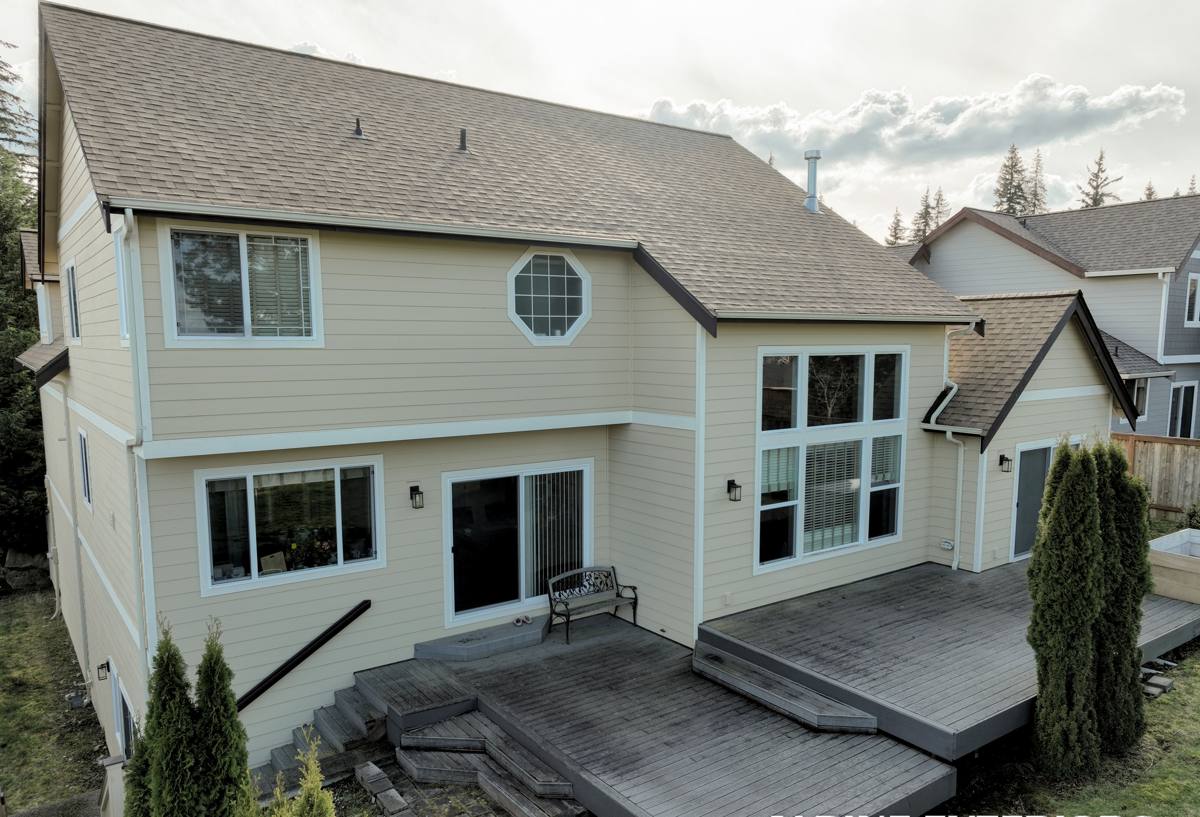
Composite decking is a blend of wood fiber and plastic, capped or coated to resist moisture absorption, staining, and UV fading. It doesn't need annual staining or sealing the way real wood does, it won't splinter, and it resists the kind of surface rot that shows up on cedar or fir decking after a few damp winters. That said, composite boards still expand and contract with temperature and moisture, they still need proper spacing and ventilation underneath, and cheaper composite products can hold moisture at the core if the capping is thin or damaged during installation.
We don't push one specific composite brand as a blanket answer for every project. Boards vary in board density, cap thickness, color-fastness, and warranty terms, and the right choice depends on budget, how much direct salt exposure the deck gets, and whether the homeowner wants a wood-look grain or a more uniform modern finish. Part of our estimate conversation is walking through those trade-offs honestly rather than steering toward whatever happens to be in stock.
Where Composite Makes Sense in This Area
- Decks with direct or partial water/harbor views, where salt spray and wind-driven rain are a daily reality
- Homes where the owner doesn't want a yearly staining or sealing routine
- Replacement decks where the old wood deck showed rot, cupping, or repeated moss buildup
- Elevated decks over living space, where a failed board or fastener is a bigger problem than on a ground-level patio deck
What a Correct Installation Involves
The composite boards themselves are the visible 10% of the job. The other 90% — framing, ledger attachment, flashing, and fastening — determines whether the deck holds up in this climate. This is the part that separates a deck that looks fine at handoff from one that's still solid in fifteen years.
Ledger and House Connection
Where the deck attaches to the house is the single most common failure point on any Pacific Northwest deck, composite or not. Wind-driven rain off the harbor will find any gap in flashing at the ledger board, and once water gets behind the siding at that connection, rot spreads into the house framing, not just the deck. A correct ledger install uses proper flashing integrated with the house's water-resistive barrier, not just caulk over a lag-bolted board.
Framing and Substructure
Composite decking is heavier than wood per square foot in some product lines, and it needs blocking, joist spacing, and support that matches the manufacturer's span tables — not the looser spacing that's sometimes acceptable for cedar. We frame to the composite manufacturer's actual specifications, not general lumber-yard rules of thumb, because under-spanned composite boards will sag and bounce over time even though they don't rot.
Airflow Underneath
Composite boards need air moving underneath them to shed the moisture that inevitably gets driven in from the sides during a storm. Decks built low to the ground, or with skirting that seals off airflow completely, trap humidity underneath — which doesn't rot the composite boards themselves but does encourage mold and moss growth on the underside and around the framing, and it shortens the life of any wood substructure.
Fasteners and Hardware for a Salt-Air Environment
This is the detail most likely to get skipped by a crew that doesn't regularly work this close to the water. Standard galvanized fasteners corrode faster in salt air than they would a few miles inland, and once a hidden fastener starts rusting under a composite board, you get staining and eventual board movement with no easy way to inspect it. For Drayton Harbor projects we specify stainless steel or coated fasteners rated for coastal exposure at every structural connection — ledger bolts, joist hangers, and hidden deck-board clips — not just at the points that are visible.
| Hardware Type | Standard Grade | Coastal-Rated Choice |
|---|---|---|
| Structural bolts/lags | Galvanized steel | Stainless steel or hot-dip galvanized to a higher spec |
| Joist hangers | Standard G90 galvanized | Triple-zinc or stainless in high-salt-exposure zones |
| Hidden deck clips | Basic coated steel | Stainless steel clips matched to the board brand |
| Flashing | Aluminum | Corrosion-resistant flashing compatible with adjacent metals |
Moss, Algae, and Drainage
Whatcom County's long wet season — realistically October through May most years — means any north-facing or shaded section of a deck is going to grow moss and algae unless water is actively shedding off the surface. Composite decking resists moss taking root the way it does on porous wood, but a film of algae can still build up on boards that stay damp for weeks at a stretch, and it makes the surface slick.
Two things control this more than anything else: board spacing that lets water drain through rather than pool, and a surface texture that isn't so smooth it becomes slippery when wet. We also grade and slope the substructure slightly away from the house so water sheets off rather than sitting against the ledger — a detail that matters more here than in a drier climate.
Our Process for a Drayton Harbor Deck
- Site visit and assessment — we look at sun/shade exposure, wind direction relative to the harbor, existing structure condition if this is a replacement, and how the deck ties into the house.
- Material and layout conversation — board brand, color, railing style, and any structural changes needed to meet current code and span requirements.
- Framing and flashing — the substructure work described above, built to hold up in this exposure, inspected before boards go down.
- Composite installation — proper spacing, fastening, and picture-framing or border detail if specified.
- Final walkthrough — we go over the finished deck with the homeowner, including basic care so the warranty stays intact.
Composite vs. Wood for This Climate
| Factor | Wood Decking | Composite Decking |
|---|---|---|
| Annual maintenance | Staining/sealing needed regularly | Occasional cleaning, no staining |
| Moss/algae resistance | Porous surface, holds moisture | Capped surface sheds moisture faster |
| Salt air durability | Depends on species and upkeep | Generally stable if properly installed |
| Upfront cost | Lower material cost | Higher material cost, lower long-term upkeep |
| Repair approach | Board-by-board replacement, easy to match | Board replacement possible, color matching can shift over time |
Why Hire a Crew That Already Works Drayton Harbor
A lot of the decisions above — which fasteners to spec, how much slope to build in, where flashing needs extra attention — come from having actually built and repaired decks in this specific stretch of coastline, not from a generic installation manual. Crews unfamiliar with Semiahmoo's exposure sometimes use standard hardware and standard spacing because it's what they use everywhere else, and the deck looks fine for a year or two before the salt air starts working on it. We've seen what happens when that shortcut gets taken, and we build to avoid it from day one.
There's also a permitting and code angle worth mentioning: guardrail height, stair geometry, and structural connections on an elevated deck are inspected the same way here as anywhere in Whatcom County, and a crew that pulls permits regularly in this area moves through that process without surprises for the homeowner.
Keeping a Composite Deck in Good Shape
- Rinse the deck a few times a year, more often in shaded or north-facing areas prone to algae
- Sweep debris out of gaps between boards so water keeps draining freely
- Check railing posts and stair connections annually for any looseness
- Keep planters and furniture feet off direct contact where possible to avoid trapping moisture
- Address any staining or discoloration early rather than waiting — it's usually a drainage or airflow issue, not a defect in the board itself
If you're planning a new deck or replacing an aging one in Drayton Harbor, we're happy to walk the site, look at your specific exposure, and put together a straightforward estimate — no pressure, no upsell on materials you don't need. Use the form below to get started.