 Semiahmoo
 Why Drayton Harbor Siding Takes a Different Kind of Beating
Homes along Drayton Harbor sit right where marine air off Semiahmoo Bay meets the wind funneling down from the Strait of Georgia. That combination means siding here deals with three things at once: salt-laden air that accelerates corrosion on fasteners and trim, wind-driven rain that gets forced sideways into joints and laps, and a moss season that runs longer than almost anywhere else in Whatcom County because homes sit shaded and damp for months at a stretch. Any one of those on its own is manageable. All three, year-round, is what actually wears siding out early.
The failures we see on Drayton Harbor homes are rarely dramatic. It's caulk lines that crack and let water track behind a board. It's a fastener that wasn't rated for coastal exposure starting to bleed rust through a factory finish. It's north- and west-facing walls that never fully dry out between storms, so algae and moss get a permanent foothold. None of that is a materials problem you can paint your way out of — it's a product-and-installation problem, and it's why we're specific about both.
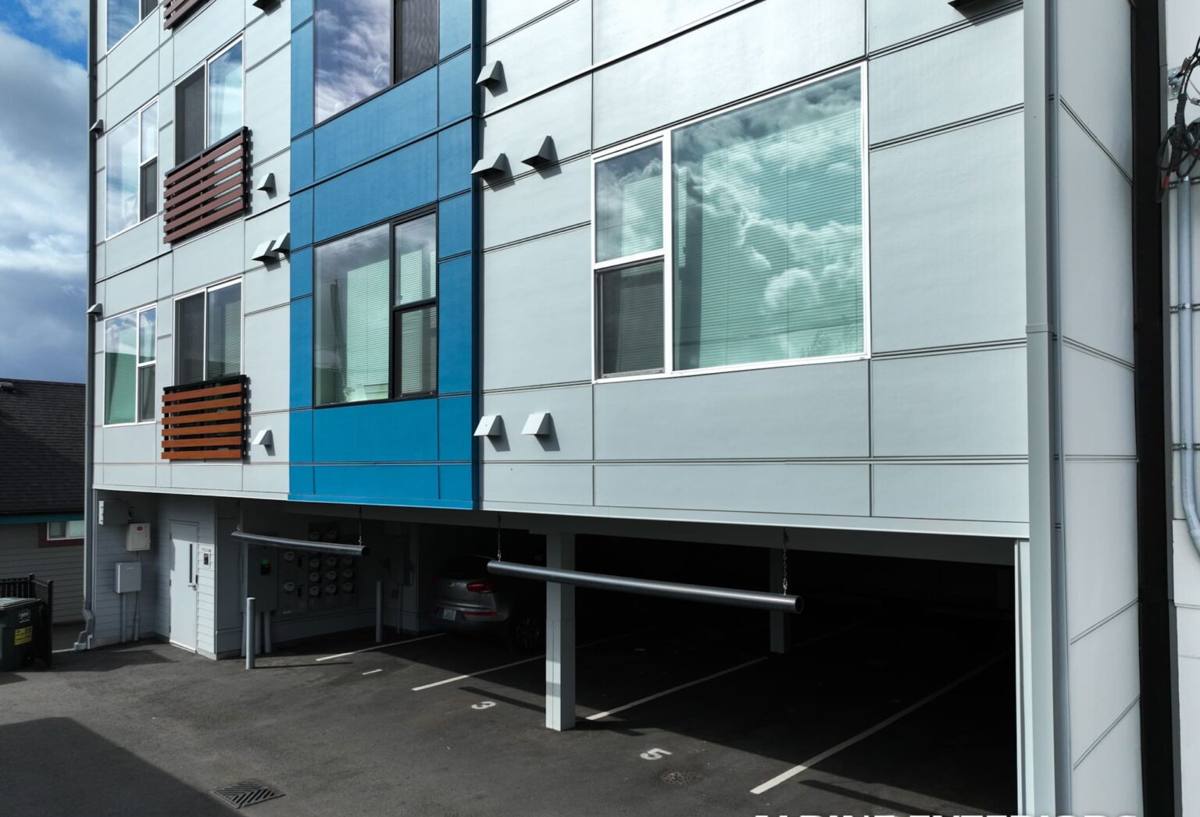
What Fiber Cement Has to Do Right in This Climate
Moisture Management Comes First
Fiber cement itself doesn't rot, and it doesn't feed mold the way wood-based products can. But it still has to be installed with a drainage path behind it — a weather-resistive barrier, correct flashing at every window, door, and penetration, and clearance where the siding meets decks, roofs, and grade. On a harbor-adjacent lot, we treat that drainage plane as non-negotiable, not a nice-to-have.
Fasteners and Trim Have to Be Coastal-Rated
This is where a lot of otherwise decent siding jobs go wrong near the water. Standard fasteners can start showing corrosion streaks within a few years in salt air. We fasten with corrosion-resistant hardware sized and spaced to manufacturer spec, and we flash and caulk trim details so water isn't sitting against metal.
The Finish Has to Resist Moss and Algae, Not Just Look Good on Day One
A factory-applied finish that's baked on and warrantied against fading holds up very differently than a field-applied paint job once moss spores and airborne salt start working on it season after season.
Why We Install James Hardie and Nothing Else
We only install James Hardie fiber cement siding. Not LP SmartSide, not vinyl, not Cemplank or Allura, not primed spruce or cedar. That's not a marketing line — it's a standard we hold to because we've seen what a Pacific Northwest marine climate does to the alternatives over time, and we don't want to hand a Drayton Harbor homeowner a product we'd have reservations about ourselves.
James Hardie fiber cement is non-combustible, dimensionally stable in wet-dry cycling, and available in HardieZone engineered formulations built specifically for climates like ours — high moisture, prolonged damp periods, and salt exposure. The ColorPlus factory finish is baked on under controlled conditions and backed by its own finish warranty, which matters more here than in a drier inland climate because the finish is doing real work fighting moss and mildew growth, not just holding color.
HardieZone HZ10: Built for This Exact Climate
James Hardie engineers its siding by climate zone, and the Pacific Northwest coastal band — which includes Drayton Harbor and the rest of Whatcom County's marine-influenced areas — falls under the HZ10 formulation. It's manufactured to perform in sustained moisture and freeze-thaw conditions rather than a one-size-fits-all mix. That distinction is easy to overlook, but it's part of why we don't treat "fiber cement" as an interchangeable commodity — the specific product line matters.
What a Correct Installation Actually Involves
- Full inspection of existing wall sheathing and framing for hidden moisture damage before anything new goes up
- Removal of old siding and any compromised sheathing or trim, not just siding-over-siding
- Installation or repair of a continuous weather-resistive barrier
- Correct flashing at every window, door, deck ledger, and roof-to-wall intersection
- Fastening per James Hardie's published schedule, using corrosion-resistant fasteners appropriate for coastal exposure
- Proper board clearances at grade, roofline, and horizontal trim to keep water moving away from the wall assembly
- Sealed and caulked joints using a sealant rated for the movement and moisture cycling this climate produces
- Final walkthrough checking reveal consistency, fastener pattern, and caulk lines before we call it done
Skipping any one of those steps is usually invisible for the first year or two. It shows up three, five, or eight years later as a soft spot, a streak, or a section of wall that never quite dries out — right when it's most expensive to fix.
Fiber Cement vs. the Alternatives in a Salt-Air Climate
| Factor | James Hardie Fiber Cement | Vinyl | Untreated Wood / LP SmartSide |
|---|---|---|---|
| Salt air / corrosion behavior | Non-combustible, dimensionally stable; performance depends on correct fastener choice | Can become brittle and discolor faster under UV and salt exposure over time | Engineered wood is moisture-sensitive; edges are the weak point if not sealed and maintained |
| Moss / algae resistance | Factory ColorPlus finish resists staining better than field-applied paint | Doesn't feed moss, but seams and laps can trap moisture and debris | Wood-based substrates can support mold and moss growth if moisture gets in |
| Wind-driven rain tolerance | Strong when installed with proper flashing and clearances | Can flex and gap in high wind, allowing water intrusion at laps | Requires diligent sealing at every cut edge and joint |
| Maintenance burden over 10+ years | Repaint cycle is longer; occasional caulk and inspection | Low maintenance but limited repair options once damaged or faded | Higher — regular repainting and edge sealing to prevent swelling |
| Fire performance | Non-combustible | Combustible | Combustible |
This isn't a knock on every alternative in every climate — vinyl and engineered wood have legitimate uses elsewhere. It's specifically about what holds up on a harbor-facing wall in Whatcom County, year after year, without babysitting it.
Our Process for Drayton Harbor Homes
We start with a walk-around and an honest look at what's actually happening behind the current siding — not just what it looks like from the driveway. Salt air and long moss seasons hide problems well, so we check corners, bottom courses, and anywhere water has historically pooled or splashed. From there we scope the job, spec the right HardieZone product and profile for the exposure on each elevation (a north wall facing the harbor often needs different attention than a sheltered south wall), and give a written estimate before any work starts.
During installation, we sequence the job to limit how long any wall is open to weather — not always possible to control completely, but something we plan around given how quickly moisture can find its way into an open wall assembly here. We finish with a walkthrough where we point out exactly what was done and why, so you're not left guessing what's behind the new siding.
Why a Crew That Already Works Drayton Harbor Matters
A lot of siding problems near the water aren't caused by bad material — they're caused by a crew applying inland techniques to a coastal wall. Fastener choice, flashing details, and clearance tolerances that are perfectly fine forty miles inland can be marginal right on Semiahmoo Bay. A crew that regularly works Drayton Harbor and the surrounding Blaine and Semiahmoo peninsula area has already seen which details matter most in this specific microclimate, and adjusts for it as a matter of course rather than as an afterthought.
There's also the practical side: knowing the permitting expectations Whatcom County applies to exterior work, understanding typical lot conditions in waterfront and near-waterfront neighborhoods, and being realistic about weather windows for tear-off and install in a place where dry stretches aren't guaranteed. None of that is exotic knowledge, but it's the difference between a job that goes smoothly and one that fights the weather the whole way through.
Signs Your Current Siding Is Already Losing to the Climate
- Persistent green or black staining that returns within weeks of cleaning, especially on north- or west-facing walls
- Rust streaks below nail heads or trim fasteners
- Caulk lines that are cracked, shrunken, or pulling away from joints
- Soft or spongy spots when you press on siding near the bottom courses or below windows
- Paint that's peeling or bubbling rather than just fading evenly
- Visible gaps or warping at butt joints and corners
- Musty smell or visible moisture damage on interior walls that back up to exterior siding
Any one of these on its own might just mean a cleaning or caulk touch-up. Several together, especially on a home that's had the same siding for 15-plus years in this climate, usually means it's worth having someone look at what's happening behind the surface.
What Drives Cost on a Drayton Harbor Fiber Cement Job
| Factor | Why It Matters Here |
|---|---|
| Extent of hidden sheathing damage | Salt air and long wet seasons can hide rot behind old siding; more repair means more cost before new siding even goes up |
| Wall exposure and elevation count | Harbor-facing and prevailing-wind walls often need extra flashing and fastening attention versus sheltered elevations |
| Existing trim and window flashing condition | Reusing failing flashing to save money usually costs more later in water damage |
| Home size and complexity | Dormers, multiple gables, and cut-up wall lines add labor time regardless of material |
| Access and site conditions | Waterfront lots, slopes, and limited staging area can affect scaffolding and material handling |
We don't quote from a distance for this reason — an accurate number requires actually seeing the walls, not just the square footage.
If your Drayton Harbor home's siding is showing its age, or you're planning ahead of the next wet season, we're happy to take a look and walk you through exactly what we'd recommend and why — no pressure, no obligation. A free estimate is a good first step to see where things stand.