 Semiahmoo
 Building New Near Drayton Harbor Means Building for the Water
Drayton Harbor sits where fresh water off the Cascade foothills meets salt water off the Strait of Georgia, and any new build going up near it inherits that mix whether the owner planned for it or not. Salt-laden air moves off the harbor and the Semiahmoo waterfront on a regular basis, wind-driven rain comes in sideways more often than most homeowners expect, and the long, damp Whatcom County winters keep north- and west-facing surfaces wet and shaded enough that moss gets a real foothold. None of that is a reason to avoid building here. It's a reason to get the window installation right the first time, because a new-construction window opening only gets built once, and every mistake made at framing stage gets sealed behind siding and trim for the next twenty years.
This page covers new-construction window installation specifically for homes and additions going up in the Drayton Harbor area — what the climate asks of the work, what a correct install actually involves, and how we run the job as a crew that already works this stretch of Whatcom County.
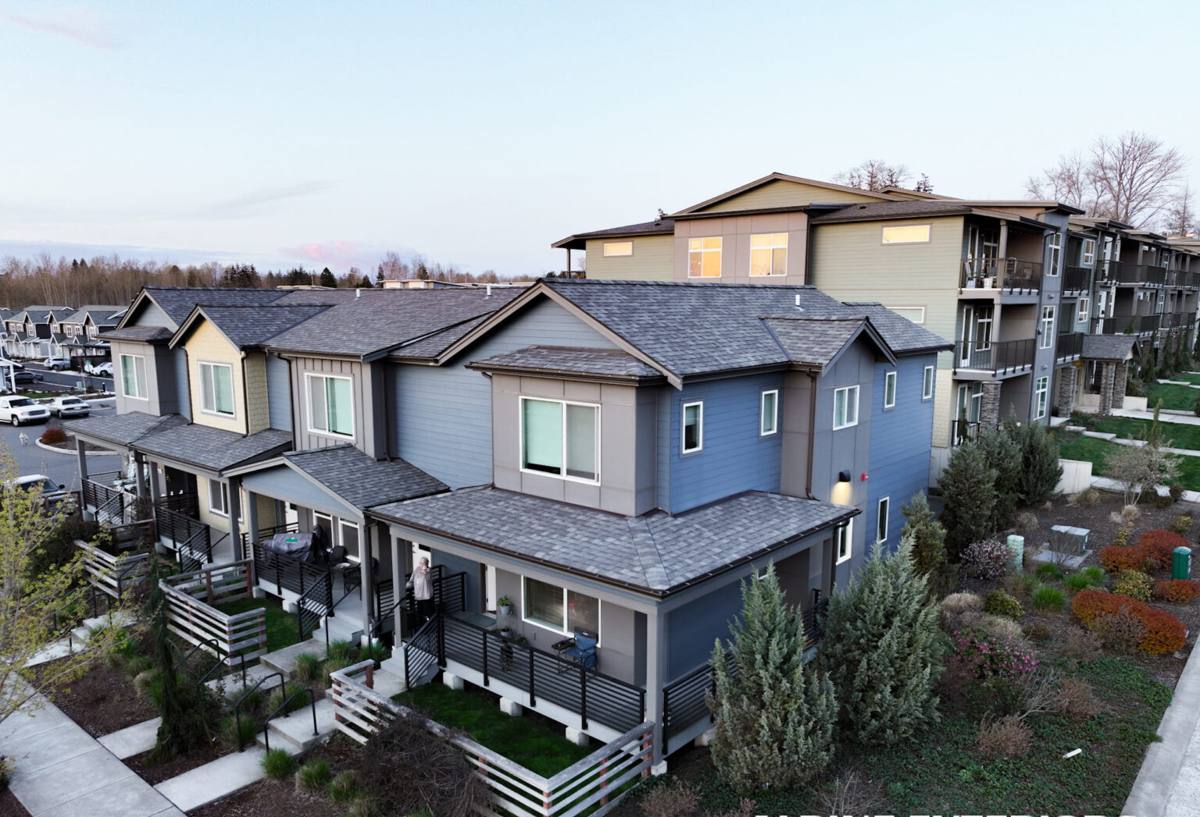
New Construction Is a Different Job Than Replacement
Replacement window work fits into an existing opening that's already been sided, trimmed, and lived in for years — the flashing decisions were made a long time ago and the new window has to work with what's there. New construction is the opposite: the rough opening, the water-resistive barrier, the flashing sequence, and the window itself all go in together, in a specific order, before siding ever gets attached. That's an advantage if it's done right, because it means the water management plane can be built continuously instead of patched around an existing window. It's a liability if it's done wrong, because there's no siding yet to hide a shortcut, and the framing crew, the window installer, and the siding crew all have to hand off clean work to each other.
Why the Handoff Matters Here
On a lot of builds, framing, windows, and siding are three different crews who never talk to each other directly. In a marine climate like Drayton Harbor's, that's where problems start — a rough opening cut a half-inch off, house wrap lapped the wrong direction, or flashing tape run in a sequence that traps water instead of shedding it. We treat the window install as the point where all three of those trades have to agree on the same water path, and we'd rather flag a framing issue before the window goes in than explain a leak after the siding is up.
What the Local Climate Actually Does to a Window Assembly
It helps to be specific about what "coastal Whatcom County climate" means for a window opening, rather than treating it as a vague warning label.
- Salt air accelerates corrosion on exposed fasteners, uncoated flashing metal, and lower-grade hardware — it doesn't just affect homes right on the water, it travels with the prevailing wind well inland from Semiahmoo and Drayton Harbor.
- Driving rain off Georgia Strait weather systems doesn't fall straight down — it hits window heads and sills at an angle, which is exactly the condition that exposes weak flashing laps and undersized sill pans.
- A long moss and algae season keeps shaded, north- and west-facing window trim and sills damp for months at a stretch, which shortens the life of any wood component that isn't properly primed, back-primed, and flashed to shed water instead of holding it.
- Wind loading off open water pressurizes and depressurizes the wall assembly around openings, which is part of why window flashing needs to be a continuous, lapped system rather than a bead of caulk at the edges.
Individually none of these is exotic. Together, over a full Whatcom County winter, they're unforgiving of a flashing detail that was "close enough."
Getting the Rough Opening and Flashing Right
This is the part of new-construction window work that homeowners rarely see and general contractors rarely get a chance to inspect closely, because it's covered by siding within days. It's also the part that determines whether the window performs for twenty years or starts leaking in five.
The Sequence We Follow
- Confirm the rough opening is square, level, and sized correctly for the specific window unit — not just "close" to spec.
- Install a sloped sill pan so any water that gets past the window has a built-in path back outside instead of sitting on the framing.
- Lap the water-resistive barrier and flashing tape in the correct shingle-style sequence — sill first, then jambs, then head — so every layer sheds water onto the layer below it, never the reverse.
- Set the window plumb and level, fasten per the manufacturer's schedule, and check operation before the opening is closed up.
- Seal and insulate the interior gap with a compatible sealant and low-expansion foam, avoiding anything that can bow the frame.
Skipping or reversing any one of these steps is invisible on install day and expensive to diagnose later, once it's a drywall or siding problem instead of a framing problem.
Choosing Frame Material and Glass for a Harbor-Adjacent Build
There's no single "best" window for every Drayton Harbor project — the right choice depends on budget, the home's exposure to wind and salt air, and how much maintenance the owner wants to take on. What we can do is lay out the honest trade-offs so the decision gets made with real information instead of a sales pitch.
| Frame Material | Coastal/Moisture Behavior | Maintenance | Typical Trade-Off |
|---|---|---|---|
| Vinyl | Won't corrode or rot; performs well in salt air | Low — occasional cleaning | Cost-effective, but frame color and structural options are more limited than other materials |
| Fiberglass | Very stable in temperature and humidity swings; strong resistance to moisture damage | Low | Higher upfront cost than vinyl, but holds up well in this climate long-term |
| Aluminum-clad wood | Exterior face resists weather well; interior wood adds warmth and strength | Moderate — exposed wood surfaces need attention if the cladding is ever breached | Attractive option, but installation quality matters more since any gap in the cladding exposes wood to moisture |
| Bare wood | Requires consistent maintenance to resist moisture and moss growth in shaded areas | High | We'll install it if that's the design intent, but we're upfront that it's the highest-upkeep option this close to the water |
On glass, we typically recommend dual-pane, low-E units as a baseline for new construction in this area — they help with both energy performance through Whatcom County's cool, wet winters and comfort near larger window walls facing the water. Impact or laminated glass comes up for homes with more direct wind exposure, and we'll talk through whether it makes sense for a given lot rather than upselling it by default.
Placement and Orientation Around Wind-Driven Rain
New construction gives you a chance to make orientation decisions that a remodel usually can't touch. Windows facing the prevailing weather off the harbor benefit from slightly deeper reveals, well-sized head flashing, and roof overhangs sized to actually shed water past the wall plane rather than down it. None of this requires exotic design — it just requires the window opening, the roof design, and the siding plan to be considered together instead of window placement being an afterthought to the floor plan. We'll flag orientation concerns during the framing walkthrough, while adjustments are still cheap to make.
Our New-Construction Window Process
For Drayton Harbor builds, our process generally runs:
- Plan review and rough opening verification against the specified window schedule
- Pre-install walkthrough with the framing crew to confirm sill pans, WRB laps, and any orientation concerns
- Window installation following the sequence above, with photos taken before the opening is closed up
- Operation and seal check on every unit before we sign off
- Coordination with the siding crew so flashing laps integrate cleanly with the siding water plane
We work directly with general contractors as a sub, and directly with homeowners managing their own build — either way, we document the flashing work before it disappears behind siding, because that documentation is what protects everyone if a question ever comes up later.
A Checklist If You're Vetting a Window Crew for a Harbor-Area Build
Whether you use us or someone else, these are worth asking any crew bidding new-construction window work near Drayton Harbor:
- Do they use a sloped sill pan on every opening, or just caulk and go?
- Can they explain their flashing lap sequence without hesitating?
- Have they worked openings in coastal or harbor-adjacent conditions before, or only inland builds?
- Will they document the flashing work with photos before it's covered by siding?
- Do they coordinate directly with the framing and siding crews, or work in isolation?
Why a Crew That Already Works Semiahmoo and Drayton Harbor Matters
A window flashing detail that's adequate for a dry inland climate can fall short a few miles away on a lot exposed to harbor wind and salt air. Crews who work this specific stretch of Whatcom County regularly have already seen which details hold up through a full winter here and which ones come back as callbacks. That's not a marketing claim — it's the practical benefit of local repetition: fewer surprises during the build, and an install that's sized to the actual weather the house will face instead of a generic spec sheet.
If you're planning a new build or addition near Drayton Harbor and want the window openings done right from the framing stage forward, we're glad to walk the plans with you and put together a straightforward estimate — no pressure, no obligation. The form below is the easiest way to reach us.