 Semiahmoo
 Why Birch Bay's Climate Is Hard on Siding
Birch Bay sits right on the water, and that location cuts both ways. The same beachfront setting that makes it a great place to live also means homes here take a beating that inland Whatcom County properties don't see nearly as often. Salt-laden air moves off the bay and settles on everything it touches, including fasteners, trim, and paint film. Winter storms bring driving rain that comes in sideways off the Strait of Georgia, not just straight down, which pushes water into joints and laps that a calmer climate would never stress-test. And because the Semiahmoo area stays cool, damp, and often shaded by conifers for a good chunk of the year, moss and mildew have a long season to work on north-facing walls and anywhere sun doesn't reach.
None of this is exotic. It's the normal weather pattern for coastal Whatcom County. But it means siding choices that work fine in a drier climate can fail early here, and it's why we treat Birch Bay as its own case rather than applying a generic siding recommendation to every job.
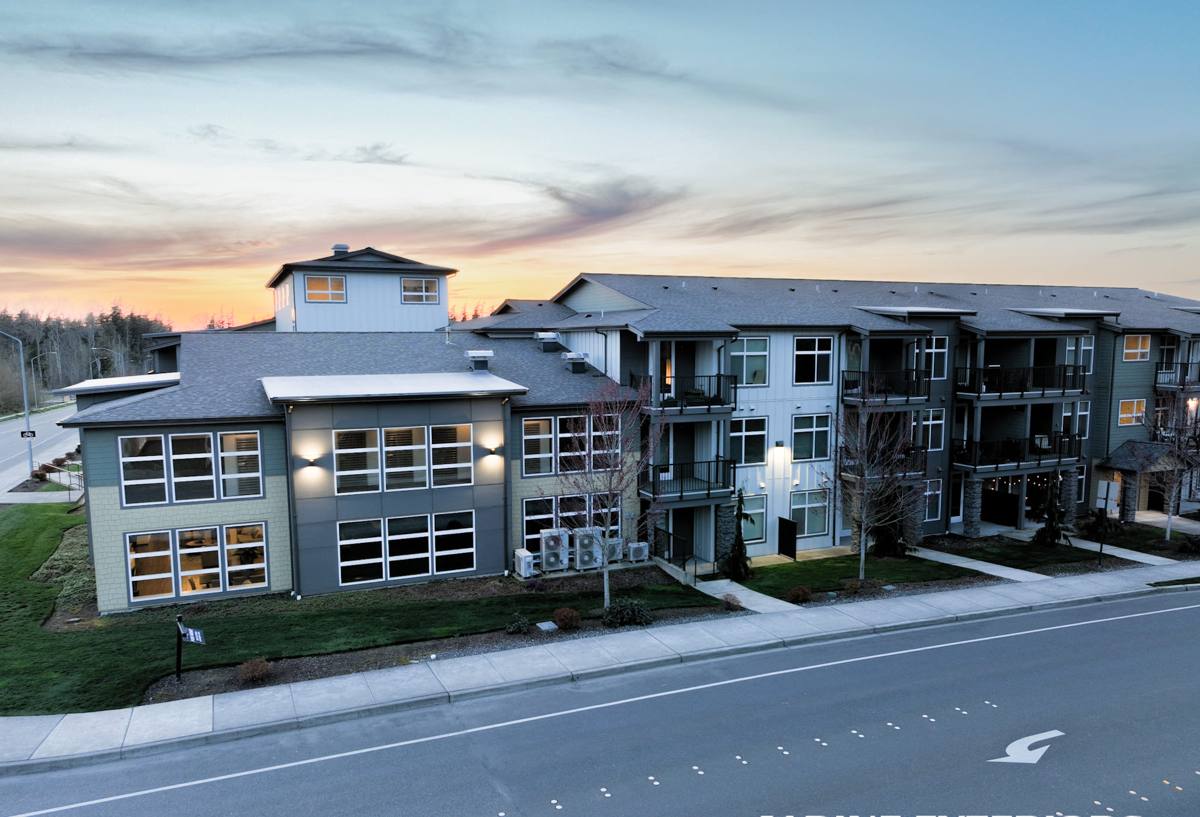
What Fiber Cement Siding Handles That Other Materials Don't
Fiber cement is a mix of Portland cement, sand, and cellulose fiber, pressed and cured into a rigid plank or panel. That composition matters for a beachfront town for a few concrete reasons:
- It doesn't rot. There's no wood to feed fungal decay, so the constant dampness that shortens the life of untreated wood siding isn't a threat to the material itself.
- It's non-combustible. Fiber cement won't ignite or contribute fuel to a fire, which matters during Whatcom County's dry summer stretches and wildfire smoke seasons.
- It holds its shape in swings between wet and dry. Wood and some engineered wood products expand and contract with moisture; fiber cement is far more dimensionally stable, which keeps joints tighter over time.
- It takes a factory finish that resists the coastal sun and salt air better than field-applied paint. More on that below.
Fiber cement isn't magic — it still needs to be installed with the right gaps, flashing, and fasteners to perform. But as a base material for a marine climate, it starts from a much stronger position than wood, engineered wood, or vinyl.
James Hardie HZ5: Built for This Exact Climate
We install James Hardie fiber cement exclusively, and one reason is that Hardie engineers its siding by climate zone rather than selling one national product. The Pacific Northwest, including Whatcom County, falls into Hardie's HZ5 zone — their moisture-focused formulation aimed at regions with high rainfall, high humidity, and freeze-thaw cycles. That's a meaningfully different product than what gets shipped to the desert Southwest.
What that means on a Birch Bay wall
HZ5 siding is engineered to resist moisture-related damage — cracking, deterioration at the plank edges, and loss of paint adhesion — better than a general-purpose formulation would in a wet coastal environment. Combined with Hardie's ColorPlus factory finish (a baked-on, multi-coat finish applied under controlled conditions rather than painted on-site after installation), you get a surface that resists fading and chalking from UV and salt exposure far longer than typical field-applied paint. Hardie backs ColorPlus with its own finish warranty separate from the substrate warranty, which is part of why we don't recommend field-painting Hardie siding unless a homeowner specifically wants a custom color down the road.
Fiber Cement vs. the Alternatives, in a Coastal Climate
| Factor | James Hardie Fiber Cement | Vinyl Siding | Untreated/Primed Wood |
|---|---|---|---|
| Moisture behavior in driving rain | Stable; won't rot or swell | Won't rot, but seams and J-channels can trap water behind the panel | Absorbs water; prone to rot without diligent maintenance |
| Salt air / corrosion exposure | Unaffected; fasteners are the main concern, addressed with proper hardware | Panel unaffected, but can become brittle and crack in cold, salt-laden wind | Finish breaks down faster near the water; more frequent repainting |
| Fire resistance | Non-combustible | Melts and can contribute fuel | Combustible |
| Moss/mildew on shaded walls | Surface growth cleanable; material unaffected underneath | Surface growth cleanable; material unaffected underneath | Growth can accelerate underlying decay if untreated |
| Finish longevity | Factory ColorPlus finish, long warranty | Color molded through, but fades and chalks over decades; can't be repainted easily | Field-applied paint, shortest repaint interval in this climate |
This is why, as a matter of professional standard, we only install James Hardie fiber cement. Vinyl and untreated wood aren't bad products in every climate, but for a beachfront Whatcom County property, the trade-offs stack up against them.
What a Correct Installation Involves
Fiber cement's real-world performance depends heavily on installation detail — probably more than any other siding material, because small mistakes don't show up as a problem for a few years, and by then the damage is inside the wall. On a Birch Bay job, we pay particular attention to:
Water management behind the siding
A weather-resistant barrier goes on the sheathing first, with all seams, penetrations, and window/door openings properly flashed and lapped so water sheds down and out rather than pooling behind the cladding. Given how much wind-driven rain this area sees, we don't treat flashing as optional trim work — it's the actual waterproofing system, and the siding is the second line of defense, not the first.
Fastener selection
Salt air corrodes standard fasteners faster than an inland job would ever reveal. We use corrosion-resistant fasteners rated for the exposure, placed per Hardie's nailing specifications — correct pattern, correct depth, no over-driving that cracks the plank edge or under-driving that leaves it loose.
Gaps, caulking, and clearances
Fiber cement needs proper clearance from grade, roofing, and decks, plus expansion gaps at butt joints and trim that get sealed with a flexible, paintable sealant rated for exterior use — not just caulked shut, which restricts the material's normal movement and traps water at the joint.
Rainscreen consideration on exposed walls
On the sides of a home that face the water directly or stay shaded and damp longest, a furred-out rainscreen gap behind the siding gives any moisture that does get past the surface a path to drain and dry, instead of sitting against the back of the plank. We evaluate this wall-by-wall rather than applying one approach to the whole house.
Our Process on a Birch Bay Project
- On-site assessment: We look at existing siding, sheathing condition, trim, and drainage — including which walls take the worst weather and moss exposure — before quoting anything.
- Tear-off and inspection: Removing the old siding lets us check the sheathing and framing underneath for hidden moisture damage before it's covered back up.
- Repair as needed: Any soft sheathing or compromised framing gets addressed before new siding goes on — covering a problem doesn't fix it.
- Weather barrier and flashing: Installed per manufacturer and code requirements, with extra attention at windows, doors, and roof intersections.
- Hardie installation: Planks or panels installed to spec — correct nailing, gaps, and fastener choice for the exposure.
- Trim and finish detail: Corners, trim boards, and caulking finished for a clean, weathertight result.
- Walkthrough: We go over the finished work with the homeowner before calling the job done.
Cost Factors on a Birch Bay Siding Job
| Factor | Why It Moves the Price |
|---|---|
| Tear-off and disposal | Removing old siding (especially old wood or multiple layers) adds labor and disposal cost |
| Sheathing repair | Rot or moisture damage found during tear-off adds material and labor to fix before new siding goes on |
| Home size and wall complexity | More square footage, more corners, dormers, and trim detail all add install time |
| Product line and profile | HardiePlank lap siding, HardiePanel vertical siding, and shingle-style profiles have different material and labor costs |
| Accessibility | Multi-story walls, tight side yards, or waterfront setbacks affect staging and scaffolding needs |
| Rainscreen detailing | Adding a furred rainscreen assembly on high-exposure walls adds material and labor but improves long-term drying |
We give a broad, honest range once we've actually seen the property — anyone quoting a firm number sight unseen for a coastal re-side is guessing.
Signs Your Birch Bay Home May Need New Siding
- Paint that's chalking, peeling, or needing repainting more often than every few years
- Soft spots, visible warping, or delamination in wood or engineered wood siding
- Persistent moss or mildew staining that comes back quickly after cleaning, especially on north- or west-facing walls
- Visible gaps, cracked caulking, or separated joints at trim and corners
- Rust streaking from corroded fasteners
- Musty smell or soft drywall on interior walls that back up to exterior siding — a sign moisture is already getting through
Any one of these on its own isn't necessarily an emergency, but a couple together on a beachfront property in Birch Bay is worth having looked at before the next winter storm season.
Why It Matters That We Already Work in Birch Bay
A crew that only occasionally works this close to the water can miss the details that matter most here — the fastener grade, the extra flashing attention at wind-exposed corners, which walls actually need a rainscreen gap and which don't. We work throughout the Semiahmoo and Whatcom County area regularly enough to know that a Birch Bay job isn't identical to one a few miles inland, and we build the install around the conditions the house actually faces, not a generic checklist.
If you're thinking about re-siding a Birch Bay home, we're happy to take a look and give you a straight, no-pressure estimate — no hard sell, just an honest read on what your home needs. Use the form below to get started.