 Semiahmoo
 Why California Creek Asks More of Its Siding
California Creek sits close enough to Semiahmoo Bay and the Strait of Georgia that the air itself is part of the maintenance equation. Homes here don't just get rain — they get wind-driven rain that hits siding sideways, salt-laden air that accelerates corrosion on fasteners and trim, and long stretches of gray, damp weather that keep exterior surfaces wet far longer than they'd stay wet inland. Add Whatcom County's mild temperatures, which are perfect for moss and algae growth nearly year-round, and you have a climate that punishes any siding product with weak points at the seams, fasteners, or finish.
We've seen what this combination does to the wrong materials over time: coatings that chalk and fade, panels that swell or delaminate where moisture gets behind them, and caulk joints that fail years before they should. None of that is a defect unique to one bad installation — it's what happens when a product not engineered for this exposure meets this exposure anyway. That's the starting point for every siding conversation we have in California Creek.
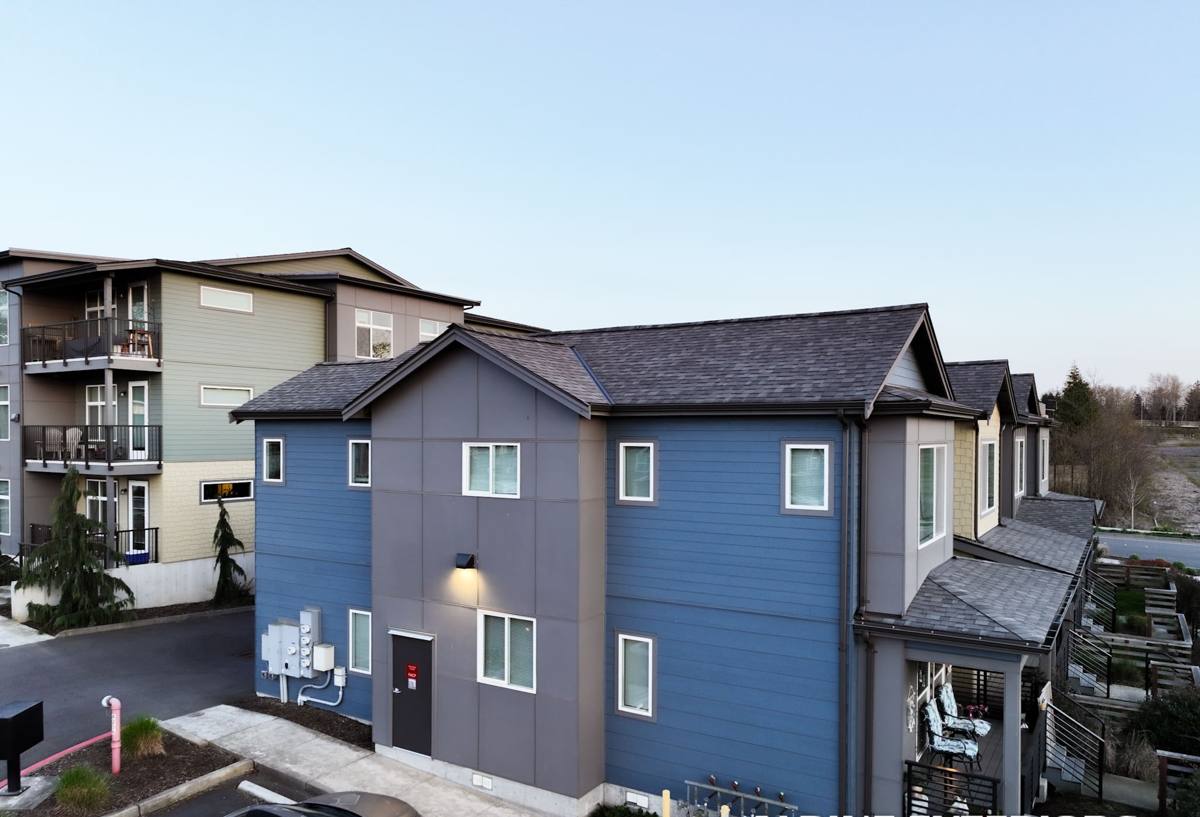
Why We Only Install Fiber Cement Here
We install James Hardie fiber cement siding exclusively, and in a neighborhood like California Creek that's not a marketing position — it's a practical one. Fiber cement is non-combustible, dimensionally stable, and doesn't absorb and release moisture the way wood-based or wood-fiber products do. That matters directly here: a product that swells slightly with every rain cycle and shrinks again as it dries will eventually work its joints loose, crack its paint film, and open small gaps for moisture to enter behind the siding.
James Hardie makes a version of its siding, the HZ5 product line, specifically engineered for climates like ours — wet, moderate-temperature, and prone to moisture cycling. It's manufactured with different moisture and durability specs than the versions sold in dry, hot climates. We use HZ5 on every California Creek job for that reason. We don't install vinyl, LP SmartSide, primed wood, or cedar, and we're upfront about why: those products each have real strengths, but none of them hold up as consistently against salt air, sustained damp, and moss pressure as correctly installed fiber cement with a factory-applied finish.
What ColorPlus Finish Adds in This Climate
Most of our California Creek installs use Hardie's ColorPlus factory-applied finish rather than field-painted siding. The finish is baked on in a controlled environment, which gives it better adhesion and UV resistance than a coat of paint applied on-site in variable weather. In a climate where surfaces stay damp for days at a time, a finish that resists moisture intrusion at the surface — rather than one that's counting on a perfect paint job holding up outdoors — is the more reliable long-term choice. It also means less repainting over the life of the siding, which matters when repainting means scaffolding and weather windows on a coastal property.
What a Correct Installation Involves
Fiber cement is only as good as its installation, and this is where a lot of siding jobs quietly go wrong — not because the crew is careless, but because they're not used to building for wind-driven rain and salt exposure. A few things we treat as non-negotiable on every California Creek project:
- Weather-resistive barrier and proper overlap: A continuous, correctly lapped water-resistive barrier behind the siding, with all penetrations and seams sealed, so any moisture that gets past the cladding has a drainage path instead of a way into the wall.
- Rainscreen or drainage gap where called for: On exposures that take direct wind-driven rain, a drainage gap between the siding and the barrier lets bulk water and trapped moisture vapor escape instead of sitting against the wall assembly.
- Correct fastener spec: Stainless or hot-dip galvanized fasteners at the manufacturer's spacing, driven flush — not overdriven, which cracks the board's edge and creates an entry point for water.
- Manufacturer-spec clearances: Proper gaps at grade, roofline, and any horizontal trim so the bottom edge of the siding isn't sitting in standing water or splash-back during heavy rain.
- Caulking only where Hardie specifies it: Over-caulking traps moisture; under-caulking leaves gaps. We follow Hardie's joint treatment guidance panel by panel rather than defaulting to "seal everything."
Skipping any one of these doesn't usually show up as a problem in year one. It shows up in year five or six, as staining, soft trim, or paint failure at specific joints — exactly the kind of slow-motion failure that's expensive to trace back to its cause once it's happened.
Our Process for California Creek Homes
1. On-Site Assessment
We walk the exterior and identify the exposures that matter most for that specific lot — which walls take the worst of the wind-driven rain, where moss and algae are already established, where existing trim or flashing shows signs of past moisture issues. Coastal-facing walls and shaded, damp corners get treated differently than a sheltered south wall.
2. Tear-Off vs. Overlay Decision
We don't recommend installing new siding over old siding or damaged sheathing, especially in this climate. If there's evidence of trapped moisture, soft sheathing, or failed house wrap underneath the existing cladding, that gets addressed before anything new goes up. Covering a moisture problem doesn't solve it — it just hides it behind a nicer surface.
3. Product and Color Selection
We help homeowners choose between Hardie's lap siding, panel, and shingle profiles, and walk through ColorPlus color options that hold up well against fading in this light and weather. Some finishes and profiles handle high-moss, high-moisture walls more gracefully than others in terms of how dirt and organic growth show up over time.
4. Installation to Spec
Barrier, drainage plane, fastening, and clearances as described above, inspected at each stage rather than just at the end.
5. Final Walkthrough
We go over caulking, trim details, and touch-up paint with the homeowner before calling the job finished, and explain what routine maintenance should look like going forward.
Comparing Siding Options for This Exposure
| Factor | Fiber Cement (James Hardie) | Vinyl | Wood / LP SmartSide |
|---|---|---|---|
| Moisture cycling | Dimensionally stable, low swell/shrink | Doesn't absorb water, but seams and J-channels trap moisture behind panels | Wood-fiber substrate absorbs moisture; swelling and edge softening over time |
| Salt air / corrosion | Non-metallic panel, factory finish resists chalking | Can become brittle and discolor with UV and salt exposure | Coatings degrade faster in sustained salt-laden dampness |
| Moss / algae resistance | Smooth factory finish sheds growth more easily; cleanable | Textured seams collect grime and organic growth | Porous surface holds moisture, encouraging growth |
| Fire resistance | Non-combustible | Combustible, can melt or warp near heat | Combustible |
| Typical repaint interval | Rarely needed with ColorPlus finish | N/A (color molded in, but fades and can't be easily patched) | Every 5-8 years in this climate |
Every product on that list has a legitimate use case somewhere. Our position is simply that for the exposure California Creek homes actually face — sustained damp, salt air, and heavy moss pressure — fiber cement with a factory finish holds up with the least maintenance burden over the life of the siding.
Living With Fiber Cement Siding Here: What Upkeep Actually Looks Like
Fiber cement is low-maintenance, not no-maintenance. In a moss-prone climate like Whatcom County, a little routine attention keeps the siding performing the way it's designed to:
- Rinse siding annually with a garden hose and soft brush attachment — avoid high-pressure washing, which can force water behind panels or damage the finish.
- Keep gutters clear so overflow doesn't run down the wall face and feed moss growth at specific spots.
- Trim back vegetation and tree cover that keeps a wall shaded and damp longer than the rest of the house.
- Check caulking at trim joints and penetrations every couple of years; recaulk if it's cracked or pulling away.
- Address any paint chips or scratches promptly with manufacturer-matched touch-up paint before bare fiber cement is exposed to moisture.
None of this is heavy lifting. It's the difference between siding that looks new at year fifteen and siding that starts looking tired at year six.
Warranty and Long-Term Value
James Hardie backs its fiber cement products with a strong, transferable warranty when installed to manufacturer specification — which is exactly why installation quality isn't optional in our process. A warranty is only as good as the install behind it; fastener spacing, clearances, and finish handling that don't match spec can affect warranty coverage. When we install, we're installing to hold up both physically and on paper, so if the home changes hands, the remaining warranty term transfers with it.
Why Local Experience in California Creek Matters
Siding crews who haven't worked this specific stretch of coastline tend to build to a generic spec — the kind that's fine in a drier, more sheltered inland setting but leaves gaps in a wind-driven-rain, high-moss environment. A crew that already works California Creek knows which walls on a typical lot take the worst weather, how moss establishes itself on north- and shade-facing exposures, and which trim and flashing details actually hold up against this specific combination of salt air and sustained moisture. That local pattern recognition is what keeps small details — a clearance, a caulk joint, a flashing lap — from becoming the reason a job needs attention again in five years instead of twenty.
If your California Creek home's siding is showing moss buildup, paint failure, soft spots, or you're planning ahead for a replacement, we're happy to walk the exterior with you and give you a straightforward, no-pressure estimate. There's a form below to get that conversation started.