 Semiahmoo
 Custer's Climate Puts Real Demands on Exterior Siding
Custer sits inland from Semiahmoo Bay and Drayton Harbor, close enough to the water that salt-laden air still reaches the homes here, but far enough from the immediate shoreline that it's easy to underestimate how much that air, combined with Whatcom County's rain and moss patterns, is working against a house's siding year-round. Between the marine moisture, the long wet season, and the tree cover common on rural and semi-rural lots in this area, exterior walls in Custer take on more sustained dampness than siding in a drier inland climate ever has to deal with.
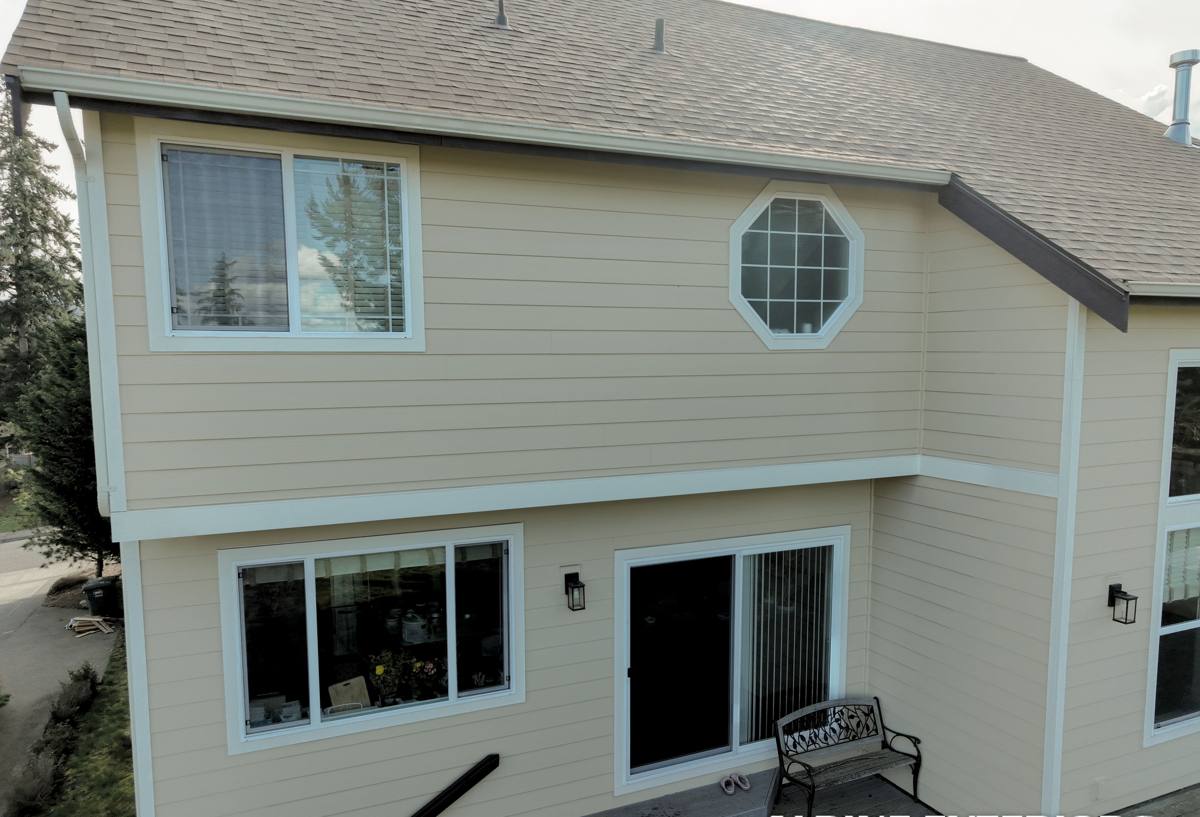
That combination — salt air, driving rain, and a moss season that can stretch across most of the year — is exactly the profile James Hardie fiber cement siding was engineered to handle, provided it's installed correctly. It's also exactly the profile that exposes shortcuts and cheap materials the fastest. A siding job done right in Custer looks almost identical to one done wrong for the first year or two. The difference shows up in year five, year ten, and year twenty.
Why Salt Air and Moisture Change the Installation, Not Just the Material
Homeowners often think the product choice is the whole decision — pick a durable siding and you're set. In a climate like Custer's, the installation details matter just as much as the material. Salt air accelerates corrosion on fasteners and flashing. Persistent moisture finds any gap in a water-resistive barrier and stays there instead of drying out quickly like it might in a drier climate. Moss and algae need sustained damp conditions to take hold, and a shaded, wet exterior wall gives them exactly that.
What This Means in Practice
On a Custer home, that translates into a short list of non-negotiables:
- Corrosion-resistant fasteners rated for the exposure, not standard interior-grade nails or screws
- A continuous, properly lapped water-resistive barrier with no shortcuts around windows and doors
- Correct flashing at every horizontal joint, window head, and roof-to-wall intersection
- Proper clearance between the bottom of the siding and grade, decks, or roof lines so water can't wick upward
- Adequate gapping and caulking per James Hardie's published fastening and installation guidelines
Skip any one of these and the siding itself can be excellent and the wall assembly will still fail early. This is the part of the job that doesn't show up in a sales pitch, and it's the part that determines whether the siding lasts fifteen years or fifty.
Why James Hardie Fits Custer's Conditions
James Hardie fiber cement is non-combustible, dimensionally stable, and manufactured with regional climate engineering in mind — Hardie's HZ5 product line is formulated for the kind of moisture-heavy, freeze-thaw-adjacent Pacific Northwest exposure Custer sits in. Unlike wood-based siding products, fiber cement doesn't provide an organic food source for moss and mildew the way cedar or primed spruce can, and it doesn't swell, rot, or delaminate the way engineered wood products can when water gets behind the surface.
The factory-applied ColorPlus finish is baked on under controlled conditions rather than field-applied, which matters in a climate where paint has to cure through damp, cool stretches for much of the year. A finish applied in a factory doesn't have to fight Whatcom County's weather to bond correctly. That's a meaningful advantage over site-painted siding in an area where a dry, low-humidity painting window can be hard to find for weeks at a stretch.
Comparing Siding Options Against Custer's Conditions
| Material | Behavior in Salt Air & Rain | Moss/Algae Resistance | Finish Durability |
|---|---|---|---|
| James Hardie fiber cement | Non-combustible, dimensionally stable, engineered for coastal PNW exposure (HZ5) | No organic material for growth to feed on; factory finish resists staining | ColorPlus factory finish, long transferable warranty |
| Vinyl | Can warp or become brittle with temperature swings; seams allow moisture intrusion over time | Growth can develop in seams and overlaps | Color is through-body but fades and chalks over time; not repaintable easily |
| Cedar/primed spruce | Absorbs moisture, prone to cupping and rot in sustained damp conditions | Organic material actively supports moss and mildew growth | Field-applied finish needs a dry cure window and regular repainting |
| LP SmartSide (engineered wood) | Better than raw wood but still wood-based; edges are vulnerable if cut ends aren't sealed correctly | Moderate; still an organic substrate | Factory finish available, but product is more installation-sensitive at cut edges and seams |
We install James Hardie exclusively. We don't carry vinyl, LP SmartSide, Cemplank, Allura, primed spruce, or cedar, because in a climate like this one, the long-term maintenance burden and moisture behavior of those alternatives is a trade-off we're not willing to put our name behind. That's not a knock on every use case for those products — it's our standard for what goes on a Custer roofline.
Moss Season and What It Actually Does to a Wall
Whatcom County's moss season isn't a cosmetic issue alone. Moss and algae holding moisture against a wall surface for extended periods keep that surface wetter, longer, than it would otherwise be — and that sustained dampness is what eventually finds its way into seams, fastener penetrations, and butt joints if they weren't detailed correctly at installation. A siding material that resists supporting growth in the first place, combined with correct flashing and drainage details, is the real defense. Pressure washing moss off a wall every year or two is a maintenance habit, not a fix, if the underlying assembly is what's letting moisture linger.
Where Growth Shows Up First
On homes in this area, moss and algae tend to appear first on north- and shade-facing walls, under eaves with limited sun exposure, and near ground level where splashback keeps the lower courses of siding damp longer than the rest of the wall. These are also the areas where flashing and clearance details matter most, which is why we pay particular attention to them during installation rather than treating every wall the same.
Our Installation Process for a Custer Home
The process doesn't change dramatically from house to house, but the level of attention to moisture management does, based on a home's exposure, tree cover, and siting. Here's the general sequence:
- On-site assessment of the existing siding, sheathing condition, and problem areas — trouble spots around windows, decks, and roof intersections get flagged before tear-off starts
- Removal of old siding and inspection of the sheathing underneath for hidden rot or moisture damage
- Repair of any compromised sheathing before anything new goes up — this step gets skipped by corner-cutting crews and it's the single biggest predictor of a callback
- Installation of a continuous water-resistive barrier, properly lapped and sealed at penetrations
- Flashing installed at every horizontal joint, window and door head, and roof-to-wall transition
- James Hardie siding installed to manufacturer fastening specifications, with correct gapping, nailing patterns, and clearances from grade and other surfaces
- Final inspection and walkthrough with the homeowner
Every one of these steps is documented as standard practice by James Hardie for a reason — the warranty depends on it, and more importantly, the performance of the wall depends on it.
What Drives Cost on a Job Like This
| Factor | Why It Matters |
|---|---|
| Sheathing condition | Rot or moisture damage found during tear-off requires repair before new siding goes up — this is the most common source of a mid-project change order |
| Home size and wall complexity | More corners, gables, and trim details mean more labor and material cuts |
| Siding profile and finish choice | Lap width, board texture, and ColorPlus color all affect material cost |
| Existing siding removal | Full tear-off versus siding over an already-compromised surface changes labor scope |
| Access and site conditions | Steep grades, mature landscaping, or limited driveway access can add setup time |
We won't quote a number without seeing the house, and we're not going to pretend every Custer home costs the same to re-side — a straightforward single-story ranch and a two-story home with multiple gables and a lot of trim are different scopes of work. What we can tell you upfront is that we price the job the same whether it's straightforward or not: based on what the wall actually needs, not what's easiest to sell.
Why It Matters That a Crew Already Works This Area
A crew that regularly works Custer and the surrounding Semiahmoo-area communities knows what this climate does to a wall assembly before the first board goes up. That's not abstract experience — it means knowing which orientations on a typical lot here get the least sun and the most moss, which older homes in the area are more likely to have moisture-compromised sheathing under the existing siding, and how the driving rain patterns off the Strait affect flashing details at window heads and roof lines. A crew installing siding here for the first time is learning those lessons on your house. A crew that already works this area brings them to the job on day one.
It also means accountability that's local, not theoretical. A company installing James Hardie throughout Whatcom County has a reputation in this specific area to protect, and a warranty claim on a Custer home isn't a long-distance inconvenience — it's down the road.
A Straightforward Checklist Before You Sign a Contract
- Confirm the contractor is installing to James Hardie's published fastening and clearance specifications, not a generalized approach
- Ask how sheathing repair is handled if rot is found during tear-off, and whether that's included or a change order
- Confirm flashing details at windows, doors, and roof-to-wall intersections are part of the written scope, not assumed
- Ask about the manufacturer warranty and how it's registered, plus what workmanship warranty the contractor themselves stands behind
- Get a written, itemized quote — vague one-line estimates make it hard to know what you're actually paying for
If a siding job in a climate like this is done right, you shouldn't need to think about it again for a very long time. That's the standard worth holding a contractor to, and it's the standard we hold ourselves to on every Custer home we work on.
If your Custer home's siding is showing moss staining, soft spots, or just age, we're happy to take a look and give you a straightforward, no-pressure estimate — use the form below to get started.