 Semiahmoo
 Why Wiser Lake Puts Extra Demands on Siding
Wiser Lake homes sit in a spot that gets hit from two directions at once. There's the lake itself — still water, tree canopy, and shaded lots that hold humidity against a house far longer than an open, sun-exposed property would. And there's the broader Whatcom County marine climate that reaches this far inland from the Semiahmoo Bay and Puget Sound side of the county: driving rain that comes in sideways during fall and winter storms, and salt-tinged air that travels further inland than most homeowners assume, especially on windy days off the water.
Put those two things together and you get a siding environment that's tougher than a typical Pacific Northwest lot. Moss and algae don't just grow on the roof here — they get a foothold on north-facing wall sections, under eaves, and anywhere a lake-adjacent lot keeps a wall shaded and damp for most of the year. Add the region's long moss season, which for Whatcom County properties can run eight or nine months out of twelve, and siding that isn't built to resist moisture and organic growth starts showing problems well before it should.
This is the environment we size every Wiser Lake job against. It's also exactly why we don't install anything other than James Hardie fiber cement.
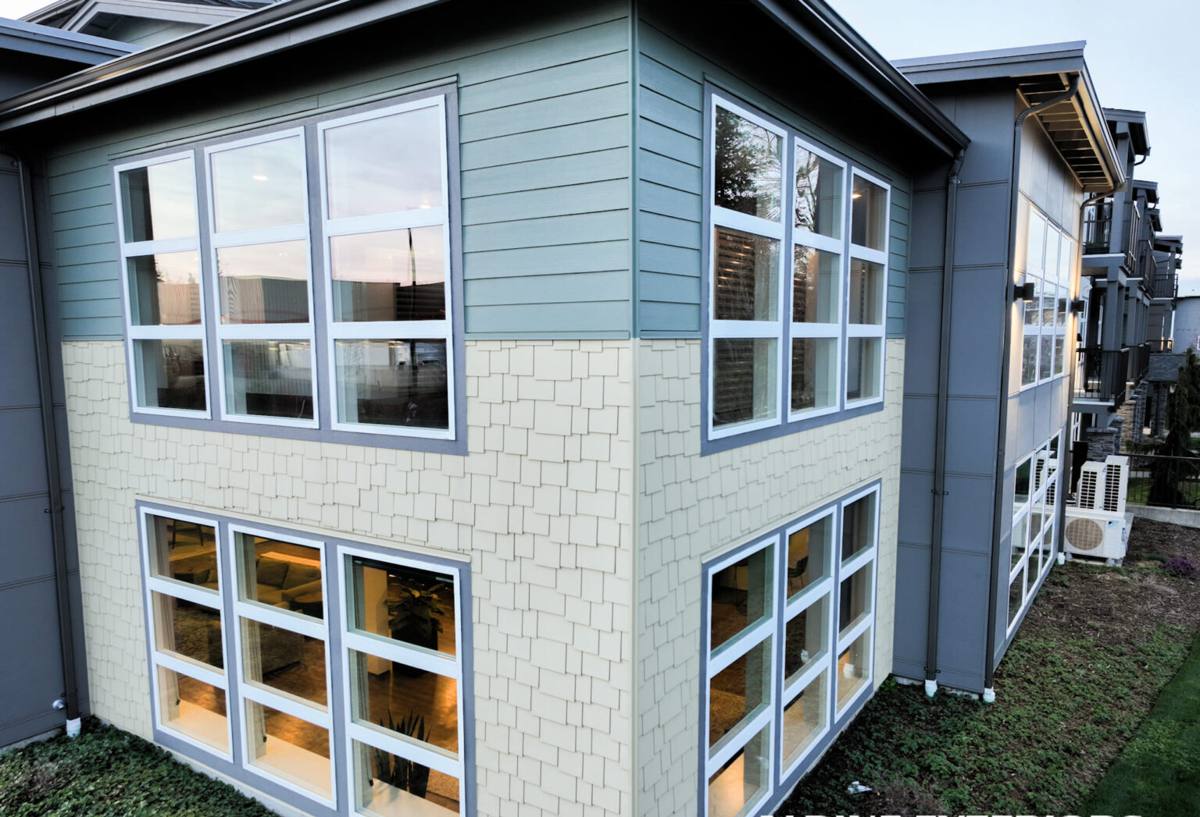
What James Hardie Siding Actually Is
James Hardie siding is fiber cement — a mix of cement, sand, and cellulose fibers engineered into planks, panels, and trim boards. It is not vinyl, and it is not an engineered wood product like LP SmartSide. That distinction matters a lot in a lake-and-salt-air environment, because fiber cement doesn't have organic wood fiber at its core to feed rot or absorb moisture the way wood-based sidings can, and it doesn't soften, warp, or become brittle the way vinyl can under years of temperature swings and UV exposure.
HZ5 Climate Engineering
James Hardie makes region-specific formulations, and the Pacific Northwest falls under their HZ5 engineering, built specifically to handle high-moisture, freeze-prone climates. That's not a marketing label — it's a different manufacturing spec aimed at exactly the conditions Wiser Lake sees: sustained dampness, temperature swings, and long wet seasons.
ColorPlus Factory Finish
Most Hardie siding we install carries the ColorPlus finish — a baked-on, factory-applied color coat that's tougher and more UV-stable than field-applied paint, and backed by its own finish warranty separate from the product warranty. In a shaded, moisture-heavy lot near the lake, that matters: a field-painted finish is the first thing to fail when a wall stays damp for weeks at a time, and repainting siding on a lake lot with limited access isn't cheap or easy to redo every several years.
What a Correct Installation Involves Here
Fiber cement is only as good as the installation behind it. Around Wiser Lake, where wall assemblies stay damp longer than average, the details that get skipped on a rushed job are the details that cause real problems in five to ten years — not the siding itself.
Drainage Plane and Rainscreen Gap
Correct installation means a weather-resistive barrier behind the siding, properly lapped and taped, with a drainage gap that lets any moisture that gets behind the cladding actually escape instead of sitting against the sheathing. On shaded, tree-covered lots this gap is not optional — it's the difference between siding that dries out between rain events and a wall cavity that never fully dries.
Flashing at Every Penetration
Windows, doors, hose bibs, light fixtures, deck ledgers — every penetration through the cladding is a place water can find its way in. Correct flashing detail at each one, installed in the right order relative to the weather barrier, is what keeps driving rain from a Whatcom County storm from working its way behind the wall.
Fastening, Clearances, and Gaps
James Hardie specifies exact nailing patterns, board overlaps, and clearances from grade, roof lines, and other trim. Siding installed too close to grade or without the specified gap at trim boards holds moisture at the exact spots where wood-framed structures are most vulnerable. This is where a lot of installation problems on any brand of siding actually originate — not in the product, but in shortcuts taken to save an hour on the job.
How James Hardie Compares for a Lake-Adjacent, Salt-Air Lot
Homeowners near Wiser Lake often ask us to explain, plainly, why we don't offer the cheaper alternatives. Here's the honest comparison for this specific kind of site — shaded, humid, and within reach of coastal air.
| Factor | James Hardie Fiber Cement | Vinyl | LP SmartSide / Engineered Wood |
|---|---|---|---|
| Core material behavior in sustained damp shade | Non-organic core, does not rot or feed fungal growth | Doesn't rot, but can warp or become brittle over decades of UV and temperature cycling | Wood-fiber core; requires an intact factory coating to resist moisture, and moss/mildew can sit on the surface |
| Salt air exposure | Does not corrode; finish is factory-baked | Generally tolerant, but color can fade unevenly near coastal air over time | Surface coating is the only moisture defense; edge-sealing becomes critical near salt air |
| Fire resistance | Non-combustible | Combustible, can melt or deform near heat sources | Combustible |
| Finish longevity | ColorPlus factory finish, separate warranty from the substrate | Color is baked into the material but can chalk or fade | Factory or field-applied coating; touch-up and re-caulking needed on a maintenance schedule |
| Typical warranty structure | Long-term, transferable manufacturer warranty on the substrate | Varies widely by manufacturer and product tier | Varies; moisture-related damage is often more tightly excluded |
None of these alternatives are junk products — vinyl and engineered wood siding both have real, legitimate uses. But for the specific combination of shaded lake humidity and coastal air that Wiser Lake properties deal with, we've made James Hardie our standard and stopped installing the others.
Our Process for a Wiser Lake Project
We run the same core process on every job, adjusted for what a given lot actually needs:
- On-site assessment. We look at sun exposure, tree canopy, existing moisture damage, and how the current siding has held up — this tells us a lot about what the house has actually been dealing with.
- Tear-off and sheathing check. Old siding comes off and we inspect the sheathing underneath for soft spots or existing moisture damage before anything new goes on.
- Weather barrier and drainage plane. A new, properly lapped weather-resistive barrier goes on, with the rainscreen gap built in.
- Flashing at every penetration. Windows, doors, and any wall penetration get flashed to spec before the cladding covers them.
- Hardie installation to manufacturer spec. Fastening pattern, clearances, and board overlap follow James Hardie's published installation requirements, not a shortcut version of them.
- Final walkthrough. We go over the finished job with the homeowner, including what routine upkeep looks like going forward.
Living With Moss Season: Maintenance That Actually Matters
Correctly installed Hardie siding is low-maintenance, not zero-maintenance. On a Wiser Lake lot with shade and moisture in play most of the year, a short annual routine keeps the siding performing the way it's designed to:
- Rinse siding (garden hose pressure, not a pressure washer) once or twice a year, focused on shaded, north-facing, and under-eave sections where moss and algae tend to settle first.
- Keep gutters clear so overflow doesn't run down the wall face during heavy fall and winter rain.
- Trim back tree branches and shrubs that keep a wall section shaded and damp longer than the rest of the house.
- Check caulking around windows, doors, and trim boards yearly — caulk is a maintenance item on any siding system and is one of the few things that does need periodic attention.
- Watch for any staining or discoloration at the bottom courses near grade, which usually points to a drainage or grading issue rather than a siding problem.
Why a Crew That Already Works This Area Matters
Siding installation isn't one-size-fits-all, even within Whatcom County. A crew that's worked Wiser Lake and the surrounding area already knows which lots hold moisture longest, which wall orientations need extra attention to flashing and drainage detail, and how the moss season here actually behaves compared to a drier or more open site. That local pattern recognition shows up in small decisions during installation — where to add extra care at a shaded corner, how to sequence work around the wetter months — that a crew unfamiliar with the area's specific microclimate might not think to make.
It also matters for warranty follow-through. A local crew that's still working in the area years later is the crew that can actually show up if a question comes up down the road, rather than a name from a one-time job that's moved on.
What Affects Your Estimate
Every Wiser Lake home is a little different, and a few things move the price of a project up or down: the amount of tear-off and disposal needed, how much of the sheathing needs repair once old siding comes off, the complexity of the roofline and number of penetrations to flash, and which Hardie product line and ColorPlus color you choose. We walk through all of that during the on-site assessment so there are no surprises once work starts.
If you're weighing a siding replacement on a Wiser Lake property, we're happy to take a look and give you a straight, no-pressure estimate — no obligation, just an honest read on what your home actually needs.