 Semiahmoo
 Siding Built for Laurel's Weather, Not Just Its Climate Zone
Laurel is inland enough that it doesn't get lumped in with the obvious waterfront trouble spots, but it still sits inside the same Whatcom County weather system that gives every siding material here a hard time: salt-tinged air that travels further inland than most homeowners assume, rain that arrives sideways more often than straight down, and a moss season that barely takes a break across the calendar. None of that is unique to Laurel specifically. What is worth paying attention to is that a lot of siding products, and a lot of siding installations, are built and detailed for a milder, drier version of the Pacific Northwest than what actually shows up here year after year.
We install James Hardie fiber cement siding, and only James Hardie fiber cement siding, on homes throughout this part of Whatcom County, including Laurel. This page covers what that means specifically for a Laurel home: what the local climate actually does to an exterior wall over time, what a correct James Hardie installation involves, how we run the job from estimate to final walk-through, and why it matters that the crew doing the work already has hours logged in this exact climate.
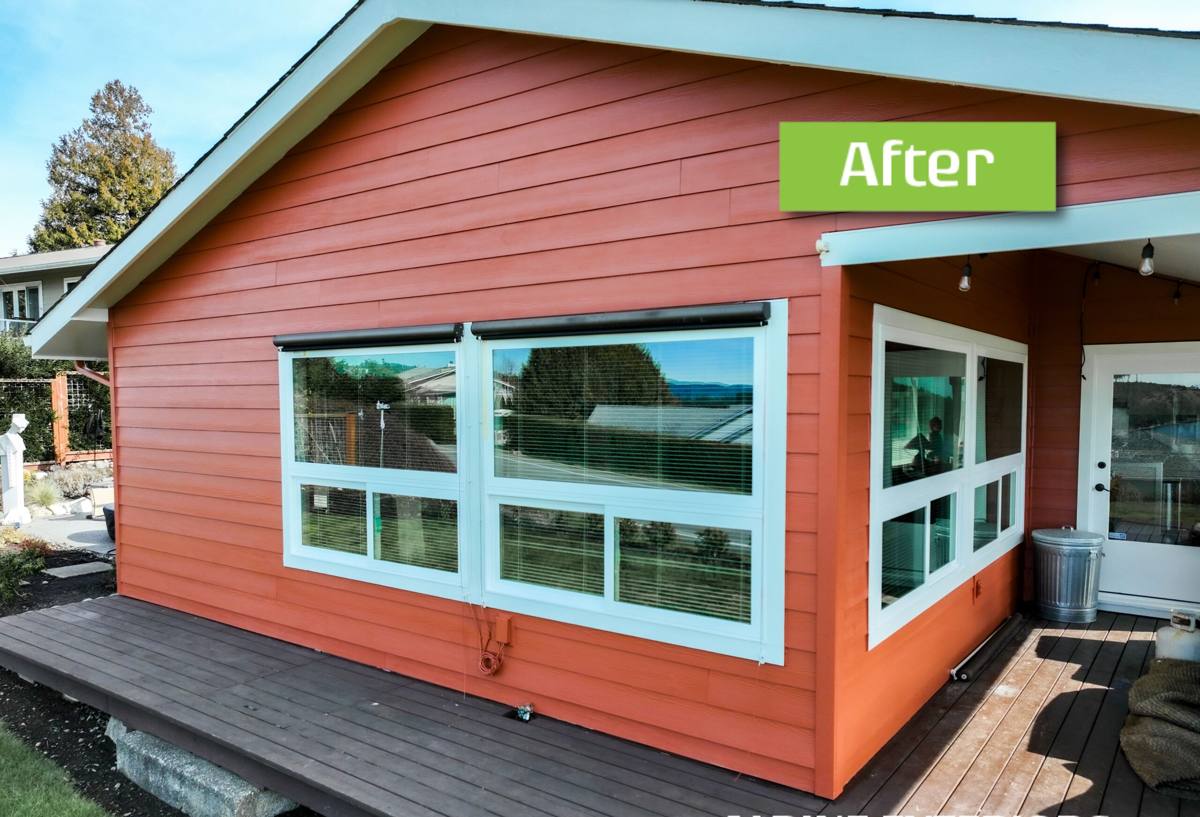
What Driving Rain, Salt Air, and Moss Actually Do Over Time
These three conditions don't damage siding in a dramatic, obvious way. They work slowly, which is exactly why so many homeowners don't think about siding performance until a problem is already established underneath the surface.
Wind-Driven Rain
Rain that gets pushed sideways by wind behaves differently than rain that just falls straight down. It finds horizontal laps, trim joints, and any seam where the water-management detail wasn't done right, and it pushes into those gaps instead of running off them. A siding system that looks fine on a calm, dry inspection day can still be taking on water during every windy storm, and that kind of intrusion often stays hidden behind the surface for years before it shows up as a soft spot, a stain, or a rot pocket.
Salt Air, Even Away From the Water
Homes right on Semiahmoo Bay or Drayton Harbor get the most obvious salt exposure, but salt-laden air moves with the wind well beyond the immediate shoreline, and it doesn't need to be constant to matter — it just needs to happen regularly. Salt accelerates the breakdown of lower-grade paints and factory coatings and speeds up corrosion in fasteners and metal trim. A finish that's rated for a generic "coastal" climate on a spec sheet doesn't always hold up the same way once you're a few years into real Whatcom County weather.
A Moss and Mildew Season That Doesn't Really End
Mild year-round temperatures combined with steady moisture keep moss and mildew active across most of the calendar here, not just in the wettest months. Shaded walls, mature trees, and tight lot spacing all make it worse. Organic growth on a siding surface holds moisture against the wall behind it, and that trapped moisture is where a lot of long-term siding failures actually start — not from the moss itself, but from what it keeps damp underneath.
Why We Standardized on James Hardie for This Climate
James Hardie siding is fiber cement — a mix of Portland cement, sand, and cellulose fiber, cured into rigid boards and panels. Because it's an inorganic material, it doesn't have a wood-based core that can swell, rot, or feed insects when it takes on moisture, and it's non-combustible, which is a real advantage independent of climate. For a property in Laurel, the specific advantages that matter are its dimensional stability in wet-dry cycling, its factory-applied ColorPlus finish, and the fact that Hardie engineers separate product lines for different climate demands rather than selling one board everywhere.
The HZ5 Product Line
Hardie's HZ5 line is engineered specifically for climates with significant moisture exposure and freeze-thaw cycling, which describes most of western Washington. It's built to resist moisture-related damage better than Hardie's products designed for drier regions, and it's the line we specify for homes in this part of Whatcom County by default, not as an upsell.
ColorPlus Factory Finish
ColorPlus is a baked-on, factory-applied finish rather than a coat of field-applied paint. It's formulated to hold up against UV and moisture cycling better than most site-applied paint jobs, and it comes with its own finish warranty separate from the substrate warranty. In a climate that's hard on paint, that finish durability is one of the more practical reasons to specify Hardie over a product that depends entirely on whatever primer and paint schedule gets applied on site.
What a Correct Installation Actually Involves
Fiber cement siding is only as good as the assembly it's installed into. Hardie's own installation instructions are specific and detailed, and skipping steps is the single biggest reason a Hardie installation underperforms in a wet climate like this one — not a flaw in the product itself.
- Weather-resistive barrier: a continuous, correctly lapped water-resistive barrier goes behind the siding, with all penetrations and seams sealed, so any moisture that gets past the cladding still has a drainage path out.
- Rainscreen or drainage gap: a gap between the back of the siding and the water-resistive barrier lets any incidental moisture drain and lets the wall assembly dry, which matters more here than in a drier climate.
- Flashing at every penetration: windows, doors, and any wall-mounted fixture need proper flashing integrated with the barrier, not just caulk bridging the gap.
- Correct fastener pattern and clearance: Hardie specifies fastener type, spacing, and minimum clearance from grade, decks, and roof lines — clearances that are easy to shortcut on a tight job site but that directly affect how much moisture the bottom of the siding takes on.
- Properly sized gaps and sealed joints: butt joints and trim intersections need the gap and sealant Hardie specifies, not just a tight fit and a bead of caulk.
- Field-cut edge sealing: any edge cut on site needs to be primed and sealed before installation, since a raw cut edge left exposed is one of the more common points where moisture gets into an otherwise good installation.
Every one of those steps is checkable after the fact by someone who knows what to look for, and every one of them is a place where a rushed or under-trained crew can cut a corner that won't show up as a problem for two or three years.
How the Job Runs, Start to Finish
The process for a Laurel home follows the same sequence we use across this part of the county, because the underlying climate risks are consistent even when individual lots vary in exposure and shading.
- On-site assessment: we look at the existing siding and sheathing condition, the wall assembly, drainage around the foundation, and any areas — north-facing walls, tree-shaded sections, low-clearance spots near grade or decking — that are seeing more moisture or moss than the rest of the house.
- Written scope and product spec: we specify which Hardie product line, profile, and finish fit the house and the budget, and put the water-management details in writing so there's no ambiguity about what "correct installation" means on that specific job.
- Tear-off and sheathing check: once the old siding comes off, we inspect the sheathing underneath for existing rot or moisture damage before anything new goes up — a step that only matters if you actually stop and look, rather than sheathing straight over what's there.
- Barrier, flashing, and rainscreen installation: this is the stage that determines long-term performance more than the visible siding itself, and it's the stage most likely to get rushed on a job that's being priced purely on speed.
- Siding installation to Hardie spec: correct fastening, clearances, joint gaps, and sealed cut edges, installed by crews trained specifically on fiber cement rather than crews treating it like an oversized vinyl panel.
- Final walk-through: we go over the completed work with the homeowner, including where the warranty coverage applies and what basic maintenance, if any, is worth doing going forward.
James Hardie Compared to Other Common Options
Homeowners in Laurel researching siding usually end up comparing Hardie against vinyl, engineered wood, or a cedar look. Here's how they stack up on the factors that matter most in this specific climate.
| Factor | James Hardie Fiber Cement | Vinyl | Engineered Wood / Cedar |
|---|---|---|---|
| Moisture response | Inorganic core, doesn't swell or rot | Doesn't absorb water, but seams aren't sealed against driving rain | Wood-based core relies on coating and edge-sealing staying intact |
| Salt air / coastal exposure | Factory ColorPlus finish holds up well | Can fade and become brittle over time | Coating and fasteners need closer monitoring near salt exposure |
| Moss and organic growth | Non-organic surface, easier long-term upkeep | Non-organic, but seams and channels trap debris | Organic surface is more hospitable to moss and mildew |
| Fire resistance | Non-combustible | Can soften or deform under heat | Combustible |
| Maintenance schedule | Minimal beyond periodic cleaning | Low, but limited repair options if damaged | Ongoing paint or stain schedule required |
Fiber cement isn't the cheapest option up front, and we're not going to pretend otherwise. The case for it in a climate like this is almost entirely about what happens between year five and year twenty-five, which is exactly the stretch where cheaper materials and rushed installations tend to show their weak points.
What It Typically Costs
Pricing depends on the size of the home, the amount of tear-off and sheathing repair needed, trim complexity, and the specific Hardie profile chosen — lap siding, shingle-style panels, or board-and-batten all price differently. Rather than quote a number that won't match your specific house, we walk the exterior with you and put together a written estimate based on what's actually there, at no cost and no pressure to sign anything on the spot.
Why Local Experience Matters More Than It Sounds Like It Should
Fiber cement installation is unforgiving of shortcuts, and the shortcuts that cause problems in Whatcom County aren't always the same ones that cause problems somewhere drier. A crew that's mostly worked inland, low-moisture markets can install Hardie competently on paper and still miss the clearance and drainage details that specifically matter here — because those details never came up as a problem where they learned the trade. A crew that's already doing this work around Semiahmoo, Blaine, and the rest of the county has run into wind-driven rain finding a bad joint, has seen where moss actually establishes first, and prices and details the job accordingly rather than by a generic checklist.
That local pattern recognition is hard to fake on an estimate, but it's easy to verify by asking a few direct questions before you hire anyone.
Questions Worth Asking Before You Hire a Siding Crew
- Are you a certified James Hardie installer, and can you explain the difference between the HZ5 line and Hardie's other regional product lines?
- Will you inspect and document the sheathing condition before installing new siding, not just after a problem shows up later?
- What's your standard for the drainage gap or rainscreen behind the siding, and is that detailed in the written scope?
- How do you handle fastener spacing and minimum clearance from grade, decks, and rooflines?
- What does the manufacturer's warranty actually cover, and what would void it based on how the job is installed?
- Can you walk me through how you'll seal and prime field-cut edges before they go up?
A contractor who answers those questions specifically, without hedging, is telling you something real about how they run a job site. One who can't isn't necessarily dishonest, but they also haven't given you a reason to trust the parts of the installation you won't be able to see once the siding is up.
What to Expect After Installation
A correctly installed James Hardie siding job in this climate should need very little from a homeowner beyond periodic washing to keep organic growth from establishing on shaded walls, and a visual check after major storms for any damage to trim, flashing, or caulked joints. It shouldn't need repainting on the schedule a wood-based product does, and it shouldn't be developing soft spots or staining if the water-management details were done correctly underneath. If you do start seeing problems on an existing Hardie installation — staining at joints, soft trim, or paint failure well ahead of schedule — that's usually a sign the installation missed one of the details above, not a sign the product itself failed.
If you're planning a siding project in Laurel or anywhere else in this part of Whatcom County, we're happy to walk the exterior with you, look at what your home is actually dealing with, and put together a straightforward, no-pressure estimate using the form below.