 Semiahmoo
 Deck Building in Lynden: Built for a Wet, Green Climate
Lynden sits in the northern part of Whatcom County, close enough to the water and the Canadian border to sit inside the same marine weather pattern that shapes exterior work across this whole corner of Washington. A deck here doesn't fail the way a deck fails in a dry climate. It fails from the outside in and from the bottom up — moisture that sits on horizontal surfaces longer than it should, moss that takes hold in shaded corners and never fully dries out, and salt-tinged air working slowly on fasteners and hardware year after year. A deck built without those specific conditions in mind can look fine the first summer and start showing soft boards, loose railings, or slick moss patches within just a few wet seasons.
We build decks for homes in and around Lynden, and we treat a deck as a structure first and a finished surface second. That means the framing, fasteners, and flashing details get the same attention as the decking material itself, because in this climate the parts nobody sees are usually what determines whether a deck lasts fifteen years or thirty.
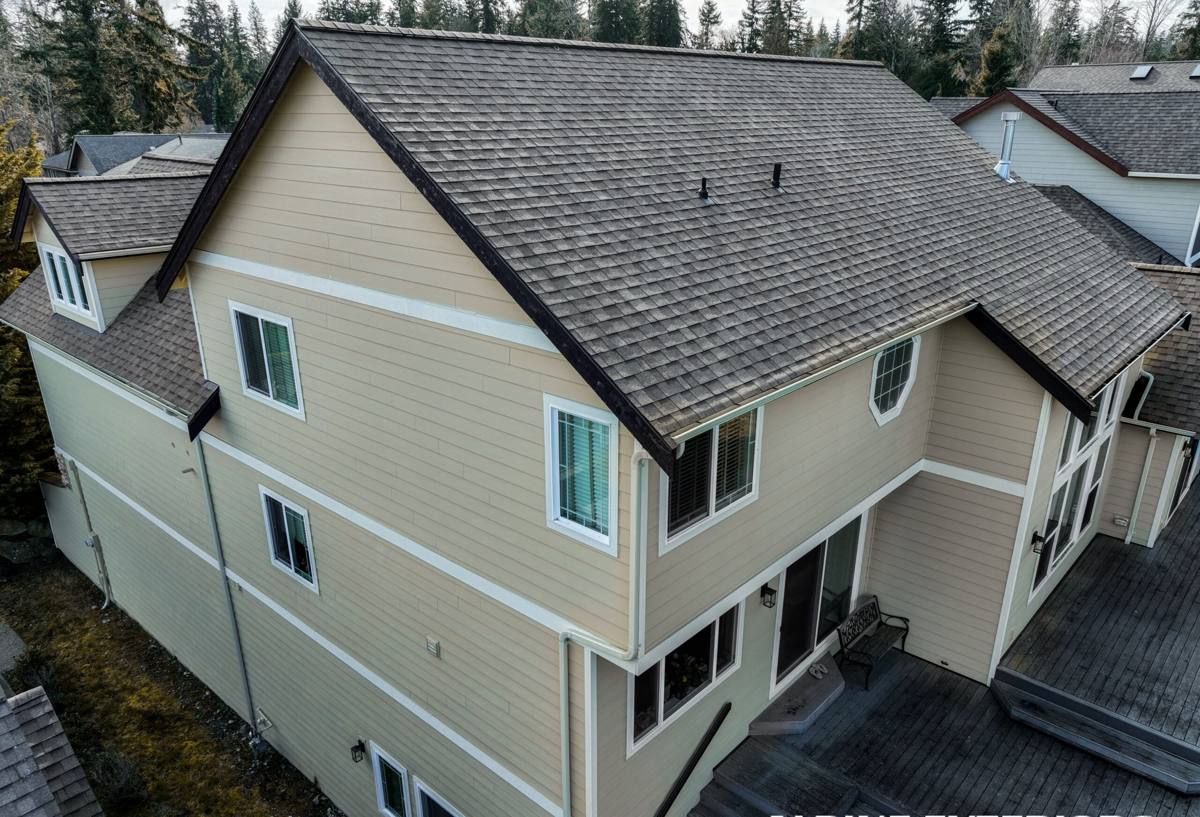
What This Climate Does to a Lynden Deck
Driving Rain and Standing Moisture
Rain in this part of Whatcom County rarely falls straight down for long. Wind pushes it sideways and it collects on horizontal surfaces — deck boards, ledger connections, and any framing member that doesn't drain and dry quickly. A deck built with tight board spacing, poor drainage slope, or a ledger connection that traps water against the house will hold moisture far longer than the same deck would in a drier climate, and that extra dwell time is what drives rot and fastener corrosion.
A Long Moss and Algae Season
Mild temperatures and consistent moisture add up to a moss and algae season that can run close to year-round on shaded deck surfaces, especially under mature trees or on the north side of a house. On a deck, that's not just a cosmetic issue — moss and algae growth on decking boards or stair treads gets slippery fast, and it holds moisture against the board surface, which accelerates whatever wear process the material is already prone to.
Salt Air's Slower but Real Toll
Lynden is inland compared to our waterfront service areas, but marine air still moves across this whole part of the county, and it still works on metal over time. Fasteners, joist hangers, and railing hardware that aren't rated for a damp, salt-tinged environment corrode faster here than they would in a dry inland climate, and a rusting fastener buried inside deck framing is one of the hardest deck problems to catch early because it's invisible until something fails.
What a Correctly Built Deck Requires Here
A lot of deck problems in this climate don't trace back to the decking material at all — they trace back to shortcuts in the framing and connection details underneath it. On every deck we build, that means:
- Footings set below frost depth and sized for the actual load of the deck and any attached structure like a hot tub or roof
- Ledger board attachment with proper flashing that sheds water away from the house rather than channeling it behind the siding
- Corrosion-resistant fasteners and joist hangers rated for the moisture and salt exposure this climate delivers
- Joist tape or another moisture barrier on top of framing members to slow water absorption into the wood
- Board spacing and drainage slope that let water shed off the deck surface instead of pooling
- Railing posts anchored with hardware built for sustained outdoor moisture exposure, not general-purpose fasteners
None of these add much to the overall cost of a deck relative to the decking material itself, but skipping them is exactly what turns a deck that should last decades into one that needs structural repair inside ten years.
Decking Material Options for a Lynden Home
There's no single right answer for every deck — budget, how much shade the site gets, and how long you plan to stay in the house all factor into the decision. What matters is understanding the honest trade-offs before committing to a material.
| Material | Moisture & Moss Behavior | Typical Maintenance | Realistic Lifespan Here |
|---|---|---|---|
| Pressure-treated lumber | Absorbs moisture readily; needs airflow underneath and regular sealing to shed water well | Annual cleaning and periodic re-sealing or staining | 10-15 years with consistent upkeep |
| Cedar | Naturally moisture-resistant but still absorbs water over time; moss can take hold if not treated | Regular staining and moss treatment | 15-20 years with consistent upkeep |
| Composite decking | Resists moisture absorption well; surface texture affects how easily moss and algae get a foothold | Periodic washing; low overall | 25-30 years depending on product quality |
| PVC/cellular decking | Fully resists moisture absorption; smooth, non-porous surface sheds moss and algae better than any wood-based option | Low; occasional washing | 30+ years |
We'll walk you through which option actually fits your site's sun exposure, shade pattern, and budget rather than defaulting to whatever's easiest to sell. A deck on an open, sun-exposed lot and a deck tucked under mature trees don't call for the same recommendation, even on the same street.
Structural Elements That Matter Most
The decking surface is what you see, but the structure underneath is what determines whether the deck is actually safe and long-lasting. Ledger attachment is one of the most common failure points on decks in this climate — a ledger that's bolted to the house without proper flashing lets water track behind the siding and rot the house's own framing, not just the deck's. Footing depth matters just as much; footings that aren't set below frost depth can shift over time as the ground freezes and thaws, which shows up as a deck that starts to feel uneven or bouncy years after it was built. Beam and joist sizing needs to account for the actual span and load, including any hot tub, built-in seating, or roof structure planned for the deck, not just a generic span table applied without checking the specifics.
How a Deck Project Actually Runs
- Site visit and design: We look at your yard's sun exposure, drainage, and how the deck will connect to the house, and talk through material and layout options honestly, including what each one costs to maintain over time.
- Permitting: Most deck projects in Whatcom County require a building permit, and we handle that process rather than leaving it to you to navigate.
- Footings and framing: This is the stage that determines the deck's long-term durability, and it's where we spend the most care — footing depth, ledger flashing, fastener selection, and joist layout all get set here.
- Decking, railing, and stairs: Once the structure is sound, we install the decking material, railing system, and any stairs, checking spacing and drainage as we go rather than just at the end.
- Final walkthrough: We walk the finished deck with you, point out any maintenance the specific material will need, and make sure everything is solid before we call the job done.
Signs an Existing Lynden Deck Needs Attention
- Soft or spongy spots underfoot, especially near the ledger or stair connections
- Moss or algae buildup that returns quickly after cleaning, particularly in shaded corners
- Visible gaps, rust staining, or corrosion around fasteners and joist hangers
- Railing posts that feel loose or move when pushed
- Water pooling on the deck surface instead of draining off
- Cracking, splintering, or graying wood that's lost its finish
- A ledger board area showing staining or gaps where it meets the house
Any one of these is worth a professional look. Caught early, most are a repair. Left through another wet season, several of them turn into a full rebuild.
Why a Local Whatcom County Crew Matters
A crew that builds decks across this county through every season sees how driving rain, moss, and moisture actually behave on real structures over years, not just how a material performs on a spec sheet. That shows up in practical decisions on a Lynden project: how much drainage slope a given site actually needs based on its shade pattern, which fastener grade is worth the extra cost for a specific yard's exposure, and where a ledger connection needs extra flashing attention because of how the house is built. It also means working with a crew that already understands the difference between a shaded, tree-lined lot and an open one, and doesn't apply the same plan to both.
Get a Free, No-Pressure Estimate
If you're planning a new deck in Lynden or dealing with an aging one that needs a closer look, we're glad to come take a look and give you a straightforward, honest read on what it actually needs. Reach out using the form below to schedule a free estimate — no pressure, no upsell script.