 Semiahmoo
 Storm Damage in Marietta: What Whatcom County Weather Actually Does to a Roof
Marietta sits low and close to the water, which means every roof here deals with a combination most inland homes never see: salt-laden air, wind that comes off the bay with real force, and rain that doesn't just fall straight down — it drives sideways under shingles, flashing, and trim. Add Whatcom County's long, damp moss season and you have a roof that's under attack from more than one direction, sometimes all at once during a single winter storm system.
A single hard blow can knock loose shingles, crack ridge caps, tear at flashing edges, or push rain up under a roof edge that's held fine for years. The damage isn't always dramatic. Often it's a handful of lifted shingles or a strip of exposed underlayment that looks minor from the ground but is enough to let water into the deck over the following weeks of steady coastal rain. That's the pattern we see most in Marietta: not one catastrophic failure, but a small storm wound that turns into a bigger interior problem because it sat unaddressed through the next few rounds of weather.
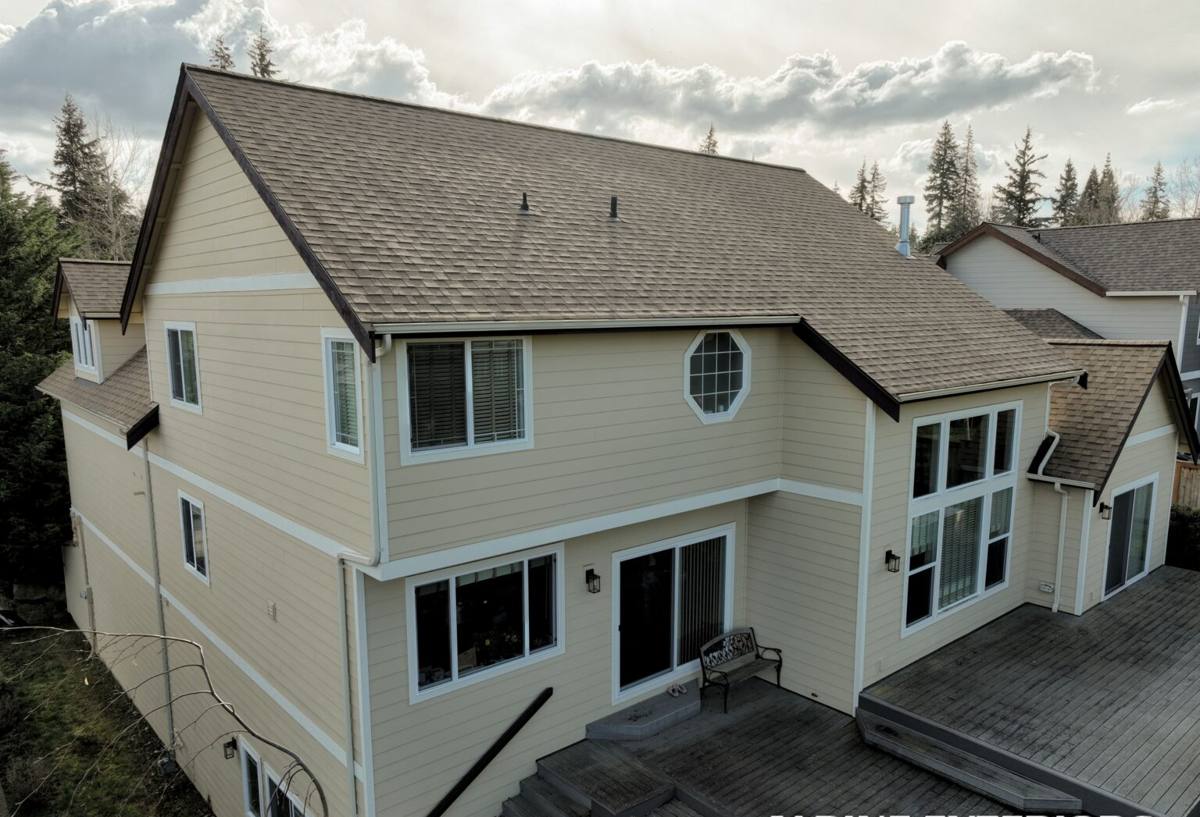
What Counts as Storm Damage — and What Doesn't
Not every roof problem after a windy night is "storm damage" in the way an insurance adjuster or a repair crew means it. Knowing the difference helps you make the right call and avoid paying for — or filing a claim over — something that isn't actually storm-related.
Wind Damage
Lifted, creased, or torn-off shingles, bent or displaced ridge caps, and flashing pulled away from a chimney or wall are classic wind damage. Whatcom County gusts off the water can be strong enough to do this even on roofs that are only a few years old, especially at exposed edges and corners where wind uplift is strongest.
Wind-Driven Rain Intrusion
This is the one homeowners miss most. Rain pushed sideways by wind can find its way under shingle tabs, around vent boots, or through gaps in flashing that would never leak in a normal straight-down rain. You may not see a hole — you'll see a stain on a ceiling or a damp patch in the attic days after the storm has passed.
What's Usually Not Storm Damage
Granule loss from age, moss-related shingle breakdown that's been building for years, and worn flashing sealant are wear-and-tear issues, not storm events — even if a storm is what finally made them leak. This distinction matters for insurance, and we'll tell you honestly which category your roof falls into rather than stretching the truth to file a claim.
The Correct Way to Handle a Storm-Damaged Roof
A rushed or partial repair after a storm is one of the most common ways a roof ends up with a repeat leak. Doing it right means working through the same sequence every time, regardless of how small the damage looks.
1. Inspection and Documentation
We walk the roof (or use a lift or camera where a walk-on inspection isn't safe) and check not just the visible damage but the areas around it — flashing, fasteners, decking condition, and the shingle courses adjacent to the damaged section. We photograph everything before touching anything, which matters if you end up filing an insurance claim.
2. Temporary Protection
If there's an active leak path or exposed decking, that gets tarped or covered the same visit. Whatcom County's storm systems rarely arrive one at a time — waiting a week for a "proper" repair while the next system rolls through off the water is how a manageable repair turns into a deck replacement.
3. Permanent Repair
Matching shingles, resealing or replacing flashing, and — critically — checking the decking underneath for saturation before closing everything back up. Covering wet decking with new shingles just traps the moisture and guarantees a callback.
Materials and Methods That Actually Hold Up Near the Water
Coastal Whatcom County conditions punish cheap fixes fast. What survives inland doesn't always survive here, and salt air in particular shortens the life of the wrong fastener or flashing metal.
| Component | What We Use and Why |
|---|---|
| Fasteners | Corrosion-resistant roofing nails or screws — standard galvanized fasteners can start rusting faster in salt-influenced air than they would further inland |
| Flashing | Properly lapped and sealed metal flashing at every penetration and wall intersection, since wind-driven rain finds gaps that gravity-fed rain never would |
| Underlayment | Synthetic underlayment as a backup water barrier under repaired sections, so a future wind event doesn't have a direct path to bare decking |
| Sealants | Products rated for UV and moisture exposure, not general-purpose caulk that dries out and cracks within a season or two |
| Ridge and Hip Caps | Matched profile and properly nailed for wind uplift resistance — a common failure point in coastal gusts |
We also pay close attention to moss buildup during any storm repair visit. A roof that's carrying a heavy moss load holds moisture against the shingles longer after every rain, which both accelerates wear and makes it harder to spot new storm damage hiding under it. If we see moss that's compromising the roof's condition during a repair call, we'll flag it honestly rather than just patch around it.
Our Process, Start to Finish
- Call or request an estimate — describe what you noticed (a stain, missing shingles, debris) and when the storm hit.
- Inspection scheduled promptly — storm damage doesn't wait, and neither do we, especially if there's an active leak.
- Findings and honest recommendation — we tell you what's storm damage, what's pre-existing wear, and what the repair actually requires.
- Temporary protection if needed — tarping or sealing to stop active water intrusion before the next system arrives.
- Permanent repair — matched materials, proper flashing and fastening, and a check of the decking underneath.
- Documentation provided — photos and a written summary you can use for insurance if you're filing a claim.
Insurance Claims: What We Do and Don't Do
We're not a public adjuster and we won't pretend to be one. What we do is document damage clearly and honestly — photos, a written scope, and a straightforward account of what's storm-caused versus what's wear-and-tear — so you have solid information to bring to your insurer. We won't inflate a scope to help a claim pay out bigger, and we won't downplay real damage to keep a repair cheap. If your insurer's adjuster wants to talk to the contractor who did the inspection, we're glad to answer their questions directly.
One honest note: many homeowner policies have a wind/storm deductible that's separate from your standard deductible, and it can be a percentage of your home's insured value rather than a flat dollar amount. That's worth checking before you assume a claim is worth filing over a smaller repair.
Signs You Should Get a Post-Storm Roof Inspection
- Shingles or shingle pieces in the yard or gutters after a windstorm
- A ceiling stain or musty smell that appeared within days of a storm
- Visible daylight or gaps around a chimney, vent, or skylight from the ground or attic
- Ridge caps that look shifted, cracked, or missing
- A sudden increase in attic moisture or condensation after a wind event
- Debris — branches, needles, gravel-like granules — collecting heavier than usual in one spot
- Any roof older than 15–20 years that just went through a significant wind event, even with no visible damage
If more than one of these applies, it's worth having someone look before the next storm system rather than after.
Why a Crew That Already Works Marietta Matters
Storm repair isn't just a matter of skill — it's a matter of knowing what this specific stretch of Whatcom County coastline does to a roof over time. A crew that mostly works drier, inland areas may not think twice about salt-air corrosion on fasteners, or about how differently wind-driven rain behaves on a roof exposed to open water versus one tucked behind trees a mile inland. We work Marietta roofs regularly, which means we're not guessing at how a particular flashing detail or shingle line typically holds up here — we've seen it hold up, or fail, in this exact environment.
It also means faster response. After a regional storm, every roofing crew in Whatcom County gets busy at once. Being a local outfit means shorter drive times between calls and a better ability to get a tarp on your roof the same day, which is often the difference between a $400 repair and a $4,000 one.
Get an Honest Look at Your Roof
If a recent storm left you with missing shingles, a new stain on the ceiling, or just a nagging feeling that something's not right up there, it's worth a look before the next system moves through. We offer free, no-pressure estimates — we'll tell you plainly what we find, what's actually storm damage, and what it will take to fix it right. Use the form below to get started.