 Semiahmoo
 Why Lynden Roofs Wear Differently Than You'd Expect
Lynden sits inland from Semiahmoo Bay, but "inland" in Whatcom County doesn't mean dry or sheltered. The same marine weather systems that push driving rain across the Salish Sea keep moving east across the county, and the salt-laden air off the coast still reaches roofs here — enough to speed up corrosion on exposed nails, flashing, and gutter hardware even miles from open water. Add in the shade from mature trees on many Lynden properties, the fog that settles into the Nooksack Valley on cool mornings, and a wet season that can stretch from October well into May, and you get a roof environment that's tougher on materials than the sunny-day picture most homeowners have in their heads.
None of this means a Lynden roof is doomed — it means repairs have to account for moisture, moss, and metal fatigue as a package, not one problem at a time. A patch that only addresses the visible leak and ignores the moss colony feeding it, or the corroding fastener next to it, is a patch you'll be paying for again in a year or two.
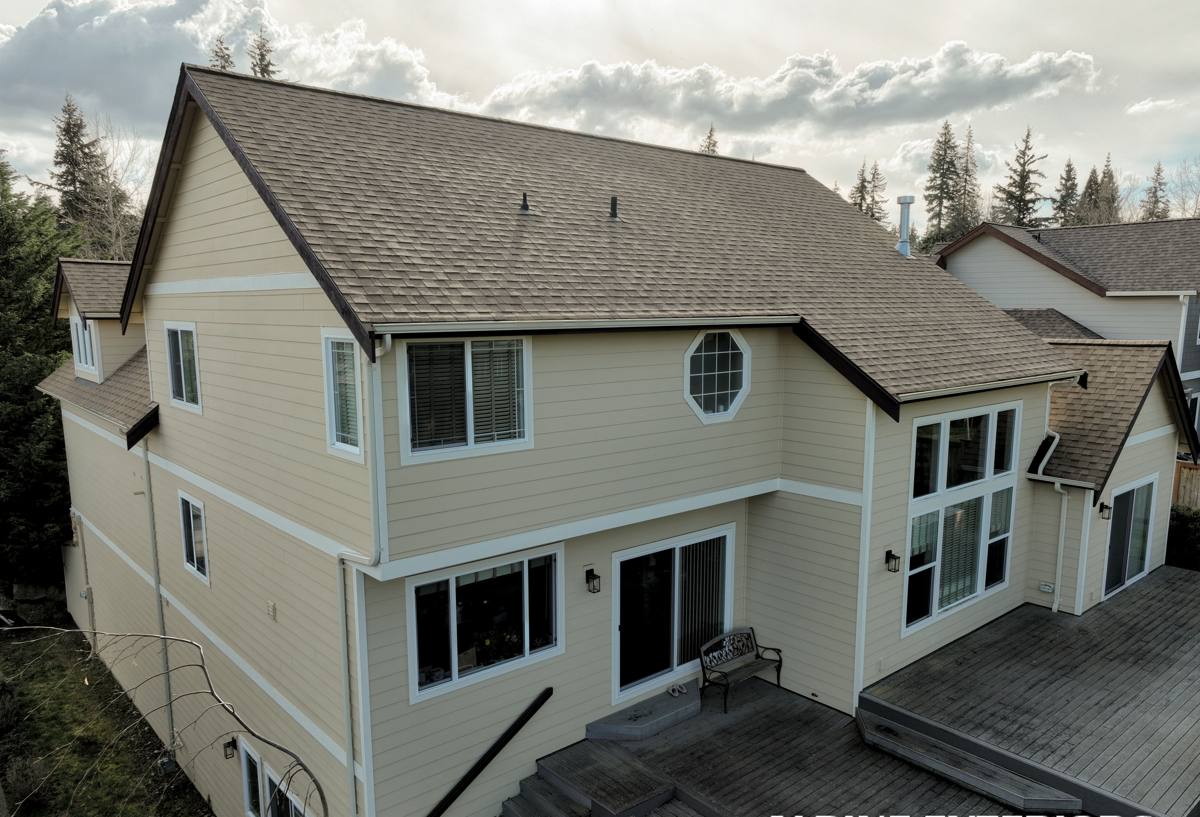
Signs a Lynden Roof Needs Repair — Not a Full Replacement
Most roofs don't fail all at once. They show localized trouble first, and catching it early is what keeps a repair a repair instead of a replacement. Watch for:
- Dark streaking or thick moss growth concentrated on north-facing or heavily shaded slopes
- Shingle granules collecting in gutters or at downspout outlets
- Curling, cracking, or lifted shingle edges after a hard freeze-thaw stretch
- Water stains on interior ceilings, especially near chimneys, skylights, or roof valleys
- Rusted or loose flashing around vent pipes and chimney bases
- Sagging or soft-feeling spots when walked on (a sign moisture has reached the decking)
- Daylight visible through the attic roof deck, or damp insulation below it
One or two of these, caught before they spread, is usually a straightforward repair. Several at once, or damage that's been sitting long enough to reach the decking, starts to tip the math toward replacement — which is exactly why an honest inspection matters more than a quick guess from the ground.
Moss Isn't Cosmetic — It's a Leak Waiting to Happen
Moss holds moisture against the shingle surface long after the rest of the roof has dried out. Over a long Whatcom County wet season, that constant dampness works shingle granules loose, lets moss roots work into seams, and eventually lifts shingle edges enough for water to get underneath. On shaded Lynden lots with tree cover close to the house, this isn't a once-in-a-while problem — it's an annual maintenance item, and skipping it is one of the most common reasons we get called out for a "sudden" leak that was actually years in the making.
Flashing and Valleys: Where Small Gaps Cause Big Damage
Roof fields — the flat expanses of shingle — rarely fail on their own. Leaks concentrate at transitions: chimney flashing, valleys where two roof planes meet, pipe boots, and skylight curbs. These spots take the brunt of driving rain because wind pushes water sideways and uphill under shingles instead of letting it run straight down. A correct repair treats these transition points as their own project, not an afterthought to shingle work.
What a Correct Roof Repair Actually Involves
A repair that holds up through another Whatcom County winter has a few non-negotiable steps, regardless of the size of the job:
- Full diagnosis before any work starts — tracing the leak or damage back to its actual source, which is often several feet from where the stain shows up inside
- Safe, complete moss and debris removal — not just knocking off the visible growth, but clearing gutters, valleys, and the moss roots that regrow if left behind
- Decking inspection at the repair site — soft or delaminated plywood under damaged shingles has to be addressed, not covered up
- Matching materials and fastening methods to the existing roof so the repair performs the same as the surrounding field, not as a patch with different expansion and wear characteristics
- Flashing and sealant renewal at any penetration disturbed during the repair — old sealant doesn't get reused
- A final water test or close visual check on valleys and flashing before calling the job done
Skip any one of these and you've bought yourself a shorter-lived fix, sometimes one that hides the real problem until it resurfaces somewhere new.
Common Roof Repair Issues We See Around Lynden
| Issue | Typical Cause | What the Fix Involves |
|---|---|---|
| Moss-driven shingle lift | Shade, tree debris, prolonged dampness | Full moss removal, damaged shingle replacement, treatment to slow regrowth |
| Flashing leaks at chimneys/vents | Corroded or improperly sealed metal, age | Remove and replace flashing, re-seal with proper materials, not just caulk over the old |
| Valley leaks | Debris buildup, undersized or worn valley material | Clear debris, install proper valley lining, re-lay adjacent shingles |
| Wind-lifted or missing shingles | Driving rain and gusts working under weak seals | Replace shingles, re-seat surrounding tabs, check nailing pattern |
| Gutter backup causing eave rot | Clogged gutters holding water against the fascia | Clear gutters, repair fascia/soffit, confirm proper roof-to-gutter overlap |
| Attic condensation staining | Poor ventilation trapping moisture | Correct intake/exhaust balance, address soffit or ridge vent blockages |
Repair vs. Replacement: How We Help You Decide
Homeowners don't need a sales pitch here — they need a straight answer about whether a repair is money well spent or a short-term delay on a bigger job. A few factors we actually weigh:
| Factor | Points Toward Repair | Points Toward Replacement |
|---|---|---|
| Roof age | Under roughly 15 years, or well-maintained older roof | Near or past the manufacturer's expected service life |
| Damage extent | Isolated to one slope, valley, or penetration | Spread across multiple slopes or recurring in the same areas |
| Decking condition | Solid, dry decking at the repair site | Soft, delaminated, or repeatedly re-damaged decking |
| Repair history | First or second repair on this roof | Third-plus repair, or patches on top of patches |
| Budget and timeline | Need a stable, cost-effective fix now | Planning to sell, refinance, or want a longer-term reset |
Most repair costs land somewhere between a few hundred dollars for a simple flashing or shingle fix and a couple thousand for a larger valley or decking repair — the range depends entirely on scope, access, and material, which is why we walk the roof and give a written number instead of guessing over the phone.
Materials We Use for Lasting Repairs
For repair work, matching what's already on the roof matters more than picking a "better" product. A repair using mismatched shingle profiles or incompatible metals can actually create new failure points at the seams. That said, when a repair opens up the chance to upgrade a trouble spot — a chronically leaking valley, for example — we'll walk you through the trade-offs honestly:
- Architectural (laminate) shingles hold up well to wind and blend more easily into most existing roofs from the last couple of decades, but exact color matching to an older, weathered roof is never perfect
- 3-tab shingles are lighter and less wind-resistant, so we typically only match them when the existing roof is 3-tab and full replacement isn't the goal
- Metal flashing and valley material should be corrosion-resistant given the marine air in this part of Whatcom County — we don't cut corners here even on small repairs, since flashing failures cause a disproportionate share of callbacks
- Cedar shake repairs require matching grain and exposure carefully; shake is more maintenance-intensive long-term than composition shingle, which we'll say plainly if that's what you're deciding between
Our Process, Start to Finish
- Free on-site inspection — we get on the roof (weather permitting) rather than diagnosing from photos or the ground
- Plain-English explanation of what's actually wrong and why, including whether repair is the right call at all
- Written estimate with the scope, materials, and price spelled out — no verbal-only quotes
- Scheduled repair work, timed around Whatcom County weather windows so shingles and sealants can cure properly
- Cleanup and haul-away of old material and moss debris — we don't leave a mess in the gutters or yard
- Photos and documentation of the completed repair, useful for your records or an insurance claim if one's involved
Why a Crew That Already Works in Lynden Matters
Roof repair is local work in a way a lot of trades aren't. A contractor who's already up on Lynden roofs regularly knows which shingle lines from the past two decades are still available for a close color match, which flashing details tend to fail first on homes with heavy tree cover, and how to sequence a repair around the wettest stretches of the Whatcom County calendar so materials actually seal instead of getting rained on mid-job. That local pattern recognition is the difference between a repair that's diagnosed correctly the first visit and one that takes two or three callbacks to get right.
It also matters for something more basic: availability. A crew based out-of-area may take days to get back out for a follow-up or a storm-damage check. A crew that's already working in and around Lynden can turn that around fast, which counts for a lot when a leak is active.
A Simple Roof Maintenance Checklist for Lynden Homeowners
Between repairs, a little seasonal attention goes a long way in this climate:
- Clear moss from shaded slopes at least once, ideally twice, a year
- Keep overhanging branches trimmed back so leaves and needles don't collect on the roof
- Clean gutters and downspouts before the fall rains start in earnest
- Do a visual check of flashing around chimneys and vents each spring
- Check the attic for damp insulation, daylight gaps, or musty smells twice a year
- Look at what's collecting in the gutters — heavy granule buildup is an early warning sign
- Have the roof looked at after any unusually hard windstorm, even if nothing looks obviously wrong from the ground
If you're seeing moss buildup, a stain on a ceiling, or just want an honest read on how much life is left in your roof, we're happy to take a look. The estimate is free, there's no pressure attached to it, and you'll get a straight answer either way — just fill out the form below to get started.