 Semiahmoo
 Why California Creek Roofs Wear Out Faster Than the Manufacturer's Warranty Suggests
If you own a home near California Creek, you already know the roof over your head is working harder than the same roof would in a drier part of the state. This corner of Whatcom County sits close enough to Semiahmoo Bay and the open water beyond it that salt-laden air is a constant, low-grade presence on every exposed surface — fasteners, flashing, gutters, and shingle granules included. Add in the region's long stretch of driving, wind-pushed rain and the shaded, damp conditions that let moss colonize a roof deck almost year-round, and you get a climate that shortens the practical lifespan of a roof well below its rated one.
None of this means a roof here is doomed. It means a roof replacement done for a California Creek home has to be planned differently than one done twenty miles inland. The materials, the underlayment, the ventilation, and the flashing details all need to account for salt exposure, sustained moisture, and moss pressure — not just wind and snow load like a generic spec sheet assumes.
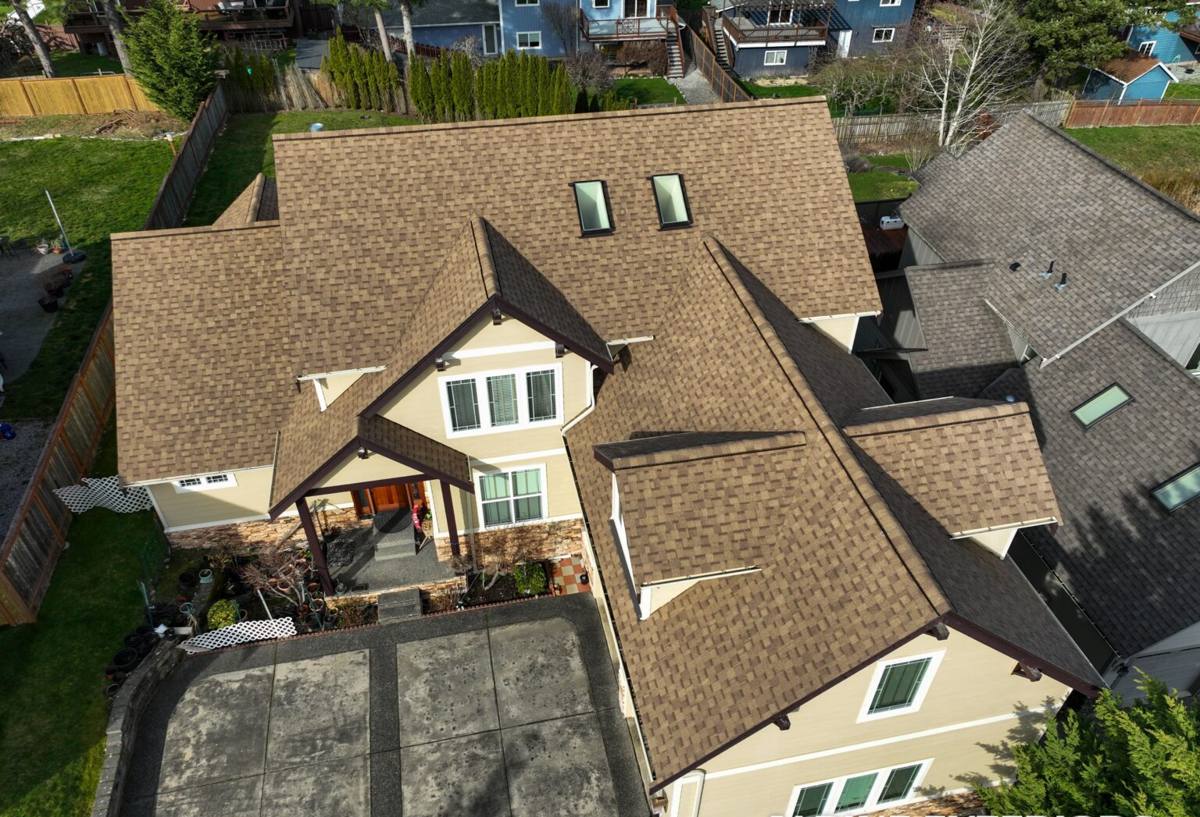
Signs a California Creek Roof Has Reached Replacement, Not Repair
Repair makes sense when the problem is isolated — a cracked pipe boot, a section of lifted flashing, a few storm-damaged shingles. Replacement becomes the honest recommendation when the damage is spread across the whole roof or when the deck underneath has started to suffer. Homeowners near the water tend to see a specific pattern:
- Moss and algae staining that returns within months of cleaning, especially on north-facing and shaded slopes
- Granule loss heavy enough that you can see bare shingle mat in more than a few spots
- Soft or spongy decking when walked, usually starting at valleys, eaves, or around chimneys
- Rusting or pitted fasteners and flashing, a direct sign of salt-air corrosion
- Curling, cupping, or cracked shingles concentrated on the sides that catch the most wind-driven rain
- Interior staining on ceilings or in the attic that shows up after heavy rain events, not just once
One or two of these on their own might still be a repair. Several at once, especially combined with a roof that's already past the middle of its expected life, usually means the underlying materials are failing together — and patching one area just shifts the water to the next weak point.
What a Correct Roof Replacement Actually Involves Here
Tear-Off and Deck Inspection
A proper job starts by removing the old roofing down to the deck, not layering over it. That's the only way to actually see what the last several years of moisture exposure have done to the sheathing. Any soft, delaminated, or rotted plywood or boards get replaced before anything new goes down — skipping this step is the single most common shortcut that leads to early failure on homes in wet coastal microclimates.
Underlayment Built for Sustained Moisture
Given how much of the year this area sees rain, and how long moss and moisture sit on a shaded roof plane, the underlayment matters more here than it does in a dry climate. A synthetic, water-resistant underlayment — with self-adhered ice-and-water membrane at eaves, valleys, and roof penetrations — gives the deck a real second line of defense if wind-driven rain ever gets under the primary roofing.
Flashing and Fasteners That Won't Corrode
Salt air degrades cheap or mismatched metal faster than most homeowners expect. Flashing around chimneys, skylights, and wall intersections, along with the fasteners holding everything down, should be corrosion-resistant material appropriate for a marine environment — not the lowest-cost option that a spec sheet technically allows.
Ventilation That Actually Moves Air
Trapped moisture under the roof deck accelerates rot and feeds the same organic growth that causes moss and algae staining on the surface. Balanced intake and exhaust ventilation — enough soffit intake matched to enough ridge or roof-line exhaust — keeps the underside of the deck drier, which extends the life of everything above it.
Material Options for a California Creek Climate
There's no single "best" roofing material for every home — it depends on budget, roof pitch, and how much long-term maintenance you want to take on. Here's how the common options actually compare for a salt-air, high-moisture, moss-prone setting:
| Material | Moss/Moisture Behavior | Salt-Air Durability | Maintenance Level |
|---|---|---|---|
| Architectural asphalt shingle | Good with proper algae-resistant granules; needs periodic moss removal | Solid when fasteners/flashing are corrosion-resistant | Low to moderate |
| Standing seam metal | Excellent — moss struggles to grip smooth metal | Very good with marine-grade coatings and fasteners | Low |
| Cedar shake | Poor in this climate without diligent upkeep — holds moisture and feeds moss/rot | Fair; hardware still needs corrosion resistance | High |
| Composite/synthetic shake | Good — sheds moisture without wicking it like natural wood | Good with proper fastener selection | Low to moderate |
We'll walk through these honestly during an estimate rather than push whatever has the best margin. Cedar, for example, can look great on the right home, but in a climate this wet it demands a maintenance commitment a lot of homeowners underestimate — that's a trade-off worth knowing before you commit, not after.
Our Process for a California Creek Roof Replacement
1. On-Site Assessment
We walk the roof and the attic, not just the ground-level view. That's the only way to catch soft decking, ventilation gaps, or moisture staining that isn't visible from the yard.
2. Clear, Written Scope
You get a written scope covering materials, underlayment, flashing approach, ventilation plan, and timeline before any work starts — no verbal-only promises.
3. Tear-Off and Deck Repair
Old roofing comes off, damaged decking is replaced, and the deck is dried in the same day whenever weather allows — an open deck sitting exposed overnight in this climate is asking for trouble.
4. Installation
Underlayment, flashing, ventilation, and the finish material go in following manufacturer specifications, not shortcuts. This is where corrosion-resistant fasteners and properly lapped flashing actually get installed, not just spec'd on paper.
5. Cleanup and Walkthrough
Magnetic sweep for stray fasteners, full debris haul-off, and a walkthrough where we point out anything you should watch for going forward.
What Drives the Cost of a Roof Replacement Here
Every roof is different, but the main variables that move the price up or down are consistent. Broad ranges only — your actual number depends on your specific roof:
| Factor | Why It Matters |
|---|---|
| Roof size and number of planes | More area and more valleys/hips mean more material and labor |
| Deck condition | Rotted sheathing discovered at tear-off adds material and labor to replace it |
| Material choice | Asphalt, metal, and composite shakes span a wide cost range per square |
| Pitch and access | Steep or hard-to-access roofs take longer and require more safety setup |
| Ventilation upgrades | Adding proper intake/exhaust venting where none exists is worth the added cost long-term |
As a rough starting point, a straightforward asphalt shingle replacement on an average home in this area typically lands in the moderate five-figure range, with metal or extensive deck repair pushing higher. We'll give you a firm, itemized number after we've actually looked at your roof — not a phone-quote guess.
Why a Crew That Already Works California Creek Matters
Roofing crews who work this specific stretch of Whatcom County coastline see the same failure patterns repeatedly — moss regrowth on shaded north slopes, flashing corrosion around chimneys facing the water, and soffit vents that get painted or blocked over time. That repetition matters. It means the material choices, flashing details, and ventilation layout we recommend aren't generic — they're based on what actually holds up on homes exposed to the same salt air and rain patterns as yours.
It also means fewer surprises during permitting and inspection, since local crews are familiar with the practical realities of building in this part of the county. A crew that's replaced roofs in the neighborhoods around you isn't guessing at what this climate does to a roof over ten or fifteen years — they've already seen it.
Protecting Your Investment After Replacement
A new roof still needs a little attention in this climate to hit its full expected lifespan. A short annual routine goes a long way:
- Clear gutters and downspouts each fall before the heavy rain season sets in
- Remove moss buildup gently — avoid pressure washing, which can strip granules and shorten shingle life
- Trim back overhanging branches to reduce shade and debris buildup that feed moss growth
- Check attic ventilation periodically to confirm vents haven't been blocked by insulation or debris
- Have flashing around chimneys and skylights visually checked every couple of years for early corrosion signs
If you're weighing a roof replacement for a California Creek home, we're glad to come take a look and give you a straight, no-pressure estimate — what your roof actually needs, what it'll cost, and why. There's a form below to get that scheduled.