 Semiahmoo
 Why Siding Repair Calls Look Different in Blaine
Blaine sits close enough to Semiahmoo Bay and the Strait of Georgia that salt-laden air is a daily fact of life, not an occasional weather event. Combine that with Whatcom County's long wet season and the moss and algae growth that comes with months of shade and moisture, and you get a siding failure pattern that's more aggressive than what a contractor in a drier inland market ever has to deal with. We see it constantly on repair calls: fasteners corroding faster than they should, paint and caulking failing years ahead of schedule, and moisture finding its way behind siding through gaps that would stay dry in a less punishing climate.
A siding repair in Blaine isn't just about patching a hole or replacing a cracked board. It's about understanding why that section failed in the first place, and whether the fix will actually hold up against the same salt air, driving rain, and moss pressure that caused the original problem.
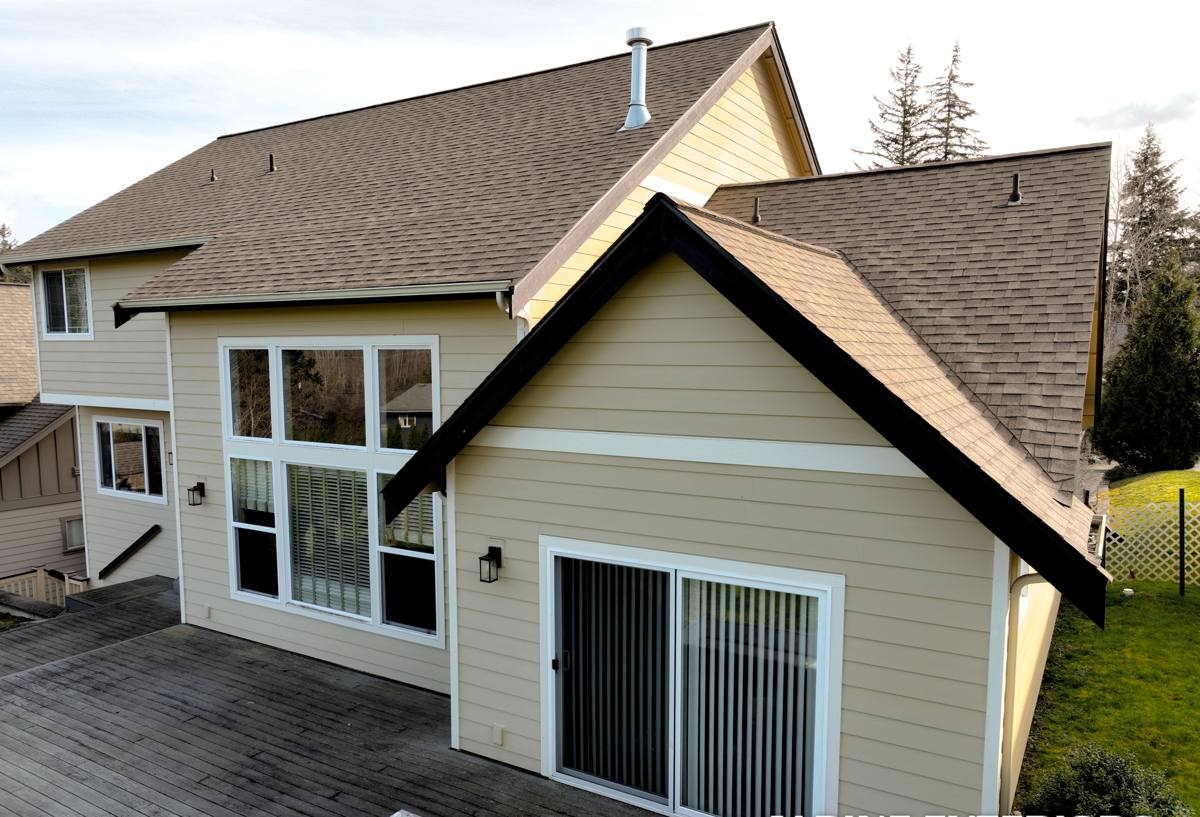
What's Actually Driving Repair Calls in This Area
Salt Air and Fastener Corrosion
Airborne salt accelerates corrosion on nails, screws, and any exposed metal trim. Once fasteners start rusting and losing their grip, siding panels can loosen, warp at the edges, or pull away from the wall — even if the siding material itself still looks fine from the ground.
Driving Rain and Wind-Driven Moisture
Blaine gets its share of storms coming off the water, and wind-driven rain finds every weak seam, unsealed joint, and poorly lapped piece of trim. Water that gets behind siding doesn't just damage that panel — it can rot sheathing, degrade the weather-resistive barrier, and cause problems that show up two rooms away from where the leak actually started.
Moss, Algae, and the Long Wet Season
Shaded north walls and roof lines that stay damp for months at a time grow moss and algae readily. On some siding materials that's mostly a cosmetic issue; on others, trapped moisture under organic growth accelerates rot, delamination, or paint failure. Either way, growth on siding is a signal worth investigating, not just pressure-washing away.
Signs Your Blaine Home Needs a Siding Repair — Not Just a Cleaning
- Soft or spongy spots when you press on the siding, especially near the bottom courses or below windows
- Visible gaps, cracks, or separation at panel seams and corner trim
- Paint that's bubbling, peeling, or failing in patches rather than evenly across a wall
- Streaking, dark staining, or persistent moss growth concentrated in one area rather than the whole exterior
- Warped, bowed, or buckled panels — a strong sign of moisture trapped behind the siding
- Rust streaks running down from nail heads or trim fasteners
- Interior clues: a musty smell, discoloration on an interior wall, or peeling interior paint on an exterior-facing wall
What a Proper Siding Repair Actually Involves
A repair that just covers the visible damage and stops there is a repair that's likely to fail again. We treat every repair call the same way we'd approach a small piece of a full installation: find out what's happening behind the siding before deciding how to fix what's in front of it.
1. Diagnose Before You Patch
We pull back or remove the damaged section and look at what's underneath — the weather-resistive barrier, the flashing at windows and penetrations, the sheathing itself. If the water intrusion has already reached the structure, patching the surface without addressing that is a short-term fix at best.
2. Fix the Water Path, Not Just the Symptom
Most siding damage in this climate traces back to a specific entry point — a missing kick-out flashing, a caulked joint that should have been lapped instead, a fastener pattern that let water in. A repair that doesn't correct that entry point is going to need to be repeated.
3. Match Materials Correctly
Matching new material to existing siding matters for both appearance and performance. This is where a lot of repair work goes wrong — patching in a different product, a different profile, or unpainted material that will weather at a different rate than the surrounding siding.
4. Reinstall to Spec, Not Just to "Close It Up"
Proper fastener spacing, correct overlap, sealed joints where the manufacturer calls for sealant and open joints where it calls for drainage — these details are exactly what determines whether a repair lasts five years or fifteen.
Repair or Replace? An Honest Look at the Decision
Not every damaged section needs a full re-side, and not every repair is worth doing instead of planning for replacement. The right call depends on how much of the wall is affected, what's causing the damage, and how old and how sound the rest of the siding is.
| Factor | Leans Toward Repair | Leans Toward Replacement |
|---|---|---|
| Extent of damage | Isolated to one or two sections | Spread across multiple walls or elevations |
| Cause of failure | Isolated impact damage or a single flashing failure | Systemic moisture intrusion or widespread fastener corrosion |
| Age of existing siding | Siding is relatively young and otherwise sound | Siding is near or past its expected service life |
| Material involved | Durable material in generally good condition | Material prone to ongoing moisture or maintenance issues in this climate |
| Match quality achievable | New material will blend well with existing siding | Existing siding is discontinued, faded, or a mismatch is unavoidable |
We'll give you a straight answer either way. If a targeted repair genuinely solves the problem, that's what we'll recommend — we're not going to push a full replacement on a homeowner who doesn't need one.
Where We Draw the Line on Repair Materials
We install James Hardie fiber cement siding exclusively, and that shapes how we approach repairs. When we're repairing a home that already has Hardie siding, matching material and finish is straightforward — Hardie's ColorPlus factory-finished panels and planks are made to be replaced in kind, board for board, without a visible seam in tone once the repair weathers in.
When we're called to repair a home sided in vinyl, LP SmartSide, cedar, or another hardboard product, we'll still diagnose the problem honestly and tell you what's actually going on. But if the underlying issue is a pattern we see repeatedly with that material in this climate — vinyl that's cracked from age and UV exposure, engineered wood that's swelling at cut edges from moisture, cedar that needs recurring maintenance to keep moss and rot at bay — we're going to tell you that plainly rather than patch it and see you again in two years. In those cases, a full or partial transition to Hardie on the affected wall is often the more honest long-term recommendation, and we'll lay out what that would actually involve and cost before you decide anything.
Our Repair Process
- On-site inspection — we look at the damaged area and the surrounding siding, not just the spot you called about
- Moisture and structural check — where damage suggests water intrusion, we check what's happening behind the siding before quoting anything
- Straight recommendation — repair, partial re-side, or full replacement, explained in plain terms with the reasoning behind it
- Material sourcing and matching — Hardie ColorPlus matching where existing siding is Hardie, or a clear plan for a clean transition where it isn't
- Repair to spec — correct flashing, fastening, and joint treatment, not a cosmetic patch
- Walkthrough — we show you what we found and what we did about it
Why Hiring Locally for Blaine Repairs Matters
A siding repair crew that works Whatcom County regularly knows what a wall facing Semiahmoo Bay is up against compared to one tucked further inland. That local pattern recognition — knowing which walls take the worst of the driving rain, which exposures grow moss fastest, which failure signs mean "patch it" versus "this is going to keep happening" — comes from doing this work on homes in this specific climate, season after season. It's the difference between a repair that's built to hold up against another Whatcom County winter and one that's just covering up the problem until it resurfaces.
Get an Honest Look at Your Siding
If you're seeing damage, staining, or moisture issues on your Blaine home's siding, we'll come take a straight look at what's going on and what it would actually take to fix it right. There's no pressure and no cost to get our assessment — just a clear answer about whether a repair makes sense or whether it's time to talk about something more permanent. Use the form below to request a free estimate.