 Semiahmoo
 Why Blaine's Coastal Climate Is Hard on Siding
Blaine sits about as close to saltwater and the Canadian border as a Washington town gets, and that location shapes what happens to a house's exterior over time. Homes near Semiahmoo and along the Blaine waterfront take on salt-laden air that settles into every crack, seam, and fastener hole in a wall system. Add Whatcom County's long stretch of wet weather — driving rain that comes in sideways off the water, not just straight down — and siding here has to do more work than siding in a drier inland climate.
Then there's moss. Northwest Washington's mild, damp winters and shaded lots give moss and algae a long growing season, and once it takes hold on a wall it holds moisture against the surface for weeks at a time. On a siding material that isn't built to shed water and resist organic growth, that combination — salt, wind-driven rain, and moss — shows up as swelling, cupping, soft spots, and paint failure well before a homeowner expects to be replacing siding.
None of this means siding fails fast in Blaine. It means the margin for error is smaller. A product that performs fine in a dry climate, or an install that cuts corners on flashing and water management, gets exposed here faster than almost anywhere else in the state.
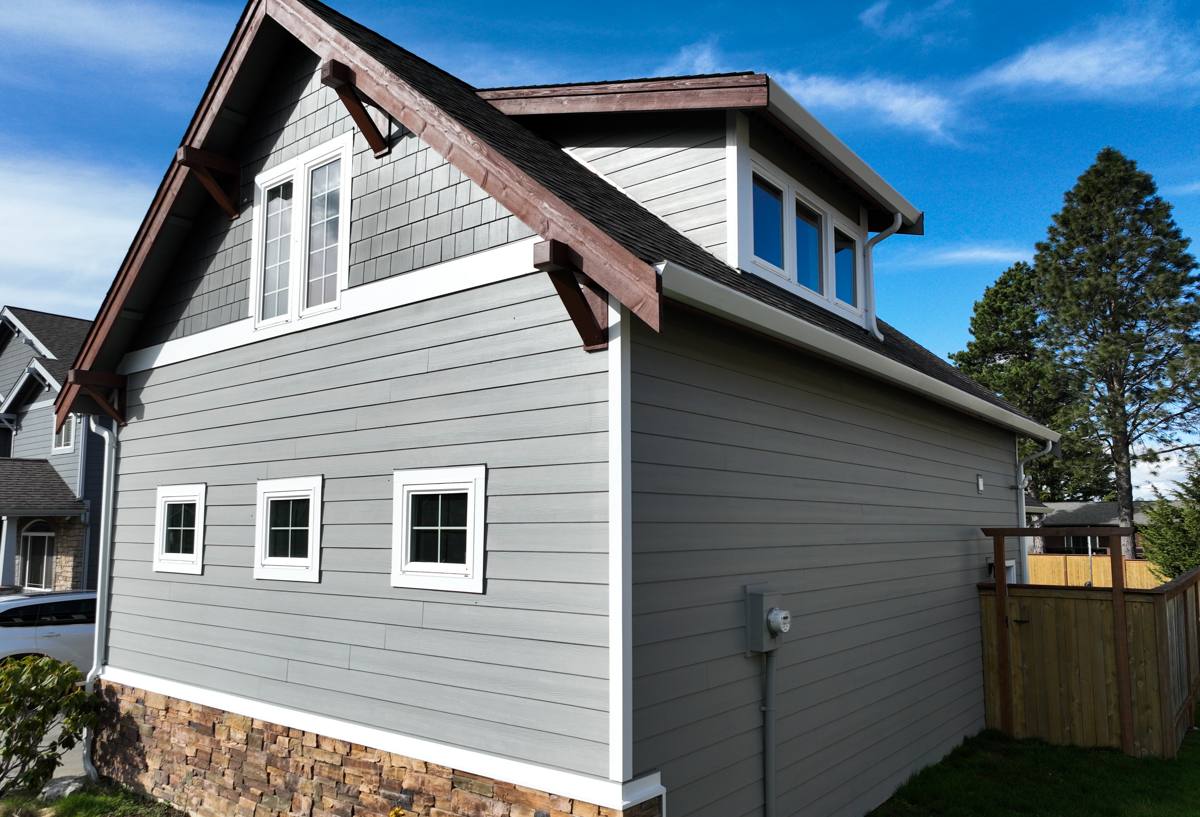
Signs a Blaine Home Needs Siding Replacement
Before recommending a full replacement, we look for specific evidence that the siding has stopped doing its job — not just cosmetic wear. On coastal Whatcom County homes, these are the signs we see most often:
- Soft, spongy, or crumbling spots when you press on the siding, especially near the bottom courses and around windows and doors
- Persistent moss or algae growth that returns within a season or two of cleaning
- Paint that's peeling, bubbling, or failing faster than a normal repaint cycle would suggest
- Visible gaps, warping, or boards that have pulled away from the wall at the seams
- Staining or discoloration running down from nail heads or seams, which usually points to water tracking behind the siding
- A musty smell or visible mold near exterior walls on the interior side, which can mean moisture has already gotten past the siding
- Siding that's more than 20-25 years old and made of a material — like untreated wood, older masonite, or damaged vinyl — that was never designed for this level of coastal exposure
One or two of these on their own might mean a repair. Several together, especially on walls that face the water or prevailing weather, usually mean the siding system as a whole has reached the end of its useful life.
Why We Only Install James Hardie Fiber Cement
We made a decision as a company to install James Hardie fiber cement siding exclusively, and we don't install LP SmartSide, vinyl, Cemplank, Allura, or unfinished wood siding like primed spruce or cedar. That's not a marketing position — it's a standard we hold because of what we've seen play out on homes in this exact climate.
Fiber cement is non-combustible, which matters as much for fire risk as for durability. It doesn't absorb and swell with moisture the way wood-based products can, and it doesn't become brittle and crack the way vinyl can in temperature swings. James Hardie backs its siding with a factory-applied ColorPlus finish, which is baked on under controlled conditions rather than site-painted, and that finish is engineered specifically to resist fading, chipping, and the kind of moisture intrusion that leads to peeling in a place like Blaine. Hardie also builds its products in different formulations for different climate zones — the line used in the Pacific Northwest is engineered for regions with sustained damp weather and freeze-thaw cycles, not for a hot, dry climate where a different product profile would perform better.
We're not going to tell you every other product is bad. LP SmartSide and cedar both have real strengths, and vinyl has its place in some markets. What we will say is that after years of working exteriors on this coastline, the trade-offs those products carry — moisture sensitivity, more frequent maintenance, shorter realistic lifespans in salt air — aren't ones we're willing to put our name behind. James Hardie is what we've standardized on because it holds up to what Blaine actually throws at a house.
What a Correct Siding Replacement Job Actually Involves
The material is only part of the equation. In a climate with this much wind-driven rain, how the job is installed matters as much as what's installed. A correct siding replacement on a Blaine home includes several steps that are easy to skip and hard to notice once the siding is up:
Full tear-off and wall inspection
We remove the old siding down to the sheathing so we can actually see the wall — not just cover over hidden problems. This is where we find rot, damaged sheathing, or past water intrusion that needs to be addressed before new siding goes on. Covering that up instead of fixing it is one of the most common shortcuts that leads to problems five or ten years down the road.
Weather-resistive barrier and flashing
A proper water-resistive barrier (WRB) goes over the sheathing, and flashing gets installed at every window, door, and horizontal transition where water can find its way behind the siding. In a driving-rain climate, flashing details are often the difference between a wall that stays dry for decades and one that fails from the inside out.
Correct fastening and clearances
James Hardie specifies exact fastener types, spacing, and placement, along with minimum clearances from grade, roofing, and decks. These specs exist because fiber cement performs the way it's rated to only when installed to them — cutting corners here doesn't show up immediately, but it shortens the life of the whole system.
Caulking and sealant at the right joints — and not at others
Certain seams need to be sealed; others are designed to allow drainage and shouldn't be caulked shut. Getting this backwards traps moisture instead of letting it escape, which is a common cause of hidden rot behind siding that looks fine from the street.
Factory-finished ColorPlus panels
Because the color coating is applied at the factory, not on site, the finish goes on evenly and is already cured before it's ever exposed to Blaine's weather — no waiting for site-applied paint to fully set in a damp climate.
James Hardie vs. Other Common Siding Options in a Salt-Air Climate
| Factor | James Hardie Fiber Cement | Wood / Primed Spruce or Cedar | Vinyl |
|---|---|---|---|
| Moisture behavior | Engineered to resist swelling and moisture absorption | Absorbs moisture, prone to swelling and rot without diligent upkeep | Doesn't absorb moisture but can trap it behind panels |
| Fire resistance | Non-combustible | Combustible | Combustible, can melt or warp under heat |
| Finish durability | Factory-applied ColorPlus finish, engineered for long-term color retention | Site-applied paint or stain, needs recoating on a regular cycle | Color is molded in but can fade and become brittle over time |
| Performance in salt air and driving rain | Built for coastal, high-moisture climates | More vulnerable without consistent, careful maintenance | Holds up to rain but seams and expansion can be a weak point |
| Typical maintenance | Occasional washing, no repainting cycle required for the finish | Regular repainting/restaining, inspection for rot | Occasional washing, but repairs can be difficult to match |
Our Process, From Estimate to Finished Job
We walk every Blaine job the same way, because skipping steps is how problems get built into a house.
- Walkthrough and assessment — we look at the current siding, note any soft spots, moss buildup, or water staining, and check trouble areas like window flashing and lower wall sections that take the most weather.
- Written estimate — a clear scope covering tear-off, any sheathing repair we anticipate, the Hardie product and color, and the full installation plan, with no vague allowances.
- Tear-off and wall inspection — old siding comes off, the sheathing gets inspected, and anything unexpected is discussed with you before we move forward.
- Weather barrier, flashing, and sheathing repair — any needed repairs happen first, then the WRB and flashing go in at every penetration and transition.
- Hardie installation to spec — panels or lap siding installed with correct fastening, clearances, and joint treatment.
- Final walkthrough — we go over the finished job with you before calling it done.
What Siding Replacement Costs in Blaine — And What Drives the Price
Every home is different, so we don't publish a flat number, but these are the main factors that move the price of a siding replacement up or down on a typical Blaine home:
| Factor | Why It Matters |
|---|---|
| Home size and wall complexity | More square footage, more corners, dormers, and roof lines mean more material and labor |
| Condition of the sheathing underneath | Rot or water damage found during tear-off adds repair work before new siding can go on |
| Siding profile chosen | Lap siding, shingle-style panels, and board-and-batten all have different material and install costs |
| Trim and detail work | Window and door trim, corner boards, and fascia details add labor time |
| Access and site conditions | Steep lots, tight setbacks, and multi-story walls near the water can affect equipment and staging needs |
| Removal and disposal of old siding | Volume and type of the existing material affects tear-off time and disposal cost |
The honest range for a full siding replacement varies widely based on these factors, which is why we walk the home in person before giving a number rather than quoting off a phone call.
Why Hiring a Crew That Already Works in Blaine Matters
Siding installation isn't one-size-fits-all across Washington. A crew that mostly works drier, inland areas may not think twice about flashing details or drainage gaps that are non-negotiable on a home exposed to Semiahmoo's wind and salt spray. A crew that already works Blaine and the surrounding Whatcom County coastline knows which walls take the worst weather, how moss establishes itself on shaded north- and west-facing exposures, and where past installs in this area have failed — because we've seen it and torn it off.
That local experience also means fewer surprises during the job. We know what typical sheathing condition looks like on homes of different ages in this area, what permitting looks like locally, and how to sequence work around the region's wet stretches so the wall isn't left exposed longer than necessary.
Caring for Your New Siding After Installation
James Hardie siding installed correctly needs relatively little upkeep, but a little attention goes a long way in this climate:
- Rinse the siding periodically to keep salt residue and organic buildup from accumulating, especially on walls facing the water
- Keep gutters clear so overflow doesn't run down the wall face repeatedly
- Trim back vegetation and tree cover where possible to reduce shade and moisture that encourage moss
- Watch caulked joints over time and have any gaps resealed before water can get behind the panels
- Address any impact damage promptly rather than letting it sit through a wet season
If you're weighing a siding replacement on a Blaine home and want a straight answer about what your siding actually needs, we're happy to take a look. Use the form below to request a free, no-pressure estimate.