 Semiahmoo
 Why Ferndale Homes Wear Out Siding Faster Than the Brochures Suggest
Ferndale sits close enough to the water and far enough into the fog belt that siding here does double duty. It's not just holding back rain — it's standing up to salt-laden air drifting off Semiahmoo Bay and the Strait, months of low-angle drizzle that never really dries between storms, and a north-facing moss season that can run from October clear through April. Siding that would coast along fine in a drier inland climate gets tested here in ways most manufacturers' marketing never accounts for.
We see the results on service calls all over Whatcom County: paint that's chalked and faded on the west and south walls, trim that's gone soft at the bottom edge, and lap siding that's cupped or delaminated where moisture got behind it and had nowhere to go. None of that is inevitable. It's what happens when a product or an installation wasn't built for this specific combination of salt, standing moisture, and biological growth.
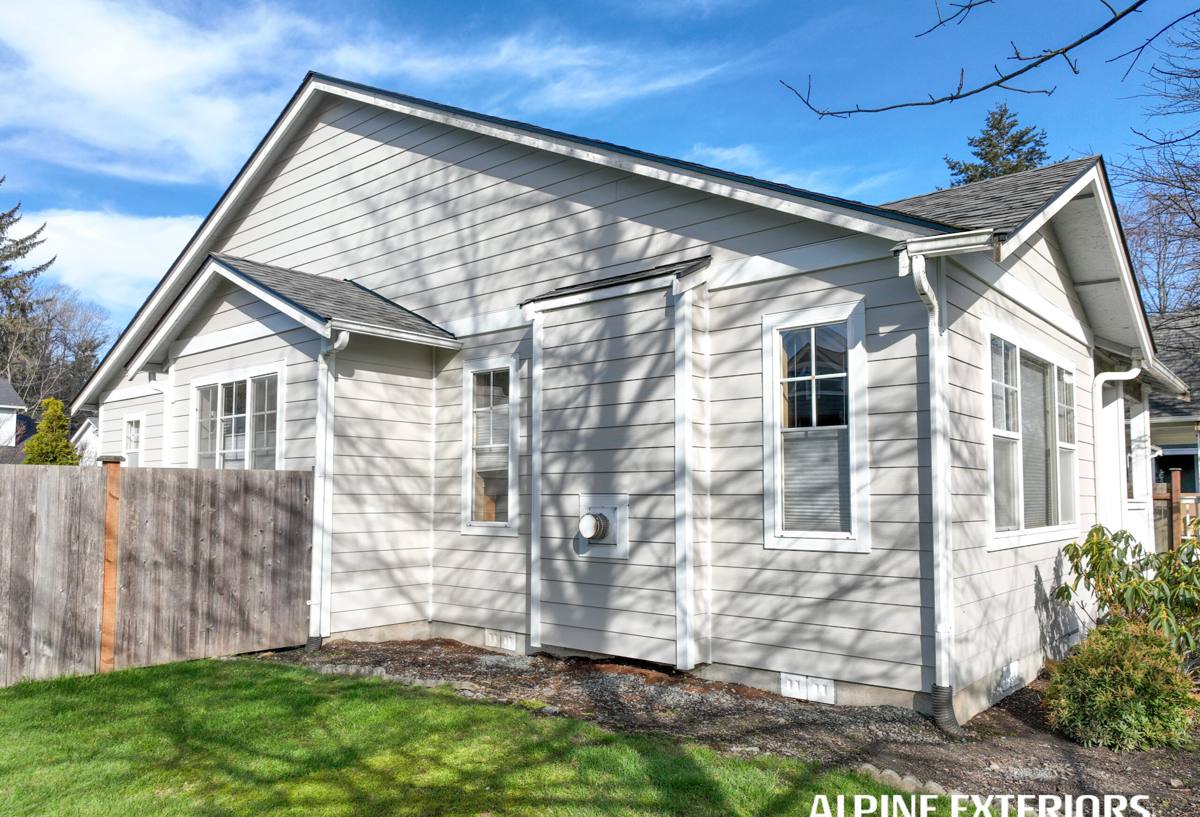
What Ferndale's Climate Actually Does to a Wall
Salt Air and Coastal Moisture
Ferndale isn't oceanfront, but it's close enough to Semiahmoo Bay and the Strait of Georgia that airborne salt reaches homes on breezy days, especially on west- and north-facing walls. Salt is hygroscopic — it pulls moisture out of the air and holds it against a surface longer than plain rain would. On untreated wood or lower-grade composite siding, that means slower drying cycles and faster paint breakdown. On fasteners and trim details, it accelerates corrosion if the wrong hardware was used.
Driving Rain
Storms off the water don't fall straight down here — wind pushes rain sideways into walls, which is a very different load than a simple downpour. Driving rain finds every gap in flashing, every under-caulked seam, and every spot where siding wasn't lapped correctly. A wall assembly that handles vertical rain fine can still fail under sustained wind-driven rain if the water-resistive barrier, flashing, and siding overlaps weren't detailed for it.
The Long Moss Season
Shaded north walls, tree-lined lots, and the region's damp, mild winters add up to a moss and algae season that can run more than half the year. Moss holds moisture against the surface it's growing on, which is exactly the condition that rots wood trim and stains paint. Siding that can't be power-washed without damage, or that absorbs moisture into its core, is at a real disadvantage in a climate like this.
What "Correct" Siding Replacement Looks Like Here
A siding replacement that's built for Ferndale's conditions isn't just a new product screwed to the old sheathing. It's a full wall assembly decision, and every layer matters:
- Water-resistive barrier (WRB): A continuous, properly lapped weather barrier behind the siding — this is the layer that actually keeps bulk water out, not the siding itself.
- Flashing at every penetration: Windows, doors, hose bibs, light fixtures, and deck ledgers all need integrated flashing so wind-driven rain can't track behind the cladding.
- Rainscreen gap where it's warranted: A small drainage/ventilation gap behind the siding lets any moisture that does get in dry back out instead of sitting against the wall.
- Correct fastening: Corrosion-resistant fasteners driven to manufacturer spec — over-driven or under-driven nails are one of the most common causes of early siding failure we find on inspections.
- Factory-applied finish: A finish that was baked on at the factory under controlled conditions holds up to salt air and UV far longer than a field-applied paint job.
- Proper joint and seam treatment: Butt joints, corners, and trim intersections sealed and detailed so they don't become the first failure point.
Skip any one of these and you can install a genuinely good product and still get a genuinely bad result. This is why we treat siding replacement as a system-level job, not a swap-the-boards job.
Why We Only Install James Hardie Fiber Cement
We don't carry vinyl, LP SmartSide, Cemplank, Allura, or primed wood siding, and that's a deliberate standard, not a limitation of what we know how to install. In a climate that combines salt air, sustained wet weather, and heavy moss pressure, the products we chose not to carry each have a real weak point:
- Vinyl can warp or become brittle with age and UV exposure, its seams rely on overlap rather than a sealed joint, and it doesn't hold paint if a homeowner ever wants a color change.
- LP SmartSide and other wood-strand products perform well when installation is flawless, but any breach at a cut edge or fastener hole lets moisture into the wood-based core, and swelling follows.
- Primed cedar and spruce are natural wood — beautiful, but they need repainting on a real schedule and are the most vulnerable of all to the rot that moss and standing moisture cause.
James Hardie fiber cement is engineered around exactly the failures we see most in this climate. It's non-combustible, it doesn't have an organic core for moisture to attack, and its ColorPlus factory finish is baked on and warrantied against fading and peeling — which matters directly here, since UV and salt exposure are what break down field-applied paint fastest. Hardie's HZ5 product line is engineered specifically for climates with sustained moisture exposure, which describes Whatcom County for a good half of the year. It holds up to power-washing, which means moss and algae can actually be removed without damaging the surface underneath it.
Vinyl vs. Wood-Based Products vs. James Hardie Fiber Cement
| Factor | Vinyl | Wood-Based (LP/Cedar) | James Hardie Fiber Cement |
|---|---|---|---|
| Moisture core risk | Low (but seams leak) | High if breached | Non-organic core |
| Salt air / UV resistance | Fades, can chalk | Paint breaks down faster | Factory ColorPlus finish |
| Moss/algae cleanup | Can be power-washed carefully | Risky — can drive moisture in | Withstands power-washing |
| Fire resistance | Melts/deforms | Combustible | Non-combustible |
| Repaint interval | N/A (color fades, can't repaint easily) | Every 5-8 years typically | Factory finish; 15-year finish warranty |
Our Process for a Ferndale Siding Replacement
- On-site assessment: We walk the exterior, check for hidden rot at trim and penetrations, and look at which walls are taking the worst weathering — usually west and north exposures here.
- Tear-off and sheathing inspection: Old siding comes off and we inspect the sheathing underneath for soft spots or existing moisture damage before anything new goes up.
- WRB and flashing installation: A new, continuous water-resistive barrier goes on, with flashing integrated at every window, door, and penetration.
- Hardie installation to manufacturer spec: Fastener spacing, joint treatment, and clearances (grade, roofline, deck) are all installed to Hardie's published specifications — this is what keeps the warranty valid and the wall performing.
- Trim, caulking, and final detailing: Corners, joints, and transitions get sealed correctly so wind-driven rain has nowhere to track in.
- Final walkthrough: We go over the finished job with the homeowner before calling it done.
Why a Crew That Already Works Ferndale Matters
Building code and best-practice detailing aren't one-size-fits-all across Washington. A crew that works Whatcom County regularly already knows which exposures on a Ferndale lot tend to take the worst driving rain, where moss tends to build up fastest, and how much rainscreen ventilation actually makes sense for a given site versus what's overkill. That local pattern recognition shows up in small decisions — flashing details, fastener choice, where extra care goes on a bid — that a crew unfamiliar with this specific coastal-fog climate might not think to prioritize.
It also matters for warranty support. If a manufacturer warranty question ever comes up down the road, having a contractor who's local, established, and easy to reach beats chasing down someone from out of the area.
What Drives Cost on a Ferndale Siding Replacement
| Factor | Why It Matters |
|---|---|
| Home size and wall complexity | More corners, dormers, and trim details mean more labor and material cuts |
| Existing sheathing condition | Rot repair found during tear-off adds cost but is essential to fix before new siding goes on |
| Hardie product line and profile | Lap width, shingle-style panels, and trim packages vary in material cost |
| Rainscreen/ventilation detailing | Recommended on more exposed or shaded walls; adds labor but improves long-term drying |
| Trim and accessory scope | Full trim replacement versus reusing sound existing trim changes the bid |
| Site access | Tight lots, fencing, or landscaping close to the walls can slow tear-off and staging |
We give straight, itemized bids so homeowners can see exactly what's driving the number rather than a single lump figure.
Signs It's Time to Replace, Not Patch
- Siding that's soft, spongy, or crumbling when pressed, especially near the bottom courses or below windows
- Paint that keeps failing in the same spots within a year or two of repainting
- Persistent moss or algae staining that comes back quickly after cleaning
- Visible gaps, warping, or cupping in individual boards or panels
- Rising energy bills with no other explanation — often a sign the wall assembly behind the siding is compromised
- Siding older than 20-25 years, especially wood-based products that were never repainted on schedule
If you're seeing one or two of these, a targeted repair might still make sense. If you're seeing several at once, that's usually the wall assembly telling you it's time for a full replacement rather than another round of patching.
Get a Straight Answer on Your Home
Every Ferndale property is a little different — sun exposure, tree cover, proximity to the water, and the age of what's currently on the walls all factor into what a job actually needs. We're happy to take a look, tell you honestly what condition your siding is in, and lay out what a correct James Hardie replacement would involve — no pressure, no inflated urgency. Reach out using the form below for a free estimate.