 Semiahmoo
 Deck Repair Built for Sumas Weather
A deck in Sumas lives a harder life than most homeowners realize. This corner of Whatcom County sits in a river valley that traps damp air, and between the long fall rains, the low winter sun that never quite dries a shaded deck, and the moss season that can stretch from October into May, wood and fasteners take a steady beating. Add in the driving rain that blows sideways off a passing front, and even decks that looked solid five years ago can be hiding real damage underneath the surface.
We're not talking about the same repair checklist you'd run in a dry climate. Salt air and marine moisture shape how contractors build and maintain decks throughout this part of Washington, and even here away from the immediate coastline, that same wet, mild, moss-friendly weather pattern is what drives most of the repair calls we get. Deck repair here isn't cosmetic work — it's about catching wood rot, corroded hardware, and hidden water paths before they become a safety problem.
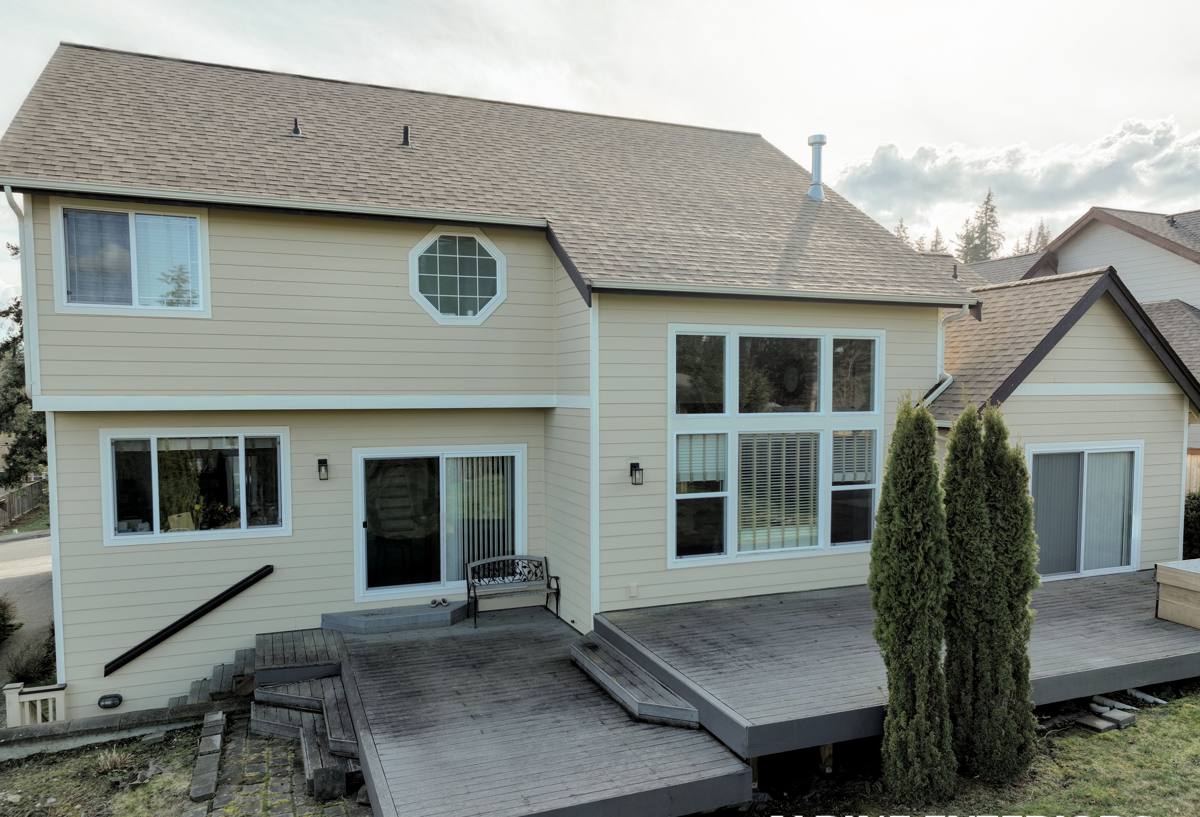
Warning Signs a Sumas Deck Needs Attention
Most deck failures don't happen suddenly. They happen quietly, over a few wet seasons, in places you don't look at every day — the ledger board where the deck meets the house, the joists underneath, the post bases sitting in soil or on old concrete. Here's what we tell homeowners to check for, or to have us check for them:
- Soft, spongy, or springy spots when you walk across the decking
- Dark streaking or discoloration around fastener heads
- Gaps opening up between the house siding and the ledger board
- Moss or green film building up on boards that stay shaded most of the day
- Railings or posts that wiggle more than they did last year
- Rust stains bleeding out from screws, nails, or joist hangers
- A musty smell or visible mold underneath the deck
- Stairs that feel less solid, especially at the stringer connections
Any one of these on its own might be minor. Several together, especially near the ledger or stairs, usually means it's time for a real inspection rather than a quick patch.
What a Proper Deck Repair Actually Involves
The Ledger Board Connection
The ledger board — the piece bolted to your house that the whole deck hangs from — is the single most important structural point on most decks, and it's also the most common place we find hidden rot. If it wasn't flashed correctly when the deck was built, water gets behind it and works its way into the house framing, not just the deck. Fixing this right means pulling back decking, checking the flashing, and replacing any framing that's compromised — not just caulking over the gap and calling it done.
Joists, Beams, and Post Bases
Underneath the visible decking, joists and beams are exposed to splashback, poor drainage, and standing moisture, especially on decks built low to the ground or over soil rather than gravel or concrete. Post bases that sit directly in dirt or in a pooling low spot are a recurring problem we see on older Sumas decks. Repair here means sistering or replacing rotted structural members, correcting drainage where we can, and making sure post bases are actually keeping wood off standing water.
Fasteners and Hardware
Galvanized and coated fasteners lose their protective coating over time, especially in a climate that stays wet as long as this one does. Once that happens, corrosion accelerates and the fastener itself becomes the weak point — sometimes before the wood around it even shows damage. We replace failing hardware with corrosion-rated fasteners and structural connectors rated for exterior, ground-contact-adjacent use, not general-purpose screws.
Railings and Guards
Loose railings are a safety issue, not a cosmetic one. Repair usually means re-securing posts to structural framing (not just to the decking or rim joist), and replacing any post that's rotted at the base — a loose railing that "just needs tightening" often turns out to be a post with no solid wood left to grab onto.
Repair or Replace? How We Decide
Not every deck problem calls for a full rebuild, and not every deck is worth patching. We look at where the damage is, how much of the structure is affected, and how the deck was built in the first place.
| Situation | Usually Repairable | Usually Needs Replacement |
|---|---|---|
| Isolated joist or board rot | Yes — sister or swap affected members | Only if rot has spread structure-wide |
| Ledger board rot, contained | Yes — reflash and rebuild that section | If house-side framing is also compromised |
| Surface moss and graying | Yes — clean, treat, or refinish | Rarely a replacement issue on its own |
| Widespread post/beam rot | Sometimes, case by case | Usually — structural integrity is compromised |
| Deck over 20-25 years old with recurring issues | Case by case | Often more cost-effective long term |
Cost ranges vary a lot depending on scope. A contained ledger or joist repair on a mid-size deck often runs from several hundred dollars into the low thousands, while a structural rebuild involving multiple framing members, new footings, or a full re-decking climbs higher. We'll never guess at a number without seeing the deck — every one of these jobs has a different combination of access, framing condition, and material choice behind it.
Our Deck Repair Process
- Inspection. We walk the deck, check underneath, probe suspect wood with an awl, and inspect the ledger connection and post bases specifically — these are where problems hide longest.
- Written scope. You get a clear explanation of what's failing, what's still sound, and what the repair actually involves — no vague "deck needs work" language.
- Demo of affected areas only. We remove decking and framing that's actually compromised, keeping sound structure intact wherever it's safe to do so.
- Structural repair. Ledger reflashing, joist sistering or replacement, post base correction, and hardware upgrades as needed.
- Decking and railing restoration. Matching or upgrading materials, resetting railings to structural framing, and finishing fasteners flush and corrosion-resistant.
- Final check. We walk it again, check for level, check rail rigidity, and make sure drainage under the deck hasn't been made worse by the repair.
Materials: Matching the Fix to the Climate
What we use to repair a deck matters as much as the workmanship. In a climate with this much sustained moisture and moss pressure, we default to:
- Pressure-treated lumber rated for ground contact on any framing member near soil or low clearance
- Stainless or heavy hot-dip galvanized fasteners and structural connectors, not standard zinc-coated hardware that corrodes faster in wet conditions
- Self-adhering or metal flashing at every ledger connection — this is non-negotiable on a repair, even if the original build skipped it
- Composite or capped decking as an option where homeowners want to reduce moss buildup and refinishing cycles going forward, weighed honestly against the higher upfront cost and the fact that framing underneath still needs to be real wood, properly protected
We'll walk you through the trade-offs rather than pushing one material. Wood decking costs less upfront and can be refinished indefinitely, but it needs re-staining or sealing on a regular cycle in this climate to keep moss and moisture out. Composite costs more initially and needs far less maintenance, but it's less forgiving to install correctly and isn't something to retrofit piecemeal onto an existing structure without planning around expansion and fastening differences.
Permits and Structural Safety
Structural deck repairs — anything touching the ledger connection, footings, or load-bearing framing — can fall under permit requirements depending on scope. We handle that conversation with you upfront rather than after the fact, and we build repairs to hold up to inspection, not just to look finished. Cutting corners on a ledger or railing repair isn't worth the risk when the whole point of the deck is that people stand on it.
Why Hire a Crew That Already Works in Sumas
Deck problems here follow patterns — the same ledger flashing gaps, the same post-base rot, the same moss buildup on north-facing sections that never get direct sun. A crew that already works decks throughout Whatcom County has seen those patterns enough times to know where to look first, instead of guessing. We're also familiar with how local weather actually behaves through a repair timeline — when it's safe to schedule structural work between rain systems, and when a repair needs to wait for a dry stretch to cure or seal properly. That local knowledge is the difference between a repair that lasts and one that reopens the same problem in a year or two.
Keeping a Repaired Deck Solid
Once a repair is done right, a little seasonal upkeep goes a long way in this climate:
- Sweep leaves and debris off the deck regularly, especially in fall — trapped organic matter holds moisture and feeds moss
- Keep gutters and downspouts clear so runoff isn't dumping extra water onto or under the deck
- Check the ledger flashing and railing connections once a year for movement or gaps
- Re-seal or re-stain wood decking on the cycle recommended for the product you have, not just when it looks faded
- Address soft spots or loose hardware immediately rather than waiting for the next dry season
If your deck in Sumas has soft boards, a shaky railing, or a ledger connection you're not sure about, we're happy to take a look and give you a straight answer about what it needs. Fill out the form below for a free, no-pressure estimate.